Discover Your Authentic Self on Daily Lemons
A White Paper on the “Art for Shadow Work: False Self” Intention
Authored by Christopher Cheung
Founder of Daily Lemons
Reviewed by Jasmine Lam
Art Psychotherapist
Author Credentials
Christopher Cheung holds a BS and MEng in Engineering from Cornell University, an MBA and MSF from Boston College, and a Certificate of Initiatic Art Therapy, Sensorimotor. His professional background spans technology, finance, and entrepreneurship, including work as a Software Architect at Sapient Corp, an Asset Manager at State Street Global Advisors and Amundi, and Co-founder of Buildium, a property management SaaS company.
Jasmine Lam is an Art Psychotherapist with professional affiliations and registrations including HCPC UKUKUK, BAAT, and HKAAT. She holds an MA in Art Therapy from the University of Hertfordshire, UK, a Bachelor of Arts HonsHonsHons in Fine Arts from the University of Hong Kong, and an Advanced Certificate in Psychology from the University of Hong Kong School of Professional and Continuing Education.
Daily Lemons™ is a therapist-designed digital art therapy app that helps users regulate emotions, externalize inner experience, build self-awareness, and develop a more compassionate relationship with themselves through short, guided creative exercises. The “Art for Shadow Work: False Self” intention is designed for users who sense that they have been living through roles, masks, adaptations, people-pleasing patterns, or survival-based identities—and who want to gently discover what feels more authentic underneath.
This white paper explains how the ten-exercise sequence “Discover Your Authentic Self on Daily Lemons” works as a progressive, art-therapy-informed pathway from recognition of the false self toward integration of the authentic self. It also describes how the sequence uses Daily Lemons’ six therapeutic pathways: emotional expression and containment, mindful embodiment, cognitive insight and identity work, trauma and resilience, creativity and mastery, and connection/co-regulation.
The sequence is not about forcing a user to “find the real self” in one breakthrough. Instead, it creates a structured visual journey: first seeing the masks, then understanding where they came from, then meeting what was hidden, grieving what was lost, reclaiming disowned parts, and finally integrating the whole self into a coherent visual map.
Executive Summary
Many people move through life performing versions of themselves. They become “the responsible one,” “the easygoing one,” “the high achiever,” “the caretaker,” “the funny one,” “the strong one,” or “the one who never needs anything.” These identities may begin as necessary adaptations. They may help a child stay safe, win approval, avoid conflict, maintain belonging, or cope with emotionally inconsistent environments. Over time, however, adaptive roles can harden into a false self: a way of being that protects the person but also distances them from their genuine needs, desires, emotions, creativity, boundaries, and aliveness.
The concept of the false self is strongly associated with psychoanalyst D. W. Winnicott, who described false-self organization as a developmental adaptation that may emerge when the person’s spontaneous self-expression is not adequately received by the environment. In this sense, the false self is not simply deception. It may be a protective compliance structure that preserves connection, safety, or continuity while obscuring spontaneous aliveness Winnicott, 1960.
The Daily Lemons Art for Shadow Work: False Self sequence addresses this pattern through ten guided art exercises:
The Mask Collection
The Applause Machine
The Adaptation Timeline
The Locked Room
Where the Body Knows
Grieving the Unlived Self
Shadow Dialogue
Reclaiming the Disowned
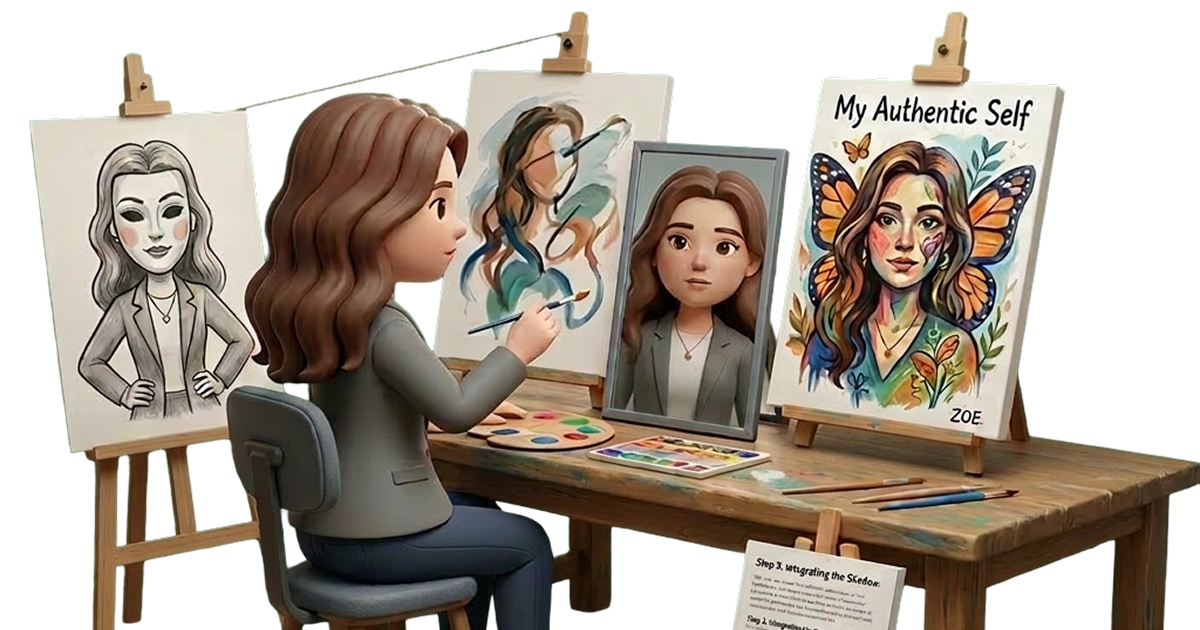
The Authentic Self Portrait
The Integration Map
Together, these exercises create a therapeutic arc:
Recognize the false self — identify roles and performances.
Reveal the emotional cost — notice what is happening behind the mask.
Understand the origin story — map how adaptation developed over time.
Meet what was hidden — safely approach tucked-away parts of the self.
Listen to the body — discover where performance and authenticity live somatically.
Grieve what was lost — honor the unlived self without shame.
Dialogue with the shadow — let hidden truth speak back.
Reclaim disowned qualities — welcome one hidden part into the light.
Create an authentic self-image — symbolize essence, values, and reclaimed qualities.
Integrate all parts — hold masks, roles, shadows, choices, and releases in one coherent map.
This progression is particularly well suited to Daily Lemons because the app combines active nonverbal expression, guided reflection, short sessions, voice-guided co-regulation, private journaling, AI-assisted but non-interpretive prompts, and optional escalation to credentialed art therapists. The sequence allows users to work symbolically rather than literally, which helps make difficult self-discovery more approachable, contained, and emotionally safe.
The white paper draws on Jungian psychology, Winnicott’s true-self/false-self theory, art therapy literature, expressive therapies theory, trauma-informed care, mindfulness, embodiment research, narrative identity, affect labeling, self-compassion, and digital mental health safety guidance Jung, 1953/1966; Jung,1951/1968; Winnicott,1960; Malchiodi,2012; Hinz, 2019; SAMHSA, 2014; Neff, 2003; Torous et al., 2021.
1. The Origins of Shadow Work — Carl Jung and the Hidden Self
The practice commonly called shadow work originates in the psychological theories of Swiss psychiatrist Carl Gustav Jung, who introduced the concept of the shadow as part of his broader model of the unconscious. For Jung, the human psyche was not limited to the conscious personality—the identity a person recognizes, performs, and presents to the world. Beneath conscious awareness, Jung believed, lived rejected, undeveloped, or disowned aspects of the self that continued to influence emotion, behavior, relationships, creativity, and identity Jung,1951/1968; Jung,1953/1966.
Jung used the term shadow to describe those parts of the personality that the conscious ego does not recognize or accept. These may include traits a person has been taught to see as unacceptable, shameful, dangerous, weak, selfish, excessive, or unlovable. Over time, such traits can be pushed out of awareness because they threaten a person’s preferred self-image or their belonging within a family, community, or culture.
Importantly, the shadow is not synonymous with evil or pathology. While it may contain anger, envy, fear, aggression, shame, or grief, it may also contain vitality, confidence, desire, creativity, sensitivity, ambition, playfulness, or personal power. In Jungian thought, anything the conscious personality cannot safely claim may become part of the shadow. A person may repress their anger because it once felt dangerous, but they may also repress their joy, beauty, assertiveness, sexuality, intelligence, or need for care if those qualities were punished, mocked, or discouraged Jung,1951/1968; Stein,1998.
This makes shadow work especially relevant to the concept of the false self. A false self often forms as an adaptive identity: the version of the person that learns how to gain approval, avoid rejection, maintain control, or survive relational threat. The shadow contains what had to be hidden or sacrificed in order for that adaptive identity to function. If the false self says, “I am always fine,” the shadow may hold grief or need. If the false self says, “I am never angry,” the shadow may hold rage, boundaries, or self-protection. If the false self says, “I must be impressive,” the shadow may hold exhaustion, vulnerability, or the longing to be loved without performance.
Jung’s larger framework for psychological growth was called individuation: the lifelong movement toward becoming a more whole, integrated, and authentic person. Individuation does not mean perfecting the persona or eliminating undesirable traits. Rather, it involves bringing unconscious material into conscious relationship so that previously disowned parts of the psyche can be understood, integrated, and expressed in more constructive ways. From this perspective, shadow work is not an act of self-criticism. It is an act of self-retrieval Jung,1953/1966; Stein,1998.
The shadow often appears indirectly through emotional triggers, projections, dreams, fantasies, creative images, recurring conflicts, and patterns of attraction or avoidance. A person may strongly judge in others what they cannot yet recognize in themselves. They may feel disproportionate discomfort around people who express qualities they have disowned. They may repeatedly create masks that protect them from shame while also separating them from authenticity. Shadow work begins by noticing these patterns without immediately judging or interpreting them.
This is one reason art-making is particularly well suited to shadow work. Jung placed significant value on symbols, images, dreams, and imagination as pathways into unconscious material Jung, 1964. Many shadow qualities cannot initially be named in ordinary language. They appear first as images: a mask, a locked room, a dark figure, a split face, a hidden flame, a child behind glass, a door, a cage, a landscape, or a body with missing parts. The image may arrive before the explanation.
In an art-based setting, shadow work allows users to externalize inner experience safely. Rather than asking users to diagnose themselves or produce a fixed verbal answer, the creative process gives shape, color, texture, distance, and symbolic form to what has been hidden. The user can look at the image, relate to it, modify it, speak to it, reclaim parts of it, or place it within a larger composition of self. This externalization creates space for reflection without forcing premature interpretation Malchiodi, 2012; Rubin, 2016.
For Daily Lemons, Jung’s concept of the shadow provides the psychological foundation for the Art for Shadow Work: False Self intention. The intention is not designed to tell users who they are, what their symbols mean, or which parts of themselves are “true” or “false.” Instead, it guides users through a structured creative sequence that helps them notice masks, explore what those masks protect, encounter disowned qualities, and begin integrating those qualities into a more honest self-understanding.
This Jungian foundation also supports Daily Lemons’ commitment to user-led meaning-making. In classical and post-Jungian psychology, symbols are meaningful, but they are not mechanically decoded. A mask does not mean the same thing for every person. A dark room is not automatically trauma. A flame is not always anger or passion. A user’s imagery belongs first to the user. Daily Lemons preserves this principle by prompting reflection rather than imposing interpretation Jung, 1964; Samuels, Shorter, & Plaut, 1986.
The purpose of shadow work, then, is not to expose a hidden “bad self.” It is to restore relationship with the parts of the self that were exiled, silenced, or overruled by survival. When practiced with care, shadow work can help users move from fragmentation toward integration, from performance toward authenticity, and from unconscious repetition toward conscious choice.
Within this white paper, shadow work is therefore understood as a creative, reflective, and integrative process rooted in Jungian psychology. It provides the conceptual basis for using art to explore the false self: not as something to shame or destroy, but as a protective structure that once served a purpose and can now be examined, softened, and reorganized in service of greater wholeness.
2. The Problem: Living Through the False Self
The “false self” is not simply pretending. In many cases, it is a learned survival strategy. A person may become agreeable because anger once created danger. They may become hyper-competent because mistakes once led to shame. They may become entertaining because sadness was ignored but performance was praised. They may become invisible because being noticed felt unsafe.
The term false self is strongly associated with psychoanalyst D. W. Winnicott, who described false-self organization as a developmental adaptation that can arise when spontaneous gesture, need, or expression is not adequately met by the caregiving environment. In Winnicott’s formulation, the false self may function as a protective compliance structure. It can preserve connection and continuity, but it may also obscure the person’s spontaneous, alive, authentic self-experience Winnicott,1960.
Over time, the person may no longer know where the adaptation ends and the authentic self begins.
They might ask:
“Do I actually want this, or am I just being who people expect me to be?”
“Why do I feel exhausted after being praised?”
“Why do I feel guilty when I rest?”
“Why do I not know what I want?”
“Why does being myself feel risky?”
“What part of me did I hide to stay loved?”
The problem is not that the false self is “bad.” Often, it deserves respect. It helped the user survive, belong, succeed, or stay safe. But when the false self becomes the only self allowed to appear, the user may experience anxiety, burnout, resentment, numbness, perfectionism, relational over-functioning, or a persistent sense of disconnection.
Contemporary trauma and attachment-informed perspectives similarly recognize that behaviors such as compliance, appeasement, emotional suppression, perfectionism, hypervigilance, and attunement to others can develop as adaptive responses to relational threat, chronic invalidation, or unsafe environments. These adaptations can be protective in their original context while later becoming restrictive or costly Herman, 1992/2015; Ogden, Minton, & Pain, 2006; van der Kolk, 2014.
Daily Lemons approaches this not through harsh self-analysis, but through art-making. The user does not need to explain everything. They draw masks, stages, timelines, rooms, body maps, figures, dialogues, portraits, and integration circles. These images become containers for complex inner material.
3. Why Art Therapy Is Well Suited to Authentic Self-Discovery
Authentic self-discovery is difficult because the false self often forms before it can be clearly named. Many adaptive identities are built early in life through repeated relational cues: what earns approval, what creates safety, what prevents conflict, what avoids shame, and what keeps connection intact. Over time, these adaptations become automatic. A person may not consciously decide to people-please, overperform, stay silent, hide anger, appear cheerful, or become hyper-independent. These behaviors may simply feel like “who I am.”
This is why intellectual insight alone is often insufficient. A user may be able to say, “I know I people-please,” or “I know I perform competence,” yet still feel unable to stop. The false self may be organized not only as a belief, but as a body-based, emotional, relational, and symbolic pattern. It may live in posture, tone of voice, facial expression, muscle tension, automatic apology, over-explaining, perfectionism, avoidance, dissociation, or the reflex to scan others for approval.
In other words, the false self often lives below language.
It may be held in:
automatic emotional responses;
visual and sensory memories;
relational expectations;
nervous-system patterns;
internalized roles;
shame-based beliefs;
bodily contraction or numbness;
symbolic images of who one is allowed to be;
and old survival logic that continues long after the original threat has passed.
Art therapy literature has long emphasized that image-making can access forms of experience that are difficult to verbalize directly. Visual expression may hold affect, memory, sensation, metaphor, and contradiction simultaneously, making it useful for experiences that are pre-verbal, implicit, fragmented, or emotionally complex Malchiodi, 2012; Rubin, 2016; Case & Dalley, 2014.
An art-therapy-informed approach is especially well suited to this terrain because it does not require the user to begin with a complete explanation. Art gives users a way to approach the self through image, gesture, color, shape, metaphor, sensation, and composition. These forms can hold complexity before the user has words for it. A drawing can reveal contradiction, fragmentation, longing, protection, grief, anger, and possibility all at once.
Daily Lemons uses this strength of art-making to support authentic self-discovery in a structured, accessible, and user-led way. The goal is not to interpret the user’s art for them, diagnose what a symbol “means,” or force disclosure. Instead, the exercises create conditions in which the user can safely encounter patterns of performance, protection, concealment, and desire—and begin to relate to those patterns with curiosity rather than shame.
Art-therapy-informed practice is useful here for three primary reasons: externalization, symbolic safety, and bottom-up/top-down integration. These mechanisms are consistent with established art therapy frameworks, including the Expressive Therapies Continuum, which describes how creative work can engage kinesthetic-sensory, perceptual-affective, cognitive-symbolic, and creative modes of processing Hinz, 2019; Lusebrink, 2010.
3.1 Externalization
One of the most powerful functions of art-making is externalization: the process of moving an inner experience into an outer form.
When a user draws a mask, a locked room, a shadow figure, an unlived self, or a map of inner parts, something that was previously diffuse and internal becomes visible. The experience is no longer only happening inside the user. It now exists on the page, screen, or canvas. This creates psychological distance.
Externalization is widely used in therapeutic contexts because it can help clients relate to a problem, feeling, or inner part as something observable rather than as the totality of who they are. In art therapy, this can occur when an internal state is given form through image, color, gesture, metaphor, or object-making, allowing the person to notice, revise, dialogue with, or recontextualize the material Malchiodi, 2012; Moon, 2010; Rubin, 2016.
That distance matters.
When a person is fully identified with a false-self pattern, the pattern often feels absolute:
“I am fake.”
“I am weak.”
“I am too much.”
“I am not lovable unless I perform.”
“I always ruin things.”
“I don’t know who I really am.”
“There is something wrong with me.”
These statements collapse the person and the pattern into one fused identity. Externalization helps loosen that fusion. Instead of “I am fake,” the user may begin to see, “I have learned to wear different masks in different contexts.” Instead of “I am weak,” they may see, “There is a part of me that learned to stay small to avoid conflict.” Instead of “I don’t know who I am,” they may see, “There are several parts of me that have not had room to speak.”
This shift is subtle but foundational. It moves the user from identity-based shame toward relationship-based curiosity.
For example, a user may begin an exercise believing, “I’m just fake around everyone.” In a verbal journal entry, that belief may remain abstract and self-critical. But if the user is invited to draw the masks they wear in different environments, they may create:
a polished, competent work mask;
a cheerful family mask;
a quiet, agreeable friendship mask;
a detached mask for romantic relationships;
and a hidden face behind all of them.
Once these masks are visible, the user may notice that each one has a function. The work mask may protect them from being seen as inadequate. The cheerful mask may prevent others from worrying or becoming disappointed. The agreeable mask may preserve belonging. The detached mask may protect against rejection. The hidden face may represent grief, exhaustion, anger, tenderness, or desire.
The image allows the user to say: “These masks are not proof that I am false. They are evidence that parts of me adapted.”
This is a major therapeutic reframe. The false self becomes less of a moral failure and more of a protective structure. It can be studied, respected for how it once helped, and gradually reorganized.
Externalization also supports choice. When a pattern remains internal and automatic, the user may feel controlled by it. Once the pattern is visible, the user can begin asking:
When did this mask appear?
What does it protect?
What does it cost me?
Where do I still need it?
Where am I ready to soften it?
What part of me is hidden behind it?
What would it look like to choose rather than automatically perform?
This is especially important for authentic self-discovery because authenticity is not simply the removal of all masks. Human beings naturally adapt to context. A person may appropriately show different aspects of themselves at work, with family, with intimate partners, or in public. The issue is not whether a person has social roles. The issue is whether those roles are chosen consciously or enforced by fear.
Externalization helps users distinguish between healthy role flexibility and compulsive self-abandonment.
A visual exercise can reveal this distinction more quickly than language alone. A user may notice that one mask feels light, flexible, and chosen, while another feels rigid, suffocating, or fused to the skin. They may notice that some roles are aligned with their values, while others require emotional disappearance. They may notice that a “strong” mask is actually protecting a terrified part, or that a “nice” mask is suppressing resentment.
Because the image remains present, the user can return to it over time. They can add to it, alter it, draw what is underneath, place it in dialogue with another part, or create a new image representing a more integrated self. This makes externalization not just a moment of expression, but a foundation for ongoing reflection.
In Daily Lemons, externalization is central to exercises such as The Mask Collection, The Locked Room, Shadow Dialogue, and The Integration Map. Each exercise invites the user to move an internal structure into visible symbolic form. The user is not asked to immediately solve the pattern. They are first invited to see it.
Seeing is the beginning of choice. This distinction between being fused with an experience and being able to observe it is also compatible with mindfulness-based and acceptance-based approaches, which emphasize awareness, defusion, and values-guided choice Kabat-Zinn, 1990; Hayes, Strosahl, & Wilson, 2012.
3.2 Symbolic Safety
Shadow work can become overwhelming if approached too directly. Asking a user to immediately explain their deepest wounds, identify every false-self pattern, or narrate painful memories may create pressure, shame, avoidance, or emotional flooding. For many users, direct verbal disclosure is not the safest first step.
Art offers another route: symbolic safety.
Symbolic safety means the user can approach difficult material indirectly, through image and metaphor. Instead of writing a full trauma narrative, they can draw a locked door. Instead of explaining an old relational wound, they can draw a thread connecting two figures. Instead of naming rage directly, they can use red marks, jagged lines, heat, smoke, or a contained flame. Instead of describing numbness, they can create a gray field, an empty room, or a faceless silhouette.
The symbol creates distance while still carrying truth.
Trauma-informed approaches emphasize safety, choice, collaboration, trustworthiness, and empowerment. Symbolic expression can support these principles by allowing users to titrate contact with difficult material, choose how much to reveal, and maintain distance from overwhelming memories or emotions SAMHSA, 2014; Herman, 1992/2015; Malchiodi, 2020.
This is particularly important in work with the false self because false-self structures often formed to protect the person from emotional exposure. If an exercise demands too much vulnerability too quickly, the same protective systems may activate again. The user may shut down, intellectualize, perform the “right” answer, abandon the exercise, or produce an image they think they are supposed to make rather than one that feels true.
Symbolic art-making allows the user to control the pace of revelation.
A locked room can remain locked. A mask can be drawn without removing it. A shadow figure can stand at the edge of the page. A hidden self can be represented by color rather than detail. A boundary can be drawn around material that is not ready to be explored. This pacing is not resistance; it is part of the work. Respecting symbolic distance helps build trust between the user and their own inner world.
Daily Lemons’ no-interpretation stance is essential here. If the app or practitioner were to tell the user, “This dark shape means anger,” or “This door represents trauma,” the symbolic container would be compromised. The user might feel exposed, misread, or subtly coerced. Instead, Daily Lemons prompts the user to make their own meaning:
What do you notice about this image?
Which part draws your attention?
If this mask could speak, what might it say?
What does this locked room protect?
Is anything asking to be seen, moved, softened, or left alone?
What feels safe to name today?
What does not need to be named yet?
These questions preserve the user’s authority. They also reflect a core principle of safe shadow work: the goal is not to force unconscious material into consciousness, but to create conditions where hidden material can emerge at a tolerable pace.
Symbolic safety also supports complexity. Words often pressure users into linear explanation: “This happened, so I became this way.” But authentic self-discovery is rarely so simple. A user may feel love and anger toward the same family system. They may feel proud of their competence and exhausted by their performance. They may want to be seen and fear being seen. They may grieve the false self and feel grateful that it helped them survive.
Art can hold these contradictions without requiring premature resolution. Art therapy is particularly suited to ambivalence and complexity because an image can contain multiple affects and meanings at once. Rather than forcing a single verbal explanation, the artwork can preserve contradiction, uncertainty, and layered meaning until the user is ready to reflect further McNiff,1992; Rubin, 2016; Malchiodi, 2012.
For instance, a user drawing a mask may make it beautiful and painful at the same time. They may decorate it with gold while placing cracks along the edges. They may draw a smile over a sealed mouth. They may place flowers around a locked cage. These images can express ambivalence more accurately than a single sentence can. The user does not have to choose between “this mask is bad” and “this mask helped me.” The image can hold both.
This matters because authentic self-discovery is not achieved by attacking the false self. The false self often developed as protection. If it is shamed, it may become more rigid. If it is approached symbolically and respectfully, it may begin to soften.
Symbolic safety also makes the work more accessible for users who are not ready, able, or willing to verbalize personal history. Some users may not know the origin of a pattern. Some may not identify with clinical language. Some may have cultural or familial reasons to avoid direct emotional disclosure. Some may simply process visually before they process verbally. Art allows these users to participate meaningfully without needing to produce a polished psychological narrative.
In this way, symbol becomes a bridge between the known and the unknown. It allows the user to say, “I do not yet know what this means, but I can see that it matters.”
That is often enough for the next step.
3.3 Bottom-Up and Top-Down Integration
Authentic self-discovery requires more than insight. A user may understand the origins of a false-self pattern and still feel unable to change it because the pattern is also held in the body and nervous system. For this reason, Daily Lemons’ art exercises are designed to support both bottom-up and top-down integration.
Top-down processing begins with conscious reflection. It uses language, meaning, memory, analysis, values, and narrative. A user identifies roles, names patterns, understands origins, recognizes protective strategies, and clarifies what kind of life feels more aligned.
Examples of top-down reflection include:
“I learned to be agreeable because conflict felt unsafe.”
“My work mask protects me from feeling inadequate.”
“I perform independence because needing people once led to disappointment.”
“I want my authentic self to include softness, directness, and creative risk.”
“This mask helped me survive, but I no longer want it to make every decision.”
Top-down work is important because it helps the user organize experience into meaning. It supports self-understanding, language, conscious choice, and values-based action.
But top-down insight has limits. A user can know something intellectually without feeling it as true. They can describe a pattern without sensing how it lives in the body. They can decide to be more authentic, yet still freeze, fawn, collapse, overperform, or detach in the moment.
This is where bottom-up processing becomes essential.
Bottom-up processing begins with sensation, movement, image, rhythm, gesture, breath, and emotion. It works through the body before it becomes fully verbal. In art-making, bottom-up processing may occur when the user chooses colors intuitively, presses hard with a pencil, shades an area repeatedly, draws a boundary, tears paper, softens an edge, traces the outline of a body, or notices where tension appears while making an image.
Bottom-up approaches attend to sensory, motor, autonomic, and affective information, while top-down approaches emphasize cognition, language, narrative, and reflective meaning-making. Trauma-informed somatic and expressive therapies often seek to integrate both forms of processing because traumatic or survival-based adaptations may be encoded not only as explicit beliefs but also as implicit bodily responses and procedural patterns Ogden et al., 2006; vanderKolk, 2014; Hinz, 2019.
Examples of bottom-up awareness include:
noticing tightness in the chest while drawing a smiling mask;
feeling heat in the hands while using red or black marks;
sensing relief when drawing a boundary around a figure;
noticing numbness when trying to represent the authentic self;
feeling sadness arise when drawing the hidden face beneath the mask;
experiencing calm after giving a shadow part a place in the image;
feeling energy or aliveness when adding a previously disowned quality.
These responses may reveal truths that language has not yet reached.
For example, a user may begin by saying, “My cheerful mask is not a big deal.” But as they draw it, they may notice their jaw tightening and their breath becoming shallow. They may shade the mouth again and again. They may feel unexpectedly sad when asked what the mask is protecting. This body-based information complicates the intellectual story. The mask may be more costly than the user first believed.
Alternatively, a user may assume that their anger is dangerous. But when they draw anger as a contained flame or protective animal, they may feel steadier, warmer, or more alive. The body may reveal that anger is not only destructive; it may also contain boundary, clarity, and self-respect.
This is why Daily Lemons combines image-making with reflection. The user is not asked only to think about authenticity. They are invited to sense it.
Authentic self-discovery requires both kinds of knowing:
The user needs to understand their story.
The user also needs to feel what changes when a hidden part is welcomed back.
The user needs language for the false self.
The user also needs sensory evidence of where the false self tightens, numbs, protects, or exhausts them.
The user needs to identify values.
The user also needs to notice where those values feel alive in the body.
Art-making naturally bridges these forms of knowing. It is physical and symbolic, emotional and reflective, intuitive and structured. A user draws, feels, notices, reflects, names, revises, and integrates. The page becomes a meeting place between body and meaning.
Research on interoception—the perception and interpretation of internal bodily signals—also supports the importance of body awareness in emotional regulation and self-understanding. Interoceptive awareness has been linked to emotion regulation, bodily trust, and an integrated sense of self Price & Hooven, 2018; Gibson, 2019; Weng et al., 2021.
Daily Lemons’ sequencing supports this integration over time. Early exercises may focus on visible roles and masks. Middle exercises may invite symbolic encounters with hidden or disowned material. Later exercises may ask the user to reclaim qualities, redraw relationships among parts, and create an integration map. This progression allows insight to develop gradually while remaining connected to felt experience.
In practical terms, this means the user does not simply conclude, “I should be more authentic.” Instead, they may begin to recognize:
“My body tightens when I draw the mask I wear at work.”
“The hidden part of me is not empty; it is angry and tired.”
“The part I called selfish is actually asking for boundaries.”
“The role I thought was my whole identity is only one part of me.”
“When I place the reclaimed part inside the circle, the image feels more complete.”
“Authenticity feels less like exposure and more like alignment.”
This kind of integration is deeper than cognitive insight alone. It supports the movement from knowing about the self to being in relationship with the self.
For users exploring the false self, that relationship is the core of healing. The aim is not to destroy the masks, force vulnerability, or declare one final authentic identity. The aim is to develop enough awareness, safety, and choice that the user can recognize when they are performing, understand what the performance protects, and decide how they want to respond.
Authentic self-discovery is therefore not a single revelation. It is an ongoing integration of body, image, memory, meaning, and choice. Art therapy is well suited to this process because it gives hidden experience a form, protects the pace of disclosure through symbol, and helps users connect what they understand intellectually with what they feel somatically.
Through this combination, Daily Lemons supports users in moving from automatic performance toward embodied authenticity.
4. Daily Lemons’ Design Advantage for Shadow Work
The “False Self” sequence fits naturally within Daily Lemons’ broader product architecture.
4.1 Short, Contained Sessions
Each exercise is designed to be completed in about ten minutes. This matters because shadow work can be emotionally intense. Short sessions help users approach deep material without over-immersing. The time boundary communicates: “You do not have to solve your whole identity today. You only need to make one image, notice one truth, and close safely.”
Time-limited, structured exercises are consistent with trauma-informed recommendations to support emotional containment, user choice, and manageable exposure to difficult material. Short sessions can help reduce the risk of emotional flooding by creating a clear beginning, middle, and end SAMHSA, 2014; Ogden et al.,2006.
4.2 Miss Lemon as a Co-Regulating Guide
Daily Lemons’ voice-guided companion, Miss Lemon, provides steady, warm, nonjudgmental guidance. In shadow work, tone matters. Users may encounter shame, grief, anger, tenderness, or confusion. A calm guide can help the process feel accompanied rather than isolating.
Co-regulation is a core principle in many relational and trauma-informed models. A steady, nonjudgmental guide can help establish cues of safety and pacing, especially when users are approaching emotionally charged material Porges, 2011; Siegel, 2012; SAMHSA, 2014.
The experience is not “Here is a blank page; expose your deepest self.” It is: “Let’s take this one step at a time.”
4.3 No Art Skills Required
The sequence uses masks, outlines, timelines, rooms, body maps, speech bubbles, symbols, circles, bridges, and colors. These are accessible forms. The point is not visual beauty. The point is emotional contact.
A shaky line may be more authentic than a polished portrait.
This accessibility is consistent with art therapy’s emphasis on process, expression, and meaning-making rather than aesthetic achievement. Art-making in therapeutic contexts does not require artistic skill; the image is valued for what it helps the maker notice, express, contain, or transform Rubin, 2016; Malchiodi, 2012.
4.4 No Interpretation Principle
Daily Lemons does not tell the user what their drawing means. This is essential for authentic self-discovery. If an app says, “Your black mask means depression,” it replaces the user’s authority with external interpretation. That would repeat the very dynamic this sequence is trying to heal: the user being told who they are.
The no-interpretation principle aligns with client-centered and art therapy ethics. Art therapists are generally trained to avoid imposing fixed meanings on images and instead support the maker’s own associations, context, and meaning-making process Rubin, 2016; American Art Therapy Association, 2013; British Association of Art Therapists, 2019.
Instead, the sequence asks:
“What stands out to you?”
“Which part feels ready?”
“What emotions arise?”
“What does your body seem to be asking for?”
“What might you reclaim?”
Meaning stays user-owned.
4.5 Secure Journal Core
Because each exercise builds on earlier work, the Secure Journal Core is central. The user can revisit the Mask Collection when creating the Integration Map. They can return to the Locked Room before Reclaiming the Disowned. They can compare body sensations, symbols, colors, and roles over time.
The journal becomes a private visual record of becoming.
Reflective journaling and revisiting creative work can support narrative integration, self-observation, and continuity of identity over time. In a digital setting, privacy and data protection are especially important because mental health and wellness reflections may contain sensitive personal information Pennebaker & Smyth, 2016; Torous et al., 2021.
5. The Therapeutic Arc of the Sequence
5.1 The Progressive Therapeutic Arc
The ten exercises in Art for Shadow Work: False Self are designed as a progressive therapeutic arc. While each exercise can stand alone as a meaningful creative reflection, the full sequence is structured to guide the user through a gradual movement from recognition, to understanding, to emotional contact, to reclamation, and finally to integration.
The sequence reflects a phased approach often recommended in trauma-informed and depth-oriented work: first establishing awareness and containment, then approaching emotionally charged material gradually, and finally supporting meaning-making, integration, and future-oriented choice Herman, 1992/2015; Courtois & Ford, 2013; Malchiodi, 2020.
The arc begins with seeing the false self. In The Mask Collection and The Applause Machine, the user identifies the visible forms of performance: the masks they wear, the roles they inhabit, and the external approval systems that reinforce those roles. This opening stage reduces vagueness. Instead of feeling generally disconnected, fake, exhausted, or uncertain, the user begins to see the specific patterns through which the false self operates. They may notice a work mask, a family mask, a cheerful mask, a competent mask, or a mask of emotional detachment. They may also begin to recognize the “applause” that keeps these masks in place: praise, validation, safety, status, belonging, avoidance of conflict, or relief from shame. By making these patterns visible, the user gains language and imagery for what has previously felt automatic.
The sequence then moves into understanding the adaptation. Through The Adaptation Timeline and The Locked Room, the user explores how the false self developed and what it required them to hide. This stage is essential because it reframes the false self as an adaptive structure rather than a personal failure. The user is invited to consider when certain masks first appeared, what environments required them, what they protected against, and what parts of the self were placed out of view. The locked room becomes a symbolic container for the emotions, needs, memories, qualities, or desires that could not be safely expressed. At this point in the arc, shame often begins to soften into compassion. The user may begin to see that the false self was not created because something was wrong with them, but because some part of them was trying to survive, belong, or stay safe.
From there, the work deepens into feeling the truth. In Where the Body Knows and Grieving the Unlived Self, the user moves beyond cognitive insight into embodied and emotional awareness. This is a crucial transition. A person may intellectually understand that they have been performing, but the body may reveal the cost of that performance more directly. The user may notice tightness, numbness, heaviness, contraction, or exhaustion when representing certain roles. They may also notice aliveness, warmth, spaciousness, or grief when imagining the self that did not get to fully emerge. Grieving the Unlived Self gives form to what was delayed, silenced, sacrificed, or never given permission to develop. This stage honors loss without treating it as final. Grief becomes a doorway to recognition: something real was hidden, and something real may still be recoverable.
The next part of the sequence supports reclaiming voice and disowned qualities. Through Shadow Dialogue and Reclaiming the Disowned, the user begins to relate more actively to the hidden self. Rather than simply observing masks or grieving what was lost, the user gives shadow material a voice. A disowned part may speak as anger, tenderness, ambition, play, need, sensuality, power, sensitivity, creativity, or rest. The user is invited to listen without immediately judging or suppressing what emerges. In Reclaiming the Disowned, this movement becomes more concrete: the user chooses one hidden quality and creates an image of welcoming it back in a healthy, integrated form. This stage builds agency. The user is no longer only identifying what happened to them; they are participating in the return of what had been excluded.
The arc concludes with embodying and integrating authenticity. In The Authentic Self Portrait and The Integration Map, the user begins to imagine and organize a more whole sense of self. The authentic self portrait is not meant to be a perfect or idealized identity. It is an image of a self that is more honest, more internally connected, and less governed by automatic performance. The user may include contradiction, complexity, uncertainty, strength, vulnerability, and emerging desire. The final integration map then brings the sequence together by placing masks, shadow elements, reclaimed qualities, protective roles, released patterns, and authentic values into relationship with one another. This final stage consolidates identity. It helps the user see that authenticity does not require rejecting every mask, destroying the false self, or becoming completely transparent in all contexts. Rather, authenticity involves having a more conscious relationship to all parts of the self.
This integrative stance is consistent with contemporary parts-oriented and Jungian approaches, which emphasize developing a conscious, compassionate relationship among parts of the self rather than eliminating protective adaptations Jung, 1953/1966; Schwartz, 2021; Stein, 1998.
Taken as a whole, the therapeutic arc moves the user from unconscious performance toward conscious choice. The sequence begins by making the false self visible, then explores why it formed, what it cost, what it protected, and what it concealed. It then helps the user feel the emotional truth of that adaptation, give voice to hidden parts, reclaim disowned qualities, and create a more integrated image of selfhood.
The progression can be summarized as follows:
Stage | Exercises | Therapeutic Function |
Seeing the false self | The Mask Collection; The Applause Machine | Makes masks, roles, and approval systems visible |
Understanding the adaptation | The Adaptation Timeline; The Locked Room | Builds compassion by exploring origins and hidden material |
Feeling the truth | Where the Body Knows; Grieving the Unlived Self | Connects insight to body awareness and grief |
Reclaiming voice and qualities | Shadow Dialogue; Reclaiming the Disowned | Gives hidden parts expression and restores agency |
Embodying and integrating authenticity | The Authentic Self Portrait; The Integration Map | Consolidates a more whole, conscious, and authentic identity |
This arc reflects the core purpose of the False Self intention: not to shame the user for adapting, but to help them understand the adaptation, recover what was hidden, and move toward a more embodied and integrated experience of authenticity.
5.2 Why the Sequence Is Progressive Rather Than Random
A user could, in theory, draw an Authentic Self Portrait first. But the result might be idealized, vague, or based on who they think they “should” be. The sequence prevents that by building authenticity through evidence.
Each exercise gives the next exercise more depth:
The Mask Collection gives material for the Integration Map.
The Applause Machine reveals the exhaustion that later appears in Where the Body Knows.
The Adaptation Timeline explains why certain parts appear in The Locked Room.
The Locked Room provides the element later reclaimed in Reclaiming the Disowned.
Grieving the Unlived Self softens the user before Shadow Dialogue.
Shadow Dialogue helps the user include complexity in The Authentic Self Portrait.
The Authentic Self Portrait becomes a central reference for The Integration Map.
This cumulative structure is one of Daily Lemons’ strongest differentiators. The user is not completing ten disconnected prompts. They are building a visual archive of self-discovery.
6. The Pathway Model: How the Sequence Works Mechanistically
Daily Lemons organizes its exercises through six therapeutic pathways. The False Self sequence primarily uses five of them:
Emotional Expression, Regulation, and Containment
Mindful Embodiment and Sensory Modulation
Cognitive Processing, Meaning-Making, Insight, and Identity
Trauma, Resilience, and Growth
Creativity, Play, and Mastery
Connection and Co-Regulation
The sixth pathway, connection and co-regulation, is present indirectly through Miss Lemon’s guided voice, optional community sharing, and optional live art therapy sessions.
These pathways synthesize principles from art therapy, expressive therapies, trauma-informed care, mindfulness, embodiment research, and identity development. They are not presented as diagnostic categories, but as practical mechanisms through which guided art-making may support reflection, regulation, and self-awareness Hinz, 2019; Malchiodi, 2012; SAMHSA, 2014.
6.1 Pathway 1: Emotional Expression, Regulation, and Containment
This pathway helps users safely get emotions out and hold them visually. In the sequence, it appears in:
The Mask Collection
The Applause Machine
The Locked Room
Where the Body Knows
Grieving the Unlived Self
Shadow Dialogue
The false self often suppresses emotion. Pathway 1 gives those emotions a place to go. The user can draw exhaustion inside the body, grief between two figures, fear behind a door, or anger in a speech bubble. The page becomes a container.
The act of naming and symbolizing emotion may support regulation. Research on affect labeling suggests that putting feelings into words can reduce limbic reactivity and increase prefrontal engagement during emotional processing. Art-making may extend this principle visually by giving emotion a symbolic and contained form Lieberman et al., 2007; Torre & Lieberman, 2018; Malchiodi, 2012.
This is especially important because authentic self-discovery can release feelings that were previously managed by the false self. If a user realizes, “I have been performing happiness for years,” sadness may surface. The drawing holds that sadness so the user does not have to hold it alone.
6.2 Pathway 2: Mindful Embodiment and Sensory Modulation
This pathway grounds the user in the body and senses. In the sequence, it appears in:
Where the Body Knows
The Authentic Self Portrait
The body often knows the difference between performance and authenticity before the conscious mind does. A user may say, “I’m fine,” while their shoulders tighten, stomach clenches, or throat closes. Conversely, when imagining a truer self, they may feel warmth, expansion, breath, or energy.
Body mapping and interoceptive awareness practices are increasingly recognized as useful for understanding emotional experience. Because emotions are often experienced through bodily sensation, mapping performance-related tension and authenticity-related aliveness can help users connect cognitive insight with embodied information Price & Hooven, 2018; Gibson, 2019; Nummenmaa et al., 2014.
The exercise Where the Body Knows is pivotal because it asks users to map “performing” sensations and “alive and true” sensations. This moves authentic self-discovery out of abstraction and into embodied evidence.
6.3 Pathway 3: Cognitive Processing, Meaning-Making, Insight, and Identity
This is the central pathway of the sequence. It appears in:
The Mask Collection
The Applause Machine
The Adaptation Timeline
Shadow Dialogue
Reclaiming the Disowned
The Authentic Self Portrait
The Integration Map
Pathway 3 helps users understand their story. The false self is not treated as a random flaw but as part of a narrative: roles learned, adaptations made, sacrifices endured, and identities shaped by context.
Narrative identity research suggests that people make sense of their lives by organizing events, roles, values, and turning points into coherent personal narratives. The sequence’s timelines, dialogues, portraits, and maps support this kind of meaning-making through visual narrative rather than text alone McAdams, 2001; McAdams & McLean, 2013.
This pathway transforms self-blame into insight. Instead of “I’m fake,” the user may come to see: “I learned to become whatever kept the peace. That helped me then. Now I can choose differently.”
6.4 Pathway 4: Trauma, Resilience, and Growth
This pathway supports gentle processing of pain, loss, and survival adaptation. It appears in:
The Adaptation Timeline
The Locked Room
Grieving the Unlived Self
The Integration Map
Not every false self emerges from trauma, but many emerge from distress, attachment wounds, cultural pressure, chronic invalidation, family roles, bullying, grief, or survival environments. Pathway 4 allows users to approach these origins symbolically and gradually.
Trauma-informed practice emphasizes that survival adaptations should be approached with respect rather than pathologized. The goal is not to force catharsis or memory retrieval, but to support safety, stabilization, agency, and gradual integration SAMHSA, 2014; Herman, 1992/2015; Courtois & Ford, 2013.
The sequence does not ask users to relive difficult memories. It asks them to draw symbols, timelines, rooms, and figures. This creates distance while still honoring the impact of the past.
6.5 Pathway 5: Creativity, Play, and Mastery
This pathway appears later in the sequence:
Reclaiming the Disowned
The Authentic Self Portrait
The Integration Map
At first glance, shadow work may seem serious rather than playful. But reclaiming the authentic self requires creative permission. Users are invited to draw reclaimed qualities large, surround them with marks of welcome, create metaphorical self-portraits, and arrange parts into an integration map.
Art therapy theory has long emphasized that creative action can support mastery, agency, experimentation, and the reorganization of experience. In this sequence, users are not only discovering inner material; they are actively shaping, revising, enlarging, welcoming, and integrating it through creative choice Kramer, 1971; McNiff, 1992; Malchiodi, 2012.
This is not just insight. It is agency. The user practices shaping a new image of self.
6.6 Pathway 6: Connection and Co-Regulation
Although not explicitly tagged in the sequence, Pathway 6 is present through the Daily Lemons environment:
Miss Lemon’s warm, voice-guided pacing
Captions for accessible support
Optional community sharing
Optional live sessions with credentialed art therapists
The possibility of sharing selected drawings with a therapist
Authentic self-discovery often requires being witnessed. Some users may complete the sequence privately. Others may bring their Authentic Self Portrait or Integration Map to therapy. Others may share a non-identifying image with the Daily Lemons community and feel less alone.
Human support remains important in emotionally complex work. Digital tools can provide accessible guided practices, but users experiencing significant distress, trauma symptoms, suicidality, or functional impairment should be directed toward qualified clinicians or crisis resources Torous et al., 2021; NICE, 2022; SAMHSA, 2014.
Pathway 6 reminds us that becoming authentic is not only an internal act. It is also relational: being seen without being reduced, judged, or interpreted.
7. The Progressive Sequence
The power of this intention lies in sequencing. Each exercise builds on the last. The sequence does not begin by asking users to draw their authentic self immediately. That would be too abrupt for many people. Instead, it begins with what is most visible: the masks.
Then it moves progressively inward.
Exercise 1: The Mask Collection
Pathways: 1 and 3
Function: Recognizing the Roles
Instructions
Draw three to five masks—each representing a role or persona you wear in daily life. Label each one. Then, in the center or behind all the masks, sketch an outline of a face with no features yet—just an open silhouette.
Reflection Questions
Which of your masks seems to take charge most often—and how does it serve you?
What emotions arise when you imagine setting these masks aside?
How might life feel if your faceless, authentic self could step forward a bit more each day?
How It Works
The sequence begins with externalization. The user draws the masks they wear rather than trying to define the authentic self directly. This lowers defensiveness. Masks are familiar and concrete. They can be labeled: “The Helper,” “The Achiever,” “The Funny One,” “The Calm One,” “The Good Daughter,” “The One Who Has It Together.”
The mask also connects directly to Jung’s concept of the persona: the social face or adaptive role through which a person meets the expectations of the world. Jung did not treat the persona as inherently bad; rather, the danger lies in overidentification, when a person mistakes the social role for the whole self Jung, 1953/1966; Stein, 1998.
The faceless outline behind the masks is important. It represents possibility, not absence. The authentic self is not yet fully visible because the user may not know it yet. Rather than forcing definition, the exercise honors uncertainty.
This exercise engages Pathway 1 by allowing emotions about the masks to surface safely and Pathway 3 by initiating identity reflection.
Anecdote
A user named Elena draws four masks: “Work Elena,” “Family Peacekeeper,” “Social Butterfly,” and “No Needs.” She laughs at first because the masks look theatrical. Then she notices that all four masks have wide smiles. The faceless outline behind them has no mouth. When asked what emotions arise if she sets the masks aside, she feels fear. “If I stop smiling,” she realizes, “people might ask what I actually want—and I’m not sure I know.”
The exercise has not solved anything. But it has made the pattern visible.
Exercise 2: The Applause Machine
Pathways: 1 and 3
Function: Revealing the Cost of Performance
Instructions
Draw yourself on a stage performing—producing joy, managing details, making others happy. Then draw the audience’s reactions. Now draw what is happening inside your body using colors or abstract marks.
Reflection Questions
What emotions surfaced when you saw the contrast between your outward light and inner truth?
What might happen if you allowed your “stage lights” to dim just a little—what would be revealed?
How can you offer the same compassion to your exhausted self that the audience offers to your performing self?
How It Works
After identifying masks, the user examines performance. Many false selves are socially rewarded. The user may be praised for competence, humor, emotional caretaking, beauty, selflessness, or strength. The “audience” may applaud the very behaviors that exhaust the user.
This exercise reveals the split between outer presentation and inner reality. It asks the user to draw not only the performance but the body beneath it. This creates emotional contrast: bright stage lights outside, perhaps dark scribbles inside the chest; smiling audience outside, jagged red lines in the stomach.
The exercise continues Pathway 1 by giving emotional exhaustion visible form and Pathway 3 by helping the user understand the social reinforcement of the false self. It also builds on research and clinical theory suggesting that emotional awareness can be supported by labeling, symbolizing, and observing affect rather than remaining fused with it Lieberman et al., 2007; Torre & Lieberman, 2018; Hayes et al., 2012.
Anecdote
Marcus draws himself juggling flaming torches while the audience claps. Inside his body, he draws a tiny gray battery at 3%. He realizes that the applause does not feel nourishing. It feels like pressure to keep juggling. The prompt asks what might happen if the stage lights dim. He writes one word: “Rest.”
That one word becomes a clue to authenticity.
Exercise 3: The Adaptation Timeline
Pathways: 3 and 4
Function: Understanding Where the False Self Came From
Instructions
Draw a winding timeline from childhood to now. At key points, draw scenes or symbols showing moments you learned to adapt—when you first became “the responsible one,” “the one who makes it work,” or “the one who puts others first.” Use one color for moments of genuine choice and another for moments of survival adaptation. Mark where the false self was born.
Reflection Questions
What patterns do you notice between authentic choice and adaptation across your life?
How did your younger self learn to keep peace or feel worthy—and what might she need from you now?
Looking at your path, what part of it feels ready for a new kind of choice today?
How It Works
The sequence now moves from present-day performance into developmental narrative. This exercise is crucial because it reframes the false self as an adaptation rather than a defect.
The two-color system helps users differentiate between:
Genuine choice: moments aligned with desire, curiosity, values, or joy.
Survival adaptation: moments shaped by fear, pressure, approval-seeking, conflict avoidance, or emotional necessity.
The instruction to “mark where the false self was born” is symbolic. It gives the user a way to locate an origin without needing clinical precision.
This exercise engages Pathway 3 through narrative identity work and Pathway 4 through resilience-oriented processing of earlier adaptation. Narrative identity research suggests that people construct meaning by organizing life events, roles, and turning points into coherent personal stories; this exercise allows that process to happen visually McAdams, 2001; McAdams & McLean, 2013.
Anecdote
Priya uses green for genuine choice and blue for survival adaptation. Her timeline begins with green drawings of singing and climbing trees. Around age eight, blue dominates: helping her mother, staying quiet during arguments, earning perfect grades. She marks the false self at age nine: a small blue house with all the lights on.
When asked what her younger self needed, she draws a blanket around the house. The answer is not productivity. It is protection.
Exercise 4: The Locked Room
Pathways: 1 and 4
Function: Meeting Hidden Parts Safely
Instructions
Draw a door that leads to a room inside you that you rarely visit. Now draw what is inside that room: the parts of yourself you’ve tucked away. Use intuitive colors and marks.
Reflection Questions
What emotions or memories arose when you opened this room?
Which hidden parts of yourself feel ready to be welcomed back—and which still need more time to trust you?
How might you honor what lives in this room in small, everyday ways?
How It Works
Once the user understands the adaptation timeline, the sequence invites them to approach what was hidden. The locked room is a powerful container. It allows the user to imagine inner exile without forcing immediate reintegration.
Some users may find anger in the room. Others may find playfulness, grief, sexuality, ambition, softness, spirituality, messiness, creativity, or the right to say no.
The reflection question wisely asks which parts are ready and which need more time. This is trauma-informed pacing. Not every hidden part should be forced into the light immediately. Trust matters.
This exercise engages Pathway 1 by containing emotion and Pathway 4 by supporting gentle contact with wounded or exiled parts. The locked room functions as a symbolic container, consistent with trauma-informed principles of safety, choice, and titration SAMHSA, 2014; Herman,1992/2015; Malchiodi, 2020.
Anecdote
Dani draws a heavy red door. Inside the room is not rage, as she expected, but a child painting on the walls. The child is messy, delighted, and loud. Dani realizes she has hidden not only pain but joy. She writes, “I thought being playful made me irresponsible.”
The locked room reveals that the shadow is not only darkness. Sometimes it contains forbidden aliveness.
Exercise 5: Where the Body Knows
Pathways: 2 and 1
Function: Distinguishing Performance from Authenticity Somatically
Instructions
Draw a simple body outline. Fill in areas where you feel tension when performing your roles. Use one color for “performing” sensations and another for places that feel alive and true.
Reflection Questions
What surprised you most about where tension or authenticity appeared in your body?
What might your body be asking for from you—rest, expression, honesty?
How would it feel to make daily choices that let the “alive and true” sensations grow?
How It Works
This exercise shifts the work from story to body. Authenticity is not only a concept. It is often felt as breath, warmth, spaciousness, groundedness, energy, or ease. Performance may be felt as tightness, pressure, numbness, constriction, or fatigue.
The user maps these sensations visually. This can be deeply clarifying. A role that looks successful externally may appear as red pressure in the throat or gray heaviness in the shoulders. A small authentic impulse may appear as yellow warmth in the hands.
This exercise engages Pathway 2 through body awareness and Pathway 1 through emotional expression and containment. It is supported by interoception research, which links awareness of internal bodily signals with emotion regulation and self-understanding Price & Hooven, 2018; Gibson, 2019; Weng et al., 2021.
Anecdote
Lena colors her jaw and chest dark purple for “performing.” She colors her hands bright orange for “alive and true.” She realizes that authenticity is connected to making things—cooking, drawing, fixing, gardening. Her body is not giving her an essay. It is giving her a direction.
Exercise 6: Grieving the Unlived Self
Pathways: 4 and 1
Function: Honoring Loss Without Shame
Instructions
Draw two figures side by side: the self you became and the self you might have been if you hadn’t needed to adapt. Let the “unlived self” have qualities you’ve longed for. Between the two figures, draw what was lost or sacrificed.
Reflection Questions
What qualities did your “unlived self” embody that you miss or long for most?
What emotions came up as you drew what was lost?
How might you begin, even in a small way, to invite your unlived self back into your life?
How It Works
After identifying hidden parts and body truth, the user is ready to grieve. This is a necessary stage. Authentic self-discovery is not only exciting; it can also reveal what was missed, delayed, sacrificed, or unlived.
The exercise carefully avoids blame. It does not say “the real you is gone.” It asks the user to draw the self they became and the self they might have been. Between them, the user draws what was lost.
This engages Pathway 4 by supporting grief and resilience, and Pathway 1 by giving sorrow a container. Trauma and recovery frameworks recognize mourning as part of integration, while expressive arts therapy emphasizes symbolic forms that can hold loss without overwhelming the person Herman, 1992/2015; Malchiodi, 2020.
Anecdote
Sam draws “the self I became” as a person in a suit holding a calendar. The unlived self is barefoot, holding a guitar. Between them, he draws a pile of unopened invitations. He feels grief, then surprise: the guitar is not gone. It is still in the picture.
The exercise helps him see that grief and possibility can coexist.
Exercise 7: Shadow Dialogue
Pathways: 3 and 1
Function: Creating Conversation Between False Self and Hidden Truth
Instructions
Divide your page in half. On one side, draw your false self speaking—write its words in speech bubbles. On the other side, draw your shadow self responding—the hidden, authentic voice answering back. Let this become a visual conversation.
Reflection Questions
What did your false self say that surprised you?
How did your shadow self respond—did she speak softly, or was there power in her voice?
What might the two of them need from each other to live together in honesty and peace?
How It Works
This exercise creates inner dialogue. It avoids the simplistic idea that the false self must be destroyed. Instead, it allows the false self and shadow self to speak.
The false self may say:
“I keep you safe.”
“If you disappoint people, they will leave.”
“We cannot be messy.”
“We have to stay useful.”
“Don’t risk wanting too much.”
The shadow self may respond:
“I am tired.”
“I want to be seen.”
“I am angry.”
“I need space.”
“I am not dangerous.”
“I have gifts too.”
This exercise engages Pathway 3 through insight and identity work, and Pathway 1 by expressing emotionally charged internal voices within a visual container.
Dialogue between parts is consistent with Jungian integration, parts-oriented approaches, and art therapy practices that allow different aspects of the self to be represented, witnessed, and brought into relationship Jung, 1953/1966; Schwartz, 2021; Rubin, 2016.
Anecdote
In Maya’s drawing, the false self is polished and upright. Its speech bubble says, “If we stop helping, we won’t matter.” The shadow self is drawn as a small figure with wild hair. It replies, “I matter when I am resting too.”
Maya expected the shadow to be rebellious. Instead, it is tender. The dialogue softens her relationship with herself.
Exercise 8: Reclaiming the Disowned
Pathways: 3 and 5
Function: Welcoming One Hidden Quality Back
Instructions
Return to your “Locked Room” drawing. Choose one element from inside the room. Draw it large on your canvas. Surround it with marks of welcome. Write one sentence beneath it beginning with “I reclaim…”
Reflection Questions
What did you choose to reclaim, and why do you think it was hidden in the first place?
How did it feel to give it light and space on the page?
What’s one small way you can nourish this part of you moving forward?
How It Works
This is the first major turn toward active reclamation. The user returns to earlier material, chooses one hidden element, enlarges it, and welcomes it.
The act of drawing it large matters. What was hidden becomes central. What was small becomes visible. What was tucked away receives space.
The sentence “I reclaim…” transforms the exercise into an identity statement. Examples might include:
“I reclaim my anger as a boundary.”
“I reclaim my playfulness.”
“I reclaim my ambition.”
“I reclaim my softness.”
“I reclaim my voice.”
“I reclaim my need for rest.”
“I reclaim my creativity.”
This exercise engages Pathway 3 through identity reframing and Pathway 5 through creative agency and mastery. It reflects art therapy’s emphasis on active image transformation, creative agency, and the capacity to reshape one’s relationship to difficult or disowned material Kramer, 1971; McNiff, 1992; Malchiodi, 2012.
Anecdote
Noor returns to her Locked Room and chooses a small yellow bird she had drawn in the corner. She redraws it across the whole page, wings open. Underneath she writes, “I reclaim my singing voice.” She does not immediately sign up for a choir. Her first step is smaller: humming in the car without lowering the volume at stoplights.
Reclamation begins as a small behavior.
Exercise 9: The Authentic Self Portrait
Pathways: 3, 5, and 2
Function: Creating an Image of Genuine Selfhood
Instructions
Draw a full self-portrait—not how you look, but how you feel when most genuinely yourself. Use metaphors, symbols, textures, and colors that represent your authentic essence. Include reclaimed shadow qualities.
Reflection Questions
What sensations did you feel while drawing your authentic self?
Which symbols or colors represent the essence of who you are right now?
How can you honor this self daily—in small, genuine choices or moments of freedom?
How It Works
Only now does the sequence ask for an authentic self portrait. This timing is intentional. The user has already identified masks, performance costs, adaptation history, hidden parts, body truth, grief, dialogue, and one reclaimed quality. The authentic self portrait is therefore not superficial. It is informed by the whole journey.
The instruction “not how you look, but how you feel” frees the user from realism. They may draw themselves as a tree, ocean, flame, animal, constellation, house, garden, or abstract field.
Including reclaimed shadow qualities helps prevent the authentic self from becoming a sanitized ideal. The authentic self includes complexity.
This exercise engages Pathway 3 through identity synthesis, Pathway 5 through creative self-construction, and Pathway 2 through attention to sensations while drawing. It also supports narrative identity and psychological integration by helping the user form a visual representation of who they are becoming, not merely who they have performed McAdams & McLean, 2013; Jung, 1953/1966; Hinz, 2019.
Anecdote
A user named Talia draws her authentic self as a lighthouse with vines growing around it. The light is not blinding; it is warm. The vines represent softness, and the lighthouse represents steadiness. She includes a red line at the base for anger—not as danger, but as protection. Her reflection says, “I am allowed to be kind and have edges.”
That sentence becomes a daily practice.
Exercise 10: The Integration Map
Pathways: 3, 4, and 5
Function: Holding the Whole Self Together
Instructions
Draw a large circle. Inside, arrange all the parts of yourself—masks, shadow elements, reclaimed qualities, roles you genuinely choose, and those you’re releasing. Place them in relationship to each other. Draw threads or bridges between parts that now feel connected. Outside the circle, draw what you’re leaving behind. Title this map and date it.
Reflection Questions
Which parts within your circle surprised you—ones you thought you’d forgotten or released?
How did it feel to see all your selves held together in one space?
What connections or insights stood out between your different aspects?
How It Works
The final exercise is integration, not perfection. The user does not erase the masks. They arrange them. Some roles may remain because they are genuinely chosen. Others may be placed outside the circle as patterns being released. Shadow elements, reclaimed qualities, younger selves, grief, body wisdom, and authentic symbols all find a place.
The circle acts as a container of wholeness. Bridges and threads create relationship between parts. This is psychologically important: authenticity is not a single pure identity replacing all previous identities. It is a more honest internal organization.
The user dates the map, turning it into a milestone. In the Secure Journal Core, it becomes a visual record of integration.
This exercise engages Pathway 3 through meaning-making and identity coherence, Pathway 4 through resilience and growth, and Pathway 5 through creative mastery and agency. The integration map reflects the Jungian aim of bringing unconscious or disowned aspects into conscious relationship, while also aligning with trauma-informed and parts-oriented approaches that seek internal cooperation rather than rejection of protective parts Jung, 1953/1966; Schwartz, 2021; Herman, 1992/2015.
Anecdote
Andre’s Integration Map includes “The Performer,” but no longer in the center. It sits near “Creativity,” connected by a dotted line. He realizes he does not need to stop performing entirely; he wants to perform from joy rather than fear. Outside the circle, he draws “proving my worth” as a broken megaphone.
He titles the map: “I Can Be Seen Without Disappearing.”
8. How the Sequence Supports Users Emotionally
The Art for Shadow Work: False Self sequence supports users emotionally by creating a structured, compassionate pathway through material that can otherwise feel confusing, shameful, or overwhelming. The false self is often experienced as a private failure: “I am fake,” “I do not know who I am,” “I only exist to please others,” or “I have been pretending for too long.”
The sequence reframes this experience. Rather than treating the false self as evidence of defectiveness, it presents it as an adaptive structure that likely developed for protection, belonging, approval, safety, or survival.
This reframing helps reduce shame. When users begin to see that their masks served a purpose, the inner tone can shift from self-attack to self-inquiry. Instead of asking, “What is wrong with me?” the user can begin asking, “What did I learn to do?” “What was this mask protecting?” “What did I have to hide in order to be accepted?” and “What do I need now?” This shift is central to the emotional safety of the sequence. Shame tends to collapse curiosity, while compassion makes reflection possible. By helping users understand the false self as an adaptation, the exercises make room for tenderness toward the parts of the self that learned to perform.
This shame-reducing stance is supported by research on self-compassion, which is associated with lower self-criticism, reduced shame, and improved psychological well-being. Compassion-based approaches do not excuse harmful patterns; rather, they create the emotional conditions under which people can take responsibility, reflect, and change without collapsing into self-attack Neff, 2003; Gilbert, 2010; Germer & Neff, 2013; Neff, 2023.
The sequence also builds emotional literacy. Many users may begin with only broad or vague language for their inner experience: stress, numbness, anxiety, confusion, exhaustion, or feeling “not like myself.” Through the exercises, they are invited to name roles, masks, approval systems, body sensations, emotions, losses, hidden qualities, and authentic symbols. A user may move from saying, “I feel bad,” to noticing, “My cheerful mask feels tight in my jaw,” or “My competent mask protects me from feeling inadequate,” or “The part I hide is not weakness; it is tenderness.” This more nuanced vocabulary helps users relate to themselves with greater precision and care.
The emphasis on naming roles, emotions, sensations, and needs is also supported by affect-labeling research. Studies suggest that putting feelings into words can modulate emotional reactivity and help organize affective experience Lieberman et al., 2007; Torre & Lieberman, 2018.
Art-making strengthens this process by making the invisible visible. A false self often operates automatically, beneath conscious awareness. It may appear as a reflexive smile, an apology, a polished performance, emotional withdrawal, overfunctioning, or the instinct to become whatever the situation requires. Drawing makes these patterns concrete.
This is consistent with art therapy’s central premise that image-making can externalize internal experience, making it available for observation, reflection, containment, and transformation Rubin, 2016; Malchiodi, 2012.
When users place masks, locked rooms, shadow figures, body maps, lost selves, and reclaimed qualities onto the page, they can observe them from a new perspective. They can see which masks dominate, which parts are hidden, where tension appears, what feels distant, what feels overdeveloped, and what wants to return.
This visibility can be emotionally relieving. What once felt like an undefined internal problem becomes a set of images, patterns, and relationships that can be explored gradually. A user may discover that they are not one false identity, but a collection of protective roles. They may see that certain masks are exhausted. They may recognize that a hidden quality has not disappeared; it has simply been waiting for safety. The page becomes a place where the user can witness their inner world without being consumed by it.
The sequence also encourages compassionate choice rather than dramatic reinvention. The goal is not to discard every role, expose every hidden part, or force immediate transformation. Authenticity is not presented as a sudden breakthrough or a new performance of being “real.” Instead, the prompts repeatedly return the user to small, daily, embodied choices:
How might the authentic self step forward a bit more each day?
What might your body be asking for?
How can you nourish this reclaimed part?
How can you honor this self daily?
Where can one mask soften slightly?
What is one truthful boundary, preference, or need you can acknowledge?
What part of you needs protection, not exposure?
These questions help authenticity become practiced rather than performed. This focus on small, values-aligned choices is compatible with acceptance and commitment approaches, which emphasize psychological flexibility, values clarification, and committed action rather than the elimination of discomfort Hayes et al., 2012.
The user is not pressured to become a completely different person. They are invited to notice where they have choice, where they can soften automatic patterns, and where they can make small movements toward alignment. This is especially important because the false self often developed in response to environments where authenticity did not feel safe. A compassionate sequence must therefore respect pacing. It must allow the user to experiment with authenticity in manageable ways.
Finally, the sequence supports integration rather than rejection. The purpose of shadow work is not to destroy the false self or condemn the masks that once helped the user survive. Some masks may still serve useful functions when they are chosen consciously rather than worn compulsively. A professional role, for example, may not be inherently false. A calm public self may not be dishonest. A protective boundary may not be avoidance. The question is whether the user has access to choice, flexibility, and inner consent.
The final integration process helps users hold this complexity. Some adaptations may be thanked and released. Some masks may be softened into flexible roles. Some hidden qualities may be welcomed back as strengths. Some shadow material may require ongoing care. Some parts may not yet be ready to emerge fully. This approach honors multiplicity. It recognizes that the self is not a single fixed identity, but a living relationship among many parts, histories, needs, values, and capacities.
By the end of the sequence, emotional support comes not from giving the user a single answer about who they are, but from helping them build a more compassionate relationship with themselves. They learn to see their masks without shame, understand their origins, listen to the body, grieve what was lost, reclaim what was hidden, and make choices that support greater authenticity.
The sequence does not ask users to reject who they have been. It helps them become less governed by old survival roles and more connected to the self that can now emerge with awareness, care, and choice.
9. Responsible Use and Safety Boundaries
The False Self sequence can be meaningful, but it is not a substitute for psychotherapy, diagnosis, crisis care, or trauma treatment. Users should seek professional support if the exercises bring up overwhelming memories, persistent distress, self-harm thoughts, inability to function, severe depression, panic, dissociation, or safety concerns.
Daily Lemons’ role is to provide a structured, art-therapy-informed wellness practice that can support self-awareness, regulation, and reflection. It can also serve as an adjunct to therapy or a bridge to live art therapy.
This boundary is consistent with best-practice guidance for digital mental health tools, which emphasizes transparency, appropriate scope of use, privacy, risk escalation, and clear pathways to human support Torous et al., 2021; NICE, 2022; SAMHSA, 2014.
The sequence is designed to be gentle, but authenticity work can be powerful. The app’s short sessions, symbolic prompts, no-interpretation stance, and optional escalation pathways are all important safety features.
10. Measuring Value
The value of this sequence can be evaluated across several levels.
Because Daily Lemons is positioned as a wellness and art-therapy-informed tool rather than a diagnostic intervention, value should be measured through user-reported outcomes such as perceived emotional clarity, self-compassion, body awareness, containment, creative confidence, and willingness to make small values-aligned choices. If studied formally, validated measures could include self-compassion, emotion regulation, psychological flexibility, body awareness, and well-being scales Neff, 2003; Gratz & Roemer, 2004; Bond et al., 2011; Mehling et al., 2012.
10.1 Immediate Outcomes
After a session, users may experience:
greater emotional clarity;
reduced internal pressure;
a sense of containment;
increased self-compassion;
recognition of a role or pattern;
relief from naming something visually.
10.2 Short-Term Outcomes
Across the ten exercises, users may develop:
clearer awareness of masks and roles;
insight into adaptation patterns;
greater ability to distinguish choice from survival response;
improved body awareness;
language for hidden or disowned parts;
increased willingness to make small authentic choices.
10.3 Longer-Term Outcomes
With repeated practice and integration, users may experience:
stronger identity coherence;
reduced people-pleasing or overperformance;
healthier boundaries;
more compassionate self-understanding;
increased creative confidence;
a more integrated relationship with shadow qualities;
greater alignment between daily choices and authentic values.
The most important outcome may be simple but profound: the user begins to feel less like a collection of performances and more like a whole person.
10.4 Possible Measurement Tools
Construct | Possible Measure |
Self-compassion | Self-Compassion Scale SCS |
Emotion regulation | Difficulties in Emotion Regulation Scale DERSS |
Psychological flexibility | Acceptance and Action Questionnaire-II AAQ−IIAAQ-IIAAQ−II |
Body awareness | Multidimensional Assessment of Interoceptive Awareness MAIA |
Well-being | WHO-5 Well-Being Index |
Shame / self-criticism | Forms of Self-Criticizing/Attacking and Self-Reassuring Scale FSCRS |
11. Conclusion: Authenticity as Integration, Not Perfection
“Discover Your Authentic Self on Daily Lemons” is not a promise of instant transformation. It is a guided creative pathway for meeting the self with honesty, safety, and compassion.
The sequence begins with masks because that is where many users are: performing, adapting, managing, pleasing, achieving, and surviving. It then moves inward—to the stage, the timeline, the locked room, the body, the unlived self, the shadow voice, the reclaimed quality, the authentic portrait, and finally the integration map.
Its central message is not “remove every mask.” Some roles are useful. Some performances become chosen expressions. Some adaptations can be honored and retired. Some hidden parts need time. Authenticity is not a single flawless self behind all the false ones. It is the growing ability to know what is protective, what is chosen, what is outdated, what is alive, what is grieving, what is returning, and what is ready to be lived.
Daily Lemons supports this process by translating art-therapy-informed mechanisms into a structured, accessible, private, nonverbal, and repeatable digital practice. Through short guided exercises, user-led meaning, visual journaling, body awareness, symbolic reflection, and optional human support, the app helps users discover authenticity one image at a time.
In the end, the user does not simply find the authentic self.
They draw it.
They feel it.
They grieve what hid it.
They reclaim what belongs to it.
They practice living from it.
And finally, they make room for all of themselves inside the circle.
References
American Art Therapy Association. 2013. Ethical principles for art therapists. American Art Therapy Association.
Bond, F. W., Hayes, S. C., Baer, R. A., Carpenter, K. M., Guenole, N., Orcutt, H. K., Waltz, T., & Zettle, R. D. 2011. Preliminary psychometric properties of the Acceptance and Action Questionnaire-II: A revised measure of psychological inflexibility and experiential avoidance. Behavior Therapy, 42444, 676–688.
British Association of Art Therapists. 2019. Code of ethics and principles of professional practice for art therapists. BAAT.
Case, C., & Dalley, T. 2014. The handbook of art therapy 3rded.. Routledge.
Courtois, C. A., & Ford, J. D. 2013. Treatment of complex trauma: A sequenced, relationship-based approach. Guilford Press.
Germer, C. K., & Neff, K. D. 2013. Self-compassion in clinical practice. Journal of Clinical Psychology, 69888, 856–867.
Gibson, J. 2019. Mindfulness, interoception, and the body: A contemporary perspective. Frontiers in Psychology, 10, 2012.
Gilbert, P. 2010. Compassion focused therapy: Distinctive features. Routledge.
Gratz, K. L., & Roemer, L. 2004. Multidimensional assessment of emotion regulation and dysregulation: Development, factor structure, and initial validation of the Difficulties in Emotion Regulation Scale. Journal of Psychopathology and Behavioral Assessment, 26, 41–54.
Hass-Cohen, N., & Carr, R. Eds.. 2008. Art therapy and clinical neuroscience. Jessica Kingsley Publishers.
Hayes, S. C., Strosahl, K. D., & Wilson, K. G. 2012. Acceptance and commitment therapy: The process and practice of mindful change 2nd ed.. Guilford Press.
Herman, J. L. 2015. Trauma and recovery: The aftermath of violence—from domestic abuse to political terror. Basic Books. Original work published 1992
Hinz, L. D. 2019. Expressive Therapies Continuum: A framework for using art in therapy 2nd ed.. Routledge.
Jung, C. G. 1966. Two essays on analytical psychology R.F.C.Hull,Trans.;2nded.;Collected Works of C.G.Jung,Vol.7 Princeton University Press. Original work published 1953
Jung, C. G. 1968. Aion: Researches into the phenomenology of the self R.F.C.Hull,Trans.;2nded.;Collected Works of C.G.Jung, Vol.9, Part 2 Princeton University Press. Original work published 1951
Jung, C. G. 196419641964. Approaching the unconscious. In C. G. Jung & M.-L. von Franz Eds.Eds.Eds., Man and his symbols pp.18–103pp. 18–103pp.18–103. Doubleday.
Kabat-Zinn, J. 1990. Full catastrophe living: Using the wisdom of your body and mind to face stress, pain, and illness. Delacorte.
Kramer, E. 1971. Art as therapy with children. Schocken Books.
Lieberman, M. D., Eisenberger, N. I., Crockett, M. J., Tom, S. M., Pfeifer, J. H., & Way, B. M. 200720072007. Putting feelings into words: Affect labeling disrupts amygdala activity in response to affective stimuli. Psychological Science, 18555, 421–428.
Lusebrink, V. B. 2010. Assessment and therapeutic application of the Expressive Therapies Continuum: Implications for brain structures and functions. Art Therapy, 27444, 168–177.
Malchiodi, C. A. 2012. Handbook of art therapy 2nd ed.. Guilford Press.
Malchiodi, C. A. 2020. Trauma and expressive arts therapy: Brain, body, and imagination in the healing process. Guilford Press.
McAdams, D. P. 2001. The psychology of life stories. Review of General Psychology, 5222, 100–122.
McAdams, D. P., & McLean, K. C. 2013. Narrative identity. Current Directions in Psychological Science, 22333, 233–238.
McNiff, S. 1992. Art as medicine: Creating a therapy of the imagination. Shambhala.
Mehling, W. E., Price, C., Daubenmier, J. J., Acree, M., Bartmess, E., & Stewart, A. 201220122012. The Multidimensional Assessment of Interoceptive Awareness MAIA. PLOS ONE, 7111111, e48230.
Moon, B. L. 2010. Art-based group therapy: Theory and practice. Charles C Thomas.
Neff, K. D. 2003. The development and validation of a scale to measure self-compassion. Self and Identity, 2333, 223–250.
Neff, K. D. 2023. Self-compassion: Theory, method, research, and intervention. Annual Review of Psychology, 74, 193–218.
NICE. 2022. Evidence standards framework for digital health technologies. National Institute for Health and Care Excellence.
Nummenmaa, L., Glerean, E., Hari, R., & Hietanen, J. K. 2014. Bodily maps of emotions. Proceedings of the National Academy of Sciences, 111222, 646–651.
Ogden, P., Minton, K., & Pain, C. 2006. Trauma and the body: A sensorimotor approach to psychotherapy. W. W. Norton.
Pennebaker, J. W., & Smyth, J. M. 2016. Opening up by writing it down: How expressive writing improves health and eases emotional pain 3rd ed.. Guilford Press.
Porges, S. W. 2011. The polyvagal theory: Neurophysiological foundations of emotions, attachment, communication, and self-regulation. W. W. Norton.
Price, C. J., & Hooven, C. 2018. Interoceptive awareness skills for emotion regulation: Theory and approach of Mindful Awareness in Body-Oriented Therapy MABT. Frontiers in Psychology, 9, 798.
Rubin, J. A. 2016. Approaches to art therapy: Theory and technique 3rded.3rd ed.3rded.. Routledge.
Samuels, A., Shorter, B., & Plaut, F. 1986. A critical dictionary of Jungian analysis. Routledge.
Schwartz, R. C. 2021. No bad parts: Healing trauma and restoring wholeness with the Internal Family Systems model. Sounds True.
Siegel, D. J. 2012. The developing mind: How relationships and the brain interact to shape who we are 2nded.2nd ed.2nded.. Guilford Press.
Stein, M. 1998. Jung’s map of the soul: An introduction. Open Court.
Substance Abuse and Mental Health Services Administration. 2014. SAMHSA’s concept of trauma and guidance for a trauma-informed approach. U.S. Department of Health and Human Services.
Torous, J., Myrick, K. J., Rauseo-Ricupero, N., & Firth, J. 2021. Digital mental health and COVID-19: Using technology today to accelerate the curve on access and quality tomorrow. JMIR Mental Health, 7333, e18848.
Torre, J. B., & Lieberman, M. D. 2018. Putting feelings into words: Affect labeling as implicit emotion regulation. Emotion Review, 10222, 116–124.
van der Kolk, B. A. 2014. The body keeps the score: Brain, mind, and body in the healing of trauma. Viking.
Weng, H. Y., Feldman, J. L., Leggio, L., Napadow, V., Park, J., & Price, C. J. 2021. Interventions and manipulations of interoception. Trends in Neurosciences, 44111, 52–62.
Winnicott, D. W. 1960. Ego distortion in terms of true and false self. In The maturational processes and the facilitating environment pp.140–152pp. International Universities Press.