Executive Summary
Daily Lemons™ — A Therapist‑Designed Digital Art Therapy App
A white paper on features, clinical rationale, and design choices that translate art therapy into everyday use
Version: June 10, 2026
Executive Summary
Mental health needs are rising across age groups, yet access to effective support remains constrained by cost, stigma, availability, and the limitations of tools that rely heavily on verbal insight or sustained motivation. Many popular digital approaches—self‑guided cognitive programs, journaling, passive meditation, or generic “AI wellness”—help some users but fall short for others, especially when emotions are intense, language feels unavailable, or the nervous system is dysregulated. In those moments, users often need a modality that is active, nonverbal, body‑based, structured, and safe.
Daily Lemons is a therapist‑designed digital art therapy app built to meet that need. In about ten minutes, users complete short, guided drawing exercises using simple shapes, color, and movement—no art skill required. A warm, voice‑guided companion (“Miss Lemon,” with captions for accessibility) supports users through a consistent flow: learn the purpose of the exercise, arrive in the present moment, check in with mood, create, reflect, and receive supportive prompts. This structure aligns with professional descriptions of art therapy as a mental health profession that uses active artmaking and psychological theory within a therapeutic context—while recognizing that formal art therapy is delivered by trained and credentialed art therapists. [1,2]
The app offers a curated journey of exercises designed to build practical skills in emotional regulation, self‑compassion, resilience, and healthier relational patterns. Users can also choose targeted “intentions” (e.g., anxiety, stress, burnout, heartbreak, aggression, joy) and—when appropriate—connect with a licensed/credentialed art therapist for an additional human layer of care, consistent with calls for clear scope and responsible use in digitally delivered mental health tools. [1–3]
This white paper explains:
(1) why art therapy can translate well to digital delivery when designed carefully—because it can engage both bottom‑up (sensory, somatic, rhythmic regulation) and top‑down (reflection, meaning‑making, identity) mechanisms;
(2) how Daily Lemons operationalizes core art therapy mechanisms into repeatable micro‑interventions;
(3) why key design choices matter (guided structure, short sessions, trauma‑informed pacing, consent‑based interaction, “no interpretation,” privacy‑minded principles, and a pathway model); and
(4) how the app fits on a continuum from wellness practice to adjunct support to optional live therapy—while maintaining crisp safety boundaries.
Anecdotes included throughout illustrate the lived experience of users who struggle with talk‑based tools, feel “stuck in their heads,” or need a gentler entry point into emotional processing. These anecdotes are fictional composites—not clinical case reports—and are provided to make design principles concrete, not to claim outcomes for any specific individual.
1. The Mental Health Context: A Need for Accessible, Effective, Low‑Stigma Tools
1.1 A “pandemic” of mental health: what’s happening now
Across many countries—and especially in digitally connected, high‑pressure environments—people report sustained anxiety, depression, burnout, loneliness, sleep disruption, and stress‑related somatic symptoms. While “pandemic” is not a clinical category for mental health, the term is increasingly used as shorthand for a recognizable reality: distress is widespread, persistent, and system‑level, affecting people across age groups, workplaces, schools, and families.
In September 2025, the World Health Organization published “Mental health of adolescents.” [11] Key facts highlighted include:
Globally, one in seven 10–19‑year‑olds experiences a mental disorder, accounting for 15% of the global burden of disease in this age group.
Depression, anxiety, and behavioural disorders are among the leading causes of illness and disability among adolescents.
Suicide is the third leading cause of death among those aged 15–29 years.
Failing to address adolescent mental health conditions can impair physical and mental health into adulthood and limit opportunities to lead fulfilling lives.
In 2023, the U.S. Surgeon General, Dr. Vivek H. Murthy, issued an advisory, “Our Epidemic of Loneliness and Isolation.” [12] It notes, among other findings:
About one in two adults in America reported experiencing loneliness.
Chronic loneliness and social isolation can increase the risk of developing dementia by approximately 50% in older adults.
Loneliness and social isolation among children and adolescents increase the risk of depression and anxiety.
Lacking social connection can be as dangerous as smoking up to 15 cigarettes a day.
Taken together, these indicators describe a high‑burden public health problem: mental health symptoms are common and persistent, often emerge in adolescence, and can carry forward into adulthood when unaddressed. The costs are not only psychological; they include elevated suicide risk among young people and measurable health harms associated with chronic loneliness and social isolation. In practical terms, mental health support must be treated as essential infrastructure— accessible before crises emerge and available in forms people can realistically use.
1.2 The mismatch between need and access
Professional help (therapy, psychiatry, primary care, specialty programs, and credentialed modalities such as art therapy) is often the most appropriate and effective option—especially when symptoms are severe, persistent, complex, or involve safety concerns. For many, professional care is not optional; it is the right level of support because it can provide assessment, diagnosis when appropriate, individualized formulation, risk management, medication evaluation, and a therapeutic relationship that reduces shame and isolation.
At the same time, many people cannot reliably access professional care when they need it most. This inadequacy is rarely about clinician competence or goodwill; it is typically structural:
Capacity limits and delays: demand can outpace supply, creating long waitlists and gaps between appointments.
Cost and coverage constraints: affordability and insurance limitations can prevent consistent care or limit provider choice.
Geographic and logistical barriers: rural access, transportation, caregiving responsibilities, and inflexible work/school schedules can make attendance difficult.
Fit and cultural alignment: finding a clinician who feels safe—culturally, linguistically, identity‑wise, and stylistically—can be difficult, and poor fit can lead to early dropout.
Modality mismatch: talk therapy can be deeply helpful, but some users cannot reliably access language when distressed (e.g., high arousal, shutdown, alexithymia, trauma activation, neurodivergence).
The “one hour a week” problem: even excellent therapy occupies a small fraction of a person’s week; many users need structured between‑session tools.
Stigma and privacy concerns: some users avoid care because they fear being seen, judged, documented, or misunderstood—especially in small communities or high‑scrutiny environments.
This gap has a predictable consequence: many people receive no care, intermittent care, or care that is helpful in principle but difficult to apply during acute moments (panic physiology, overwhelm, shame spirals, agitation, numbness). When the nervous system is dysregulated, a person may understand what to do and still be unable to do it.
1.3 When professional care is out of reach
When therapy, psychiatry, or specialized programs are inaccessible due to cost, waitlists, geography, scheduling, stigma, or poor fit, people still need credible, non‑harmful ways to reduce distress and increase stability. The goal is not to “DIY” serious illness; it is to (1) improve day‑to‑day functioning, (2) reduce escalation risk, (3) build basic coping capacity, and (4) keep pathways open to professional care when it becomes available.
Below are options and adjuncts that can help when professional healthcare is out of reach.
A) Evidence‑informed self‑help and skills practice (structured, not willpower‑based)
When clinical care isn’t available, self‑help is most effective when it is small, structured, and repeatable—especially during high‑stress periods when attention and motivation are limited. Practical options include:
brief regulation practices (grounding, paced breathing, muscle relaxation, sensory‑based calming)
behavioural activation through tiny scheduled actions (food, hygiene, sunlight, movement, one social touchpoint)
sleep and routine scaffolding (consistent wake time, simple wind‑down rituals, caffeine boundaries)
psychoeducation that normalizes nervous‑system responses and reduces shame
B) Digital tools as adjuncts (apps and guided programs)
Digital tools can act as a bridge when care is delayed—particularly when they reduce friction and offer state‑matched support. Safer, more useful tools tend to provide:
on‑demand access (support in the moment)
short sessions (2–15 minutes) that fit real life
nonverbal or lightly verbal options for times when speaking or writing feels impossible
clear boundaries (no diagnosis, no authoritative interpretation, transparent limits)
encouragement to escalate to professional support when symptoms worsen or safety is a concern
Within this category, Daily Lemons is positioned as a low‑stigma, guided drawing practice that can support bottom‑up regulation (rhythm, movement, sensory focus), externalization/containment (putting feelings “on the page”), and repeatable skill‑building over time.
C) Social and practical interventions (often overlooked, highly impactful)
Not all mental health suffering is primarily psychological; it is often intensified by solvable stressors. Addressing fundamentals can meaningfully reduce symptom load:
basic needs and stability (food security, housing stability, financial stress triage, safer environments)
work/school adjustments (reduced load, flexibility, accommodations where possible)
body‑based supports (gentle, consistent movement and time outdoors—chosen for sustainability, not intensity)
These interventions do not replace treatment when it is needed, but they can improve stability, reduce escalation, and make future care more effective when it becomes available.
This white paper examines how Daily Lemons, as a digital mental health tool, can support people within this gap—both as a bridge while professional care is delayed and as an adjunct alongside therapy or psychiatry. By offering brief, guided, nonverbal drawing practices designed for real‑life moments of stress, Daily Lemons aims to help users build repeatable regulation skills, lower barriers to starting care, and strengthen between‑session continuity. It is positioned to complement—not replace—professional treatment, and to encourage escalation to human care when symptoms intensify or safety is a concern.
2. Why This Modality + Why Now
2.1 Why many apps fail at the moment they’re most needed
A common failure mode of mental health apps occurs precisely when the user is distressed:
Top‑down approaches (cognitive reframing, structured journaling) require enough calm and executive function to analyze thoughts. When emotions are high, the cognitive load of written reflection can feel impossible. For some trauma‑impacted users, verbal recounting can be activating. For adolescents, neurodivergent users, or people who experience alexithymia (difficulty identifying feelings), “put it into words” can be the barrier itself.
Passive approaches (meditation) can be difficult when the mind is racing or the body is keyed up.
Somatic techniques (tapping, shaking, humming) may work well but can feel socially awkward or unsafe in shared environments.
“AI wellness chat” can create dependency, provide ungrounded reassurance, or blur boundaries around clinical care.
In short, the user’s nervous system state can make certain tools inaccessible.
2.2 Why art‑therapy‑informed practice works well digitally—especially now
Art‑therapy‑informed practice lends itself especially well to a mental health app because it works through doing, not just through explaining. Guided mark‑making and simple visual structure can help users externalize what they’re feeling and regulate through rhythm, movement, and sensory focus—often requiring less language and executive function than reframing or journaling.
Unlike passive tools, it offers an active, bounded way to shift state. Unlike “AI chat,” it can support reflection without pretending to interpret or replace clinical care. This makes it well suited to the present moment: high demand, limited access, and a need for tools that are usable in real life—quickly, quietly, and without requiring perfect words.
3. What Art Therapy Is + Mechanisms
3.1 Art therapy is not “making pretty art”
Art therapy is the intentional use of creative processes and materials to support emotional expression, regulation, integration, meaning‑making, and relational safety. Professional bodies describe art therapy as an established mental health profession and a form of psychotherapy delivered by trained art therapists/art psychotherapists, using art media and the creative process as a primary mode of communication within a therapeutic context. [1,2]
A common misconception of art therapy is that it is only for those who are “good at art.” In practice, users do not need art skills to benefit from art therapy—because the “success metric” is not aesthetics, technique, or originality, but contact with internal experience and the ability to give it form. Many people who don’t identify as artists can find art therapy easier to adopt than trained artists precisely because there are fewer performance expectations to unlearn: the task is not to “make art” from an external standard, but to create from within—drawing from an inner world of sensations, memories, moods, and images, and letting those emerge as simple marks, shapes, or symbols. By contrast, practiced artists sometimes arrive with a strong evaluative lens (composition, style, craftsmanship) that can pull attention away from emotional tracking and into self‑critique; part of the therapeutic work can be shifting from “making something good” to “making something true.” [13]
To avoid the misconception that art therapy is only for those who are “good at art,” an effective synonym is “visual expressive therapy.”
Art therapy’s benefits often emerge from three characteristics:
Externalization: feelings and experiences are placed outside the body onto a page, making them more observable and containable.
Embodiment: mark‑making is physical; the hand, breath, rhythm, and sensory feedback can help downshift arousal.
Symbolic language: metaphor allows approach without flooding; a person can draw “a storm” rather than relive the storm.
Research syntheses of active visual art therapy (AVAT) report improvements in health‑related outcomes across a range of studies, while noting heterogeneity in populations, interventions, and study quality—an important reason to keep claims careful and mechanism‑focused in a wellness product. [4]
Anecdote (composite): “I couldn’t talk yet.”
A 19‑year‑old college student tries multiple apps after panic episodes. Journaling feels like an exam: “What am I supposed to write?” Meditation makes her more aware of her heartbeat, which spirals into fear. She opens a guided drawing exercise that asks her to follow her breathing with a slow line. There’s nothing to explain; she just draws. Two minutes later, she notices her shoulders drop. She isn’t “fixed,” but she is back in her body enough to decide what to do next. Later, she returns to that drawing in her journal log and realizes: this was the first time she could see panic without becoming it. The tool didn’t demand insight; it created the conditions for insight to become possible later.
3.2 Mechanisms of art therapy
3.2.1 Psychology frameworks: how art therapy aligns across models
Stakeholders often ask: “Which psychology framework is art therapy based on?” The most accurate answer is that art therapy is not a single‑protocol program. Instead, it is cross‑framework: a clinical modality that can be integrated into many established approaches to support shared therapeutic aims—such as safety and stabilization, emotional processing, meaning‑making, skills building, and behavior change. [1,2]
Examples (non‑exhaustive):
Cognitive Behavioral Therapy (CBT): externalize thoughts into images; observe beliefs and patterns; support behavioural experiments. Art becomes a way to reframe thoughts or test beliefs. You might draw your “worst‑case scenario,” then visually soften it, rewriting the mental script through imagery.
Dialectical Behaviour Therapy (DBT): practice mindfulness (“observe/describe”), distress tolerance, emotion regulation, and communication when words are hard. Art therapy could guide you to create a “safe container drawing.” You might draw a box or jar and fill it with color, lines, or shapes that represent their intense emotions. The process both contains and externalises the feeling, giving them a mindful pause and a sense of control.
Acceptance Commitment Therapy (ACT): represent internal experience without immediate problem‑solving; support defusion and values clarification. Where ACT says, “Make space for the hard stuff and move anyway,” art therapy says, “Let’s draw that space — and see what moving looks like.” It turns metaphor into something your heart and hands can actually feel.
Attachment‑based: co‑regulation and safe exploration via a shared focus (the artwork). Art therapy, like a gentle, nonverbal bridge, helps you feel safety and attunement through the shared act of creation — especially when trust has been tricky.
Psychodynamic/relational: explore symbolism and patterns collaboratively rather than as fixed “answers.” Art therapy might use imagery to explore the unconscious. A drawing of a dark forest might become a portal for understanding hidden fears — much like a dream, but right there in color and shape.
Trauma‑informed/stabilization‑oriented: emphasize safety, choice, pacing, and resourcing first. The focus shifts to the body’s felt experience. Scribbling, pressing clay, or using rhythmic strokes can regulate the nervous system — art as movement and grounding.
Mindfulness/transpersonal: art taps into symbolism and spiritual meaning — finding calm or connection to something larger through creative flow.
3.2.2 Integrative practice: one modality, many formulations
Because art therapy is cross-framework, clinicians can anchor it to the model they are using by clarifying:
Case formulation: What is driving and maintaining distress in this framework?
Mechanism of change: What is the art process for (regulation, exposure, insight, communication, skills rehearsal, meaning-making)?
Structure and measurement: How will goals be tracked (symptoms, functioning, skills use, relational capacity, values-based action)?
Ethics and fit: How does the approach maintain safety, consent, cultural humility, and client choice?
In this way, art therapy functions less like a single “school” and more like a flexible clinical language—one that can be responsibly integrated into CBT, DBT, ACT, attachment-based, psychodynamic/relational, and trauma-informed care to serve shared therapeutic aims while honoring different theories of change. [14]
3.2.3 Bottom‑up and top‑down change
In mental health care, different psychological frameworks often emphasize different routes into change. Bottom-up approaches begin with the body, the senses, and the nervous system. They focus on shifting physiological state through rhythm, breath, movement, grounding, touch, posture, sensory attention, or body awareness. These approaches are often used when distress is felt first as bodily activation: tightness in the chest, shallow breathing, agitation, numbness, shutdown, restlessness, or panic. By contrast, top-down approaches begin with cognition, language, meaning, and conscious reflection. They focus on how a person understands a situation, interprets emotions, organizes memories, identifies patterns, reframes thoughts, or builds a coherent narrative. These approaches may be especially useful when a user can think and reflect, but feels stuck in rumination, self-criticism, avoidance, or limiting beliefs.
Many established therapy models can be understood through this distinction. Cognitive Behavioral Therapy and many psychoeducational models are often more top-down, using thought records, reframing, skills practice, and behavioral planning to help users notice and shift patterns. Narrative, psychodynamic, and meaning-oriented approaches may also use top-down processes by helping users understand personal stories, identity, relationships, and recurring emotional themes. Somatic therapies, sensorimotor approaches, breathwork, mindfulness of the body, and some trauma-focused methods often emphasize bottom-up regulation by working directly with arousal, sensation, grounding, and embodied awareness. In practice, most good therapy is not purely one or the other. A person may need to calm the body before they can reflect clearly, or they may need language and meaning before the body can relax. The most effective route depends on the user’s state, history, preferences, and immediate need.
Art therapy is distinctive because it naturally bridges bottom-up and top-down change. The act of making art can begin as a sensory, embodied process: moving the hand, choosing colors, repeating shapes, pressing harder or softer, filling space, creating rhythm, or containing marks inside a boundary. These are bottom-up experiences because they involve movement, sensation, visual attention, and pacing before the user has to explain anything in words. At the same time, the completed image creates an external object that can support top-down reflection. The user can name what they see, tell a story about it, notice patterns, identify metaphors, connect the image to values or relationships, and consider what might need to change. In this way, art therapy allows users to enter through the body and senses, then move toward meaning when they are ready.
This flexibility matters because distress has different drivers at different times. A user experiencing acute anxiety may benefit first from rhythmic drawing, slow shading, breath-linked lines, or grounding through color because their nervous system needs settling before verbal reflection is possible. A user struggling with grief, identity, relationship conflict, or life transition may need symbolic expression, narrative sequencing, or metaphor exploration to make meaning of what they are going through. A trauma-impacted user may need both: a safe, contained way to externalize difficult material without being overwhelmed, followed by gentle reflection that supports agency and integration. Daily Lemons is designed around this combined mechanism, offering exercises that can support bottom-up regulation, top-down insight, or both depending on the user’s intention and emotional state.[15]
4. Daily Lemons Overview
4.1 Product definition
Daily Lemons is a therapist‑designed digital art therapy app that delivers structured, nonverbal tools to help adults and young people regulate emotions in about ten minutes—without requiring art skills.
4.2 The central thesis: therapeutic structure is the product
Many drawing or coloring apps can be relaxing, but relaxation alone is not therapy. Daily Lemons is built around therapeutic structure: guided exercises, curated progression, intention‑based selection, and reflective prompts that help users translate art‑making into emotional learning.
4.3 What a typical session looks like
Daily Lemons uses a consistent flow to reduce cognitive friction and make the experience predictable—especially important for users who are anxious, overwhelmed, or trauma‑impacted:
Learn purpose: brief psychoeducation (why this exercise; what it targets).
Get grounded: arrive in the body and the present moment; orient to safety.
Check mood: a lightweight check‑in to support awareness and tracking without heavy journaling.
Create: guided drawing using simple shapes, color, and movement.
Reflect: prompts that invite the user to notice, name, and choose meaning.
Receive supportive prompts: personalized reflection prompts that scaffold user‑led meaning.
After the session, creations are saved to the journal log (Secure Journal Core), where the user can revisit prior work and optionally add notes. When users want to write or doodle independently, they can use the Journal Editor with optional templates that reduce blank‑page pressure.
The design goal is not to “analyze” the user’s art. The goal is to help the user build capacity: noticing internal state, expressing safely, regulating arousal, and integrating experience into a coherent story over time.
5. Design Philosophy
5.1 What Daily Lemons does—and does not—claim
Daily Lemons is clinically informed and therapist‑designed, but it is not presented as a replacement for diagnosis‑based psychotherapy. It provides:
mechanism‑based micro‑interventions aligned with established psychological aims,
a structured nonverbal entry point for users who cannot access purely verbal tools in the moment, and
optional escalation to credentialed art therapists for deeper individualized care—consistent with professional definitions of art therapy as a credentialed practice. [1,2]
This distinction protects user safety and preserves trust: Daily Lemons can be meaningful without overstating scope.
5.2 The multi‑pathway model
Daily Lemons organizes its approach around multiple pathways to well‑being:
emotional expression, regulation, and containment
mindful embodiment and sensory modulation
cognitive processing, meaning‑making, insight, and identity
trauma, resilience, and growth
creativity, play, and mastery
connection and co‑regulation
This pathways framing is intentionally cross‑framework. It describes how an exercise works in the moment, while psychotherapy frameworks describe broader models of change over time. This is consistent with research approaches that examine mechanisms of change in arts‑based and mindfulness‑based interventions. [8,9]
5.2.1 Frameworks vs. pathways: two complementary lenses
The framework gives you the direction — like, “We’re heading toward emotional regulation,” or “We’re exploring self‑understanding.” The pathways are the routes that take you there — the creative, sensory, or reflective processes that move you toward that goal.
Frameworks describe how clinicians conceptualize problems and plan care over time.
Pathways describe the in‑the‑moment mechanism an exercise is engaging (containment, sensory modulation, meaning‑making, mastery/play, co‑regulation).
5.2.2 Why pathways work (mechanistically)
A pathway‑based design addresses a core moment‑of‑need problem: when arousal is high or words feel unavailable, many tools become inaccessible. Pathways help because they:
Match interventions to state
In hyperarousal (panic, agitation), rhythm, breath‑linked movement, and sensory focus may be more reachable than heavy cognition.
In hypoarousal (numbness, shutdown), play, mastery, or gentle connection may be a better entry point than “talk about your feelings.”
Reduce cognitive load
“Choose an intention → do a 10‑minute guided drawing” is simpler than “analyze your thoughts,” especially under stress.
Create multiple entry points to the same goal
Regulation can occur via containment, sensory modulation, co‑regulation, or mastery; different people (and different days) need different routes.
Support trauma‑informed pacing
Pathways allow depth without forcing depth: a user can choose containment today and meaning‑making later.
Improve adherence through fit
People repeat what feels doable and relevant. Fit drives repetition, and repetition is a primary driver of skill‑building.
5.2.3 Why the pathway model is especially strong in an app
A pathway model is a product advantage because it converts clinical concepts into clear selection and clear intent:
users can answer “What do I need right now?” without clinical language
designers can build content with explicit mechanisms (primary + secondary pathway)
the model supports safety by explaining how an exercise may help without claiming the app knows what the user means
Anecdote (composite): “Different doors on different days.”
A burnt‑out manager chooses a mastery‑focused exercise: turning a messy scribble into something recognizable. It feels playful, but it restores agency: “I can transform things.” A week later, after a conflict at home, the same user chooses a containment exercise: drawing a worry container. It’s not about skill; it’s about creating a boundary.
5.2.4 The Daily Lemons pathways: what they are and why they help
Emotional expression, regulation, and containment
What it is: bounded exercises (weather maps, worry containers, borders/edges).
Why it helps: externalization makes emotion observable; containment cues “it’s here, not everywhere.”
Best for: overwhelm, intrusive worry, anxiety spikes.Mindful embodiment and sensory modulation
What it is: rhythmic mark‑making, breath pacing, bilateral movement, shading gradients.
Why it helps: bottom‑up regulation can make later reflection possible; an “active calm.”
Best for: agitation, restlessness, pre‑sleep downshifting.Cognitive processing, meaning‑making, insight, and identity
What it is: titles, values constellations, life‑path maps, metaphor prompts.
Why it helps: regulation stabilizes; meaning sustains—without imposed interpretation.
Best for: clarity, decisions, organizing rumination.Trauma, resilience, and growth
What it is: stabilization‑forward exercises (safe‑place imagery, strength shields).
Why it helps: supports staying within tolerance; builds resources first.
Best for: shame, chronic threat response, trauma‑impacted users.Creativity, play, and mastery
What it is: scribble transformation, non‑dominant‑hand drawing, finishable patterns.
Why it helps: play reduces threat; mastery restores agency; completion builds efficacy.
Best for: burnout, depression, perfectionism shame.Connection and co‑regulation
What it is: steady guidance (voice + captions), warm pacing, optional live sessions.
Why it helps: co‑regulation supports stability and counters aloneness.
Best for: loneliness, shame spirals, fragmented attention.
5.3 Trust, ethics, and the “no interpretation” principle
5.3.1 Why interpretation is risky in apps
In traditional art therapy, interpretation—if it occurs at all—emerges within a relationship, with context, consent, and the therapist’s responsibility to repair misunderstandings. In an app, authoritative interpretation can be wrong, feel invasive, trigger shame or fear, or create dependency on the app’s “judgment.” This is one reason professional definitions emphasize the psychotherapeutic relationship and trained facilitation as central to art therapy practice. [1,2]
5.3.2 The alternative: user‑led meaning with supportive scaffolding
Daily Lemons supports user‑owned meaning through prompts that emphasize:
observation (“What stands out?”)
sensation (“Where do you feel it?”)
preference (“What do you want more or less of?”)
action (“What would you change?”)
compassion (“What would you say to a friend who drew this?”)
This preserves meaning‑making without overstepping.
6. Curated Journey (Sequencing)
6.1 A Focus on Sequences of Exercises
A single exercise can offer a moment of insight, but a carefully designed sequence creates lasting transformation because it mirrors the way real psychological change actually occurs—not in one flash of understanding, but through layered stages of awareness, emotional processing, cognitive restructuring, embodied practice, and identity consolidation. When exercises build progressively on one another, each new step is supported by the foundation of what came before: you cannot meaningfully reframe a pattern you haven't first clearly seen, you cannot build practical tools until you understand what those tools need to address, and you cannot sustain behavioral change unless it's anchored in a shifted sense of self.
A sequence also respects the natural resistance that arises when confronting difficult patterns. By beginning with gentle externalization and observation before moving toward deeper emotional excavation and active change, the process builds trust and safety incrementally, preventing the overwhelm that causes people to abandon self-help after a single attempt.
Furthermore, sequencing creates what might be called cumulative coherence: each exercise references, deepens, or transforms what was created in previous exercises, so that by the final session the user holds not a collection of disconnected drawings but an integrated visual narrative of their journey from unconscious stuckness to conscious, compassionate action. This narrative itself becomes a resource—something to revisit, a tangible record that change happened and that the person possesses the self-knowledge to navigate future setbacks.
6.2 A staged progression
The Daily Lemons art therapy journey is a 48-exercise sequence structured across 10 progressive phases, designed to take a user from complete unfamiliarity with creative expression all the way through to envisioning their future with clarity, compassion, and confidence. Each phase builds intentionally on the last, creating a cumulative arc of self-discovery, emotional literacy, and inner resilience.
Phase 1: First Strokes — Familiarize with Art Expression
The journey begins by dismantling the fear of creating. Through playful, pressure-free exercises like drawing as a three-year-old, using the non-dominant hand, and exploring circles and spirals, the user reconnects with spontaneity and learns that art therapy is about process, not perfection. This phase lowers the barrier to entry and builds trust in the creative act itself.
Phase 2: Here and Now — Ground in Mindful Creative Process
Once comfort is established, the user is guided into present-moment awareness. Breath-led drawing, sensory journaling, hand tracing, and reflecting on daily routines help synchronize body and mind. The phase culminates with an emotion wheel, gently introducing the practice of naming and acknowledging feelings—a skill that becomes essential in later phases.
Phase 3: Inner Landscapes — Discover Different Selves
With grounding in place, the user begins looking inward. Metaphorical exercises like the grounding tree, identity collage, heart map, and mandala creation invite exploration of who they are beneath the surface—their values, roles, priorities, and inner qualities. This phase opens the door to self-reflection without demanding confrontation with pain.
Phase 4: The Story Within — Investigate Your Story and Value
The journey deepens into narrative and identity work. Through self-portraits, masks revealing inner versus outer personas, life maps, and ocean metaphors for emotional fluidity, the user begins to see their life as a coherent story—with turning points, contradictions, and meaning. This phase builds the self-awareness needed to face more difficult emotional material.
Phase 5: Storms and Stillness — Face Your Emotions
Now equipped with grounding skills and self-knowledge, the user is ready to confront difficult emotions directly. Exercises like the emotional weather report, anger monster personification, shape of stress, and water tornado in a jar teach externalization—getting overwhelming feelings out of the body and onto the page where they can be witnessed, named, and managed without being consumed by them.
Phase 6: Flow and Balance — Learn to Release and Regulate
Having faced their emotions, the user now learns to actively regulate them. The worry circle creates visual boundaries around anxious thoughts, the treasure box explores how emotions are stored, the transformative power exercise teaches the user to alter threatening imagery into something manageable, and the superhero exercise helps identify what kind of support is truly needed. This phase builds agency over emotional states.
Phase 7: The Strong Tree — Build Inner Resilience and Empowerment
With regulation skills developing, the focus shifts to strengthening the user's inner foundation. Drawing symbols of strength, creating safe space imagery, reflecting on objects of recognition, and mapping power within the body all reinforce self-worth and somatic resilience. These exercises create internal resources the user can return to during future challenges.
Phase 8: Circles of Connection — Make Connections and Set Boundaries
The journey now expands outward into relationships. The user examines their boundaries (rigid or weak), explores empathic connection through eye-to-eye drawing, clarifies relationship values, reflects on family dynamics through supper-time snapshots, and tends to their inner child's unmet needs through imaginary caretaker work. This phase heals relational patterns and builds healthier ways of connecting.
Phase 9: The Gentle Garden — Learn Self-Care and Compassion
With deeper self-understanding and relational awareness established, the user is guided toward self-compassion. Exercises celebrating personal strengths, practicing self-forgiveness through balloon metaphors, embracing shadow parts, and identifying sources of joy cultivate a kinder inner dialogue and acceptance of the whole self—light and dark.
Phase 10: Open Sky — Envision Possibilities
The final phase turns the user's gaze forward. Love letters to the self, wings of hope, future self-portraits, affirmation pebbles, and gifts to the future self all cultivate hope, direction, and emotional preparedness. The user completes the journey not only having processed the past but having built a bridge to who they want to become.
The Outcome
This sequence takes the user on a complete therapeutic arc: from safety and play, through grounding and awareness, into self-discovery and identity, through emotional confrontation and regulation, toward resilience and relational healing, and finally into compassion and future vision. Each phase is only possible because of what came before—you cannot face storms without first learning to ground, you cannot envision the future without first understanding your story, and you cannot practice self-compassion without first acknowledging what needs compassion. The result is a user who is more self-aware, emotionally literate, internally resourced, and forward-looking than when they began.
Anecdote (composite): “I didn’t realize I was learning.”
A user starts with low expectations: “It’s just drawing.” Two weeks later, after a tense meeting, she notices she is automatically using a skill the app taught: slow lines linked to breath, then shading to map intensity. She is not thinking, “I’m doing therapy.” She is using a skill.
7. Intentions (Intention‑Based Exercises)
7.1 Why choice matters
Intention‑based selection works best alongside the curated journey. The journey provides sequencing over time; intentions solve the moment‑of‑need problem. When a user is activated, tired, or word‑limited, they can choose a plain‑language focus (e.g., anxiety, burnout, heartbreak, joy) and enter a state‑matched exercise without extensive reflection.
Operationally, intentions provide user‑led personalization consistent with a wellness scope and the “no interpretation” stance: the user names what they want help with; the app routes toward exercises designed for relevant pathways (containment, sensory modulation, mastery/play, meaning‑making, co‑regulation) without inferring diagnosis or imposing meaning.
Micro‑scripts: what the user sees:
To keep choice simple under stress, intention language can stay plain:
“I feel anxious and I need to settle.” → 10‑minute guided containment exercise
“I feel burned out and I need something easy.” → finishable mastery exercise
“I feel sad and I need to hold it without falling apart.” → ground → create → reflect
“I feel stuck and I need clarity.” → meaning‑making exercise (after a brief grounding)
Anecdote (composite): “I didn’t want to pick the perfect thing.”
A user opens the app after a hard day. She’s tired, overstimulated, and annoyed at herself for not “handling it better.” A big exercise library would feel like homework. Instead, the app asks “What do you need right now?” She taps Burnout.
She expects something deep. She gets something doable: a “scribble transformation” exercise with a single instruction—make messy marks for 30 seconds, then turn one part into anything recognizable. She turns a scribble into a small boat. The prompt doesn’t interpret it; it asks: “What did it feel like to finish something?” She answers (mentally, not in a long journal entry): “Relief.”
Two days later, she opens the app again—this time she taps Anxiety. Same app, different doorway. That’s when she realizes the point: intentions don’t ask her to explain herself. They help her start.
7.2 Intention-based Sequences
At Daily Lemons, some intentions offer a collection of independent, non-sequenced exercises from which a user can pick and choose—these tend to serve more general emotional needs, such as "I'm feeling stressed," where any single exercise can provide immediate relief or reflection. Other intentions, however, are addressed through carefully structured sequences of exercises—these are designed for more targeted goals where meaningful change requires progression, not random selection, and where each exercise gains its power from its position within a larger therapeutic arc.
In the case of procrastination specifically, this sequential approach is essential because procrastination is not a simple behavioral problem with a simple behavioral fix. It is a layered phenomenon involving emotional avoidance, perfectionism, identity conflict, nervous system overwhelm, and fractured self-trust—each layer requiring its own stage of attention before genuine, sustainable movement becomes possible.
7.2.1 How the Intention-based Sequence Works
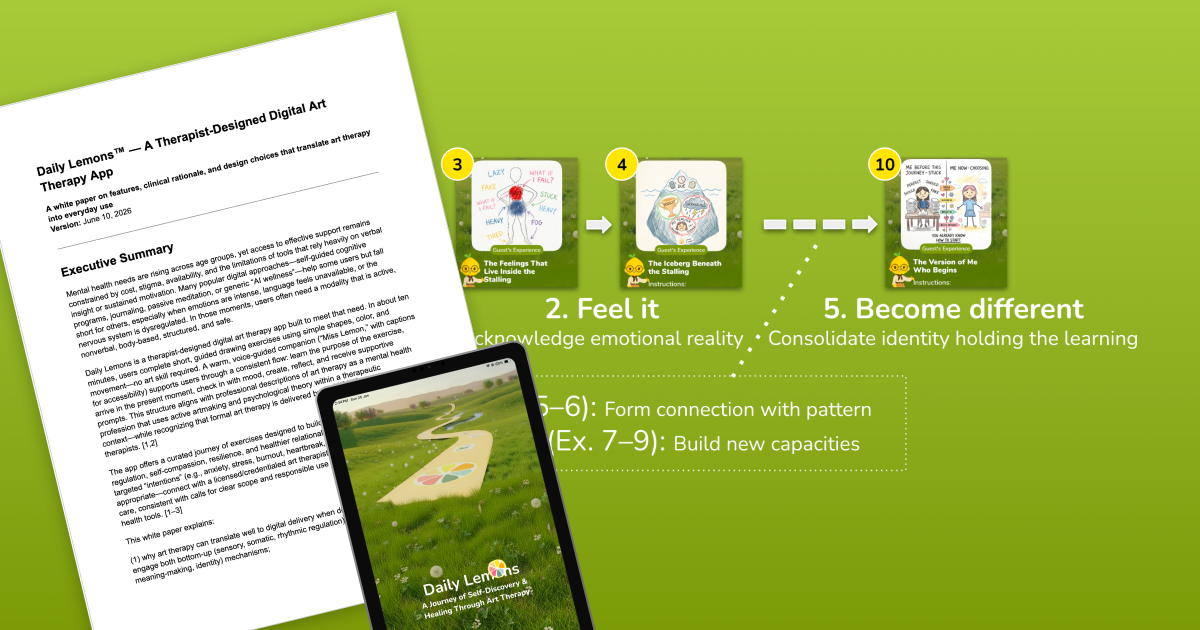
We will use the “I feel I’m procrastinating” intention as an example of how intention-based sequencing works. The genius of this procrastination sequence is its refusal to rush toward solutions. Many approaches to procrastination jump straight to productivity tips—timers, planners, accountability partners. These often fail for people because they add more external pressure to a system already overwhelmed by it.
Instead, this sequence follows the natural therapeutic arc:
See it (Exercises 1–2): Externalize the pattern so you can observe it
Feel it (Exercises 3–4): Acknowledge the emotional reality and discover root causes
Understand it (Exercises 5–6): Connect the pattern to identity, expectations, and meaning
Practice differently (Exercises 7–9): Build new capacities through embodied experience
Become differently (Exercise 10): Consolidate a new identity that holds all the learning
Each exercise builds on what came before. You cannot meaningfully shrink the mountain (Exercise 8) until you understand that the mountain's size is partly constructed by perfectionism and overwhelm (Exercises 4, 7). You cannot rewrite the label (Exercise 6) until you've done the emotional archaeology that reveals what the accurate label should be (Exercises 3–5). You cannot design a beginning ritual (Exercise 9) until you know what your nervous system actually needs in order to cross the threshold (Exercises 2, 3, 7, 8).
7.2.2 Pathway Engagement Across the Sequence
The procrastination sequence engages multiple therapeutic pathways in deliberate combination:
Pathways 1 & 3 (Emotional Expression + Cognitive Insight) dominate the early exercises, establishing both feeling and understanding
Pathway 2 (Mindful Embodiment) enters mid-sequence when the work shifts to body-based practice
Pathway 5 (Creativity, Play, and Mastery) powers the practical skill-building exercises
Pathway 4 (Resilience and Growth) bookends the reframing and integration work
This layering ensures that the participant is not just thinking about procrastination differently—she's feeling differently in her body, relating to herself differently, and acting differently from an integrated place.
Below are illustrative examples of how an intention can map to state and pathway—without claiming one “right” choice:
Anxiety (acute / racing thoughts) → containment + sensory modulation
Example exercises: “Worry Container,” “Edges and Borders,” “Weather Inside,” breath‑linked line drawing.
Why this route: anxiety often benefits from “put it somewhere” structure (containment) plus rhythmic, breath‑paced movement (bottom‑up settling).Burnout (flat / depleted / too tired to journal) → mastery/play + gentle embodiment
Example exercises: “Scribble Transformation,” “Small Finishable Pattern,” “Non‑Dominant Hand Doodle.”
Why this route: burnout can make long reflection feel impossible; quick completion and low‑stakes play can restore agency and initiate momentum.Heartbreak (activated grief + looping meaning questions) → containment first, meaning‑making second
Example exercises: “Two‑Panel Before/After,” “Memory Box (symbolic),” “Title the Feeling,” “What do I want to carry forward?”
Why this route: grief often needs both: regulation to stay within tolerance, then gentle integration so the story can be held without flooding.
7.2.3 The Outcome
By the end of this sequence, the participant should be equipped with:
Clear awareness of her specific procrastination patterns and triggers
Emotional literacy about what procrastination feels like in her body and what drives it
Self-compassion replacing shame as the primary response to stalling
Understanding of how external expectations versus internal desire create avoidance
Permission to begin imperfectly
A practical method for shrinking overwhelming tasks
A personal ritual for transitioning from avoidance to action
A new identity as someone who begins from choice, not pressure
Most importantly, she will understand that procrastination was never evidence that something was wrong with her—it was evidence that something important was trying to be heard. The sequence helps her listen, understand, and then move forward with that understanding integrated into who she is becoming.
8. Optional Live Sessions
Self‑guided practice can be valuable, but it cannot replace individualized assessment or real‑time attunement. Daily Lemons offers an optional pathway to live sessions with licensed/credentialed art therapists.
Therapeutic value: stepped care—users can start with low‑barrier self‑guided tools and escalate to human care when needs are more complex or when they want deeper relational work, consistent with professional definitions of art therapy as a credentialed psychotherapy practice. [1,2]
8.1 When a user typically wants a live session (examples)
A user may choose to connect with a therapist when:
Patterns repeat (e.g., the same symbol shows up, the same trigger loop returns).
The exercise opens something bigger than expected (grief, trauma memory fragments, intense shame).
They want help translating the artifact into change (boundaries, communication, decision‑making).
They need co‑regulation (they can do the drawing, but feel alone afterward).
They want a clinical container (pacing, consent, and safety planning for harder material).
8.2 Example workflow: “do the exercise first, then contact a therapist”
Scenario: A user completes a 10‑minute “Circles of Connection” boundary exercise after a conflict. The drawing helps her settle, but it also clarifies how stuck she feels.
A simple, efficient flow looks like:
Complete the guided exercise (10 minutes).
She arrives regulated enough to think and speak.Tap “Talk to a therapist about this” (optional).
The app offers a clear explanation of what happens next and what it is not (not crisis care; not emergency support).Choose what to share (consent‑based).
Share the drawing + reflections
Or share nothing and simply schedule (privacy‑first option)
Schedule a live session.
The therapist enters with context the user chose—not speculation.Session begins with the artifact, not a blank page.
Instead of spending the first 15 minutes trying to “catch up,” the user and therapist can start from what’s already externalized.
8.3 Why this is often more efficient than “doing the exercise on site”
In a traditional therapy workflow, a user might arrive dysregulated and spend much of the session getting to baseline and finding words, leaving less time for integration and planning.
When the user does a short exercise before the session:
Regulation happens upstream. The session doesn’t need to start at maximum distress.
Externalization is already done. The drawing becomes a shared reference point.
Less cognitive load, faster formulation. The user can point to parts of the image rather than narrating everything chronologically.
More time for high‑value therapist work: attunement, pattern‑spotting with consent, skills selection, boundary rehearsal, safety planning, and pacing.
9. Features
9.1 Voice‑guided, captioned sessions (“Miss Lemon”)
Beyond simply “guiding” an activity, Miss Lemon’s voice is designed as a co‑regulating cue: calm, warm, and non‑evaluative. Empathy is conveyed through patience, clear structure, and permission‑based prompts that protect autonomy (“if it feels okay,” “choose what fits today”). Consistent pacing and intentional pauses help users remain within a tolerable window of arousal while engaging in active expression, while captions extend this supportive presence to quiet, private, and hearing‑accessible use. Rather than “cheering” performance, Miss Lemon’s tone communicates steadiness and acceptance—supporting users to feel accompanied, not assessed.
Therapeutic value: predictability and pacing help users stay within a tolerable window of arousal while engaging in active expression. [5] Reviews of digitally delivered/telehealth arts therapies (including art therapy) generally support feasibility and potential benefit while emphasizing the need for more rigorous, standardized research designs across contexts. [6,7]
9.2 Short sessions (~10 minutes)
Daily Lemons sessions are intentionally designed to be short, typically around ten minutes, so users can access support in real-life moments when time, energy, or emotional capacity may be limited. A shorter format lowers the barrier to starting, especially when a user is anxious, overwhelmed, tired, distracted, or unsure what they need. Rather than asking users to commit to a long lesson or create a finished artwork, Daily Lemons invites them to take one manageable step: ground, create, notice, reflect, and close. This makes the exercises easier to fit into daily routines—between meetings, before bed, after school, or after a stressful interaction—and helps users build consistency through repeated small acts of care.
The ten-minute structure also supports emotional safety and reduces performance pressure. A clear time boundary reminds users that the goal is exploration, not artistic achievement or deep processing. The drawing can be simple, messy, unfinished, symbolic, or purely expressive. From a trauma-informed design perspective, short sessions help users engage with emotional material in a contained and manageable way, without becoming over-immersed. Over time, these brief completed sessions can build confidence, reinforce a sense of agency, and create a private visual record of growth in the Secure Journal Core.
9.3 No art skills required: simplicity as safety
Daily Lemons is intentionally designed so that users do not need any art skills, training, or confidence in drawing to benefit from the exercises. This is a core safety and accessibility choice. Many people carry anxiety, embarrassment, or self-criticism around art-making, often because they were told at some point that they were “not creative” or “bad at drawing.” If the app required polished images, realistic drawing, or aesthetic results, it would create unnecessary pressure and exclude many of the very users it is meant to support. Instead, Daily Lemons emphasizes simple marks, colors, shapes, lines, symbols, textures, collage elements, and written words when helpful. The goal is not to make “good art,” but to give inner experience somewhere to go.
This simplicity also supports emotional safety. When users are distressed, they may not have the cognitive or emotional capacity to make complex creative decisions. Clear prompts, sample drawings, templates, and gentle guidance help reduce the fear of the blank page and make it easier to begin. A scribble, a circle, a color field, a boundary line, or a repeated shape can be enough to express, contain, or shift an emotion. By keeping the creative demand low, Daily Lemons allows users to focus on noticing and regulating rather than performing. The app frames art-making as a private process of exploration, not a test of talent, which helps users feel safer, freer, and more willing to engage honestly.
9.4 Personalized reflection prompts (AI‑assisted, not interpretive)
A key differentiator is personalized reflective prompts based on the session experience—without diagnosing or interpreting the artwork in a clinical sense.
A trauma‑informed stance avoids interpretations such as:
“This color means you are angry.”
“This shape proves you are avoidant.”
Instead, supportive reflection asks:
“What does this part represent for you?”
“Where do you feel this in your body?”
“What would you like to change in the picture—if anything?”
“What title would you give this image?”
Therapeutic value: meaning stays user‑owned. [1,2]
9.5 Guest Hosts’ Experience Sharing
Daily Lemons exercises begin with Miss Lemon offering a brief introduction to the purpose of the exercise along with a sample drawing that gives the user a concrete sense of how the activity might unfold. For most exercises, this introduction includes a simulated guest host whom Miss Lemon invites to share their experience of doing the exercise. Listening to the guest’s experience is optional. The sample drawing shown to the user is presented as the guest host’s own creation, making the exercise feel less abstract and more approachable. Rather than functioning as a “model answer,” the guest host’s drawing serves as a gentle example of process: one possible way a person might respond to the prompt using simple shapes, colors, marks, symbols, or words.
The therapeutic purpose of guest-host feedback is to reduce blank-page pressure, normalize uncertainty, and help users begin. Many people hesitate before expressive work because they worry they are doing it “wrong,” are unsure what the prompt is asking, or cannot imagine what an emotional drawing might look like. Hearing a guest host describe their experience can lower that barrier by showing that the exercise does not require artistic skill, perfect insight, or a polished result. It also helps users understand potential outcomes of the exercise—such as feeling more settled, noticing an emotion more clearly, seeing a worry from a distance, or discovering a small sense of agency—without promising that every user will have the same response.
Importantly, the guest host’s feedback is framed as illustrative rather than prescriptive. Daily Lemons does not ask users to copy the sample drawing or interpret their own work through someone else’s experience. Instead, the guest host provides a warm, relatable entry point: “Here is how this exercise unfolded for me.” This supports the app’s broader no-interpretation principle by keeping meaning user-owned while still offering enough structure to make the exercise feel safe, understandable, and doable. In this way, guest hosts extend Miss Lemon’s co-regulating presence and help transform the start of each exercise from a blank canvas into an inviting creative doorway.
9.6 Secure Journal Core + Journal Editor (templates)
Daily Lemons stores user creations in a journal log so users can revisit prior work. When users want to write or doodle independently, they can use the Journal Editor with optional templates.
Privacy principle: creations are stored privately on the user’s device by default unless the user explicitly shares them.
Why this matters mechanistically: continuity and integration, memory support under stress, user authority and consent, bridging drawing and writing, and trauma‑informed pacing.
Anecdote (composite): “The journal kept it for me.”
After a hard night, a user completes a “weather inside” exercise and closes the app. Days later, she opens the journal log and sees the image again. She notices the storm had edges—she contained it. Using a template prompt (“What helped even a little?”), she writes: “Slow lines.”
9.7 Drawing Editor + Collage Editor
Daily Lemons includes a high‑fidelity drawing editor designed for iPad that supports expressive work with minimal friction. The editor is built to feel immediate and natural, enabling users to stay in the creative process rather than managing the tool.
Drawing editor
Large, zoomable / pan‑able canvas: users can zoom in for detail work or zoom out for whole‑page composition, supporting both fine motor calming (detail) and big‑movement expression (expansiveness).
Low‑latency ink: strokes render responsively to preserve flow and reduce interruption—especially important for rhythmic, regulation‑focused mark‑making.
Pressure‑sensitive input (iPad): supports variation in line weight and intensity, allowing users to express gradations of emotion and energy without needing “art skill.”
Tilt‑aware drawing (iPad): enables shading and broad/soft mark‑making styles (e.g., pencil‑like effects) that pair well with sensory modulation and grounding exercises.
Drawing templates (starting structure): for selected exercises, the canvas can include a light, pre‑drawn template (e.g., circles, panels, borders, body outlines, containers, or simple guides) that gives users an immediate starting point. This reduces blank‑page pressure and decision fatigue—especially for users who feel dysregulated, perfectionistic, or unsure how to begin—while preserving autonomy: users can follow the structure, modify it, or ignore it entirely. Templates are designed as scaffolding, not “correct answers,” supporting the therapeutic mechanism (containment, sequencing, mapping, or grounding) without shifting the app into interpretation or evaluation.
Collage Editor (embedded images + text on canvas)
Alongside drawing, Daily Lemons includes a Collage Editor that lets users place and arrange images and text directly on the canvas.
Users can embed images from:
the user’s own photo library, and
Daily Lemons’ online library of images and icons.
Text elements can be added to support labeling, titling, values words, intentions, and short affirmations—without requiring long journaling.
Therapeutic value and product scope
Expands the modality range: these tools allow Daily Lemons to offer both:
drawing exercises (guided mark‑making, containment, embodiment, meaning‑making), and
vision board / collage exercises (identity, values, future orientation, hope, motivation, and narrative integration).
Supports user‑led meaning (“no interpretation” compatible): collage elements and titles can externalize what matters to the user without the app asserting what symbols “mean.”
Reduces barriers for word‑limited users: collages can express preference, longing, identity, and goals when writing feels effortful.
9.8 Background music (optional)
Daily Lemons includes an optional background music feature that allows users to select from a curated in‑app library of music to listen to while creating art. The goal is not entertainment; it is state support—giving users a simple way to shape the sensory environment of a session without adding cognitive load.
What it does
Users can browse and select background tracks from a library before a drawing session.
Music playback is optional and designed to pair with guided creation (including Miss Lemon voice + captions), rather than compete with it.
Therapeutic value (mechanistic)
Supports bottom‑up regulation: steady, predictable sound can function as a rhythmic anchor that complements breath‑linked mark‑making and other sensory‑modulation pathways.
Reduces friction and decision fatigue: choosing a track is a lightweight “set the container” step that can help users begin when they feel dysregulated or word‑limited.
Enhances containment and continuity: consistent background audio can help a session feel bounded (“this is my 10 minutes”) and can become a repeatable cue for settling into the practice.
Design notes / safety alignment
Background Music is consent‑based and user‑controlled (on/off and track selection), consistent with trauma‑informed pacing and autonomy.
The feature is designed to remain compatible with accessibility needs (e.g., users who prefer silence, users relying on captions, or users who want to prioritize Miss Lemon’s voice).
9.9 Coloring templates
Daily Lemons also includes a dedicated Coloring feature for moments when users want something even more immediately accessible than a guided drawing exercise. The feature offers users tens of coloring templates, ranging from simple animals and friendly everyday images to more intricate floral patterns, geometric designs, and mandala-like compositions. Users can choose a template, select colors, and fill in the image at their own pace when they feel like mindless doodling, gentle distraction, or a low-effort creative reset.
Coloring serves a different but complementary function within the Daily Lemons ecosystem. Not every moment calls for emotional exploration, symbolic image-making, or reflective prompts. Sometimes a user may feel tired, overstimulated, bored, mildly anxious, or emotionally “full,” and may not want to investigate what they are feeling. In those moments, coloring provides a structured, low-demand activity that still engages the hand, eye, attention, color choice, and repetitive movement. The user does not have to decide what to draw, confront a blank page, or produce meaning. The template holds the structure; the user simply enters the rhythm of filling space with color.
The therapeutic value of coloring lies in its combination of simplicity, repetition, sensory focus, and containment. Repetitive coloring can support bottom-up regulation by giving the nervous system a predictable task: choose a color, fill a shape, stay inside or intentionally move beyond a boundary, repeat. This can help narrow attention, reduce cognitive load, and create a gentle sense of order when the user feels scattered. More complex mandala-like templates may support centering through symmetry, pattern, and gradual completion, while simpler animal or object templates can feel playful, approachable, and emotionally non-threatening. Because the task is pre-structured, coloring can be especially useful for users who are depleted, perfectionistic, neurodivergent, new to creative self-care, or reluctant to begin with more personally expressive exercises.
Coloring also supports Daily Lemons’ broader no-art-skills-required principle. It offers an easy on-ramp into creative regulation for users who may feel intimidated by drawing from scratch. A user who is not ready to make an image of their own can still experience color, choice, agency, and visual completion. This matters because small acts of completion can restore a sense of efficacy: “I started something; I stayed with it; I finished a section; I changed how this page feels.” Even when the activity feels “mindless,” it can create a mindful effect by anchoring attention in the present moment without demanding verbal insight.
Within Daily Lemons’ value proposition, Coloring expands the app’s range from guided therapeutic micro-interventions to everyday creative self-soothing. The core guided exercises remain the primary pathway for structured emotional expression, reflection, and skill-building. Coloring sits alongside them as a gentler, lower-intensity mode: a way to downshift, decompress, or stay connected to the app when a full exercise feels like too much. It can function as a bridge into deeper work, a recovery activity after a more emotionally meaningful session, or a maintenance practice on days when the user simply wants a quiet creative ritual.
Importantly, Daily Lemons does not position coloring as a substitute for art therapy, psychotherapy, or deeper therapeutic processing. Its role is more modest and practical: to provide a safe, accessible, visually engaging form of creative regulation that users can reach for in ordinary moments. By including coloring templates, Daily Lemons honors the reality that self-care has different intensities. Some days users need a guided exercise to externalize anxiety or explore meaning; other days they need a calm page, a set of colors, and permission to doodle without having to explain anything. This flexibility strengthens Daily Lemons’ promise: accessible, nonverbal, therapist-designed creative support that meets users where they are.
9.10 Community sharing
Daily Lemons includes an optional Community feature that allows users to share selected artwork with a community of other Daily Lemons users. After completing a drawing, collage, coloring page, or journal-based creative exercise, users can choose whether to keep the work private, save it only to their Secure Journal Core, bring it to a therapist, or share it with the Daily Lemons community. Sharing is always user-controlled and consent-based; the default therapeutic stance remains privacy, autonomy, and user ownership.
The Community feature is designed to address one of the most common emotional experiences underlying mental health distress: the sense of being alone in what one feels. Anxiety, grief, shame, burnout, loneliness, identity struggle, and emotional overwhelm often become more painful when users believe they are the only person feeling that way. Seeing other users’ artwork can gently counter this isolation. A user may recognize a familiar color field, a similar “storm,” a repeated boundary shape, a quiet image of exhaustion, or a hopeful symbol created by someone else and think, “I’m not the only one.” This kind of visual recognition can provide a low-pressure form of connection without requiring users to explain themselves verbally.
Therapeutically, community sharing supports normalization, belonging, witness, and creative courage. In art-therapy-informed practice, the artwork can become a shared object: something that allows a feeling to be seen without forcing the person to disclose everything behind it. In a digital community, this same principle can operate at a lighter wellness level. Users can share an image, title, short reflection, or intention without needing to tell a full personal story. Others can respond with supportive, non-interpretive feedback—such as appreciation, resonance, encouragement, or acknowledgment—rather than analysis or advice. This preserves Daily Lemons’ “no interpretation” principle while still allowing users to feel witnessed.
The feature also complements Daily Lemons’ emphasis on low-stigma access. For many users, posting an image feels easier than saying, “I am anxious,” “I feel ashamed,” or “I am struggling.” Visual sharing can create a softer doorway into social connection, especially for users who are word-limited, neurodivergent, socially anxious, or uncertain how to ask for support. A simple drawing can communicate mood, effort, humor, tenderness, or hope in a way that feels safer than direct disclosure. Community participation can therefore become a bridge between private regulation and relational connection.
Community also strengthens the creativity, play, and mastery pathway. When users see many different responses to the same prompt, they learn that there is no single “right” way to make therapeutic art. This can reduce perfectionism and performance anxiety. A messy scribble, a minimal line drawing, a colorful mandala, a collage, or a symbolic self-portrait can all belong. Over time, exposure to diverse user-created images may help users internalize the app’s core message: the value is in expression, process, and self-contact—not artistic skill. This makes the creative practice feel more approachable and sustainable.
The Community feature can also support continuity and motivation. While Daily Lemons is intentionally built for private, self-guided practice, some users benefit from a sense of shared ritual. Knowing that others are also taking ten minutes to draw, color, reflect, and care for themselves can increase adherence and reduce the feeling that self-care is an isolated task. Community prompts, themed galleries, shared intentions, or opt-in challenges can help users return to the app without making engagement feel competitive. The goal is not social comparison, popularity, or performance; it is gentle participation in a culture of creative care.
To remain aligned with Daily Lemons’ safety and ethical boundaries, Community should be designed with clear safeguards. Users could decide what to share, whether to include captions or reflections, and whether to post anonymously or under a chosen display identity. The app discourages diagnostic interpretation, unsolicited advice, crisis disclosures, bullying, comparison-based feedback, and comments that claim to know what another user’s artwork “means.” Community norms can emphasize supportive responses such as: “I relate to this,” “Thank you for sharing,” “The colors feel meaningful to me,” or “This helped me feel less alone,” while avoiding statements like “This means you are depressed” or “You should do this.” Moderation, reporting tools, privacy controls, and crisis-resource routing are essential to preserving the feature as a supportive wellness environment rather than an uncontained social feed.
Within the broader Daily Lemons value proposition, Community adds a relational layer to an app already built around nonverbal regulation, user-led meaning, privacy, and stepped care. The core experience helps users create privately; the Secure Journal Core helps them remember and integrate; optional live sessions allow deeper work with credentialed art therapists; and Community gives users a lightweight way to be witnessed by peers when they choose. Together, these layers form a continuum from solitude to connection: users can begin alone, stay private when needed, share selectively when ready, and escalate to professional human care when appropriate.
In this sense, Community does not change Daily Lemons into a social media product. It extends the app’s therapeutic logic: feelings become more manageable when they can be safely externalized, held, reflected on, and—when the user chooses—seen by others. By allowing artwork to move from private expression into optional shared witness, Daily Lemons supports belonging without sacrificing autonomy, connection without forced disclosure, and encouragement without interpretation. This strengthens the app’s promise as a therapist-designed digital art therapy platform: accessible, nonverbal, structured, private by default, and capable of helping users feel less alone.
Anecdote: Finding connection through the Community
After a difficult workday, Maya opened Daily Lemons feeling too drained to explain what was wrong, so she completed the prompt “Draw the weather inside you” and filled the page with gray clouds, a jagged yellow lightning bolt, and a small blue circle in the corner. She almost deleted it, but instead shared it anonymously with the Community, captioned, “Today felt loud.” When she saw other users’ imperfect but honest drawings of spirals, rain, dark colors, and small signs of hope, she felt less alone. A few gentle responses — “I relate to this,” “The small blue circle feels hopeful,” and “Today felt loud for me too” — helped her feel witnessed without being analyzed. What had seemed like a messy drawing became a reminder that she had made it through the day and could reach for connection in a safe, low-pressure way.
10. Safety, Privacy, Scope Boundaries, and Responsible Use
10.1 Safety boundaries (not crisis care)
Daily Lemons is not intended for emergencies, imminent self‑harm risk, intent to harm others, or situations requiring immediate intervention. Users in crisis should contact emergency services or local crisis resources.
10.2 Privacy and confidentiality principles
Daily Lemons emphasizes privacy and trust through principles such as:
data minimization
user control
encryption
not selling sensitive mental health data
clear boundaries about what the app does and does not do
Trust is a prerequisite for vulnerable work.
10.3 Scope boundaries: what it is / what it isn’t
Daily Lemons is positioned as a wellness product—not a medical device and not a substitute for professional mental health care.
What it does:
grounding and regulation through guided creative practice
structured art‑based emotional expression
reflective prompts supporting self‑awareness and meaning‑making
curated progression for capacity building
secure, private journaling for revisitable continuity
optional linkage to professional art therapy
What it does not do:
diagnose mental health conditions
provide clinical assessments
authoritatively interpret artwork
serve as crisis support
Anecdote (composite): “It didn’t tell me what I felt—it helped me find it.”
A user expects the app to analyze her drawing. Instead, it asks what she notices and what she wants to carry forward. Over time she realizes that naming her own experience is what builds confidence.
10.4 Responsible use and escalation guidance
Daily Lemons is best used as:
a short, repeatable practice
a bridge from dysregulation to reflection
an adjunct to therapy when available
Users should escalate to professional care when distress persists, worsens, or significantly impacts safety or functioning, or when medical evaluation may be needed.
11. Who It Is For
Daily Lemons is designed to support a broad spectrum—from everyday wellness to more significant emotional challenges (e.g., anxiety and depression)—within the limits of a wellness product.
Strong fits include:
teens and young people navigating school stress and identity formation
users who dislike meditation or journaling or find them ineffective under stress
neurodivergent users who prefer visual structure and concrete steps
professionals experiencing burnout and anxiety who need short decompression tools
trauma‑impacted users who prefer a nonverbal entry point and consent‑based pacing
Anecdote (composite): “Words made it worse.”
A 34‑year‑old who survived a serious accident says that recounting the story verbally spikes his body into panic. He uses a symbolic exercise: a safe‑place drawing. He does not draw the accident. He draws a cabin with a bright window and thick walls. Later, he tells his therapist: “That picture is the first time I felt safe thinking about safety.”
12. Differentiation
Daily Lemons is differentiated by a combination of clinical credibility, moment-of-need usability, active nonverbal engagement, structured progression, personalization, privacy, and stepped access to human care. Many mental health apps offer one or two of these elements; Daily Lemons is designed around the idea that the therapeutic value comes from how these elements work together.
At a high level, Daily Lemons is not simply a drawing app, a meditation app, a journaling app, an AI wellness chatbot, or a teletherapy marketplace. It occupies a distinct position: a therapist-designed digital art therapy app that translates art-therapy-informed mechanisms into short, structured, everyday exercises.
Where many digital tools ask users to think, talk, write, or sit still, Daily Lemons asks users to make marks, use color, move the hand, notice the body, externalize feeling, and reflect gently afterward. This matters because the moments when people most need support are often the same moments when purely verbal or cognitive tools become hardest to use.
12.1 The core differentiation: active, nonverbal regulation when words are unavailable
A central limitation of many mental health apps is that they rely on top-down cognition: identifying thoughts, writing reflections, reframing beliefs, tracking moods, or conversing with an AI companion. These approaches can be useful when a user has enough calm, focus, and language available. But during anxiety, burnout, grief, anger, shame, panic, or trauma activation, the user may not be able to organize experience verbally.
Daily Lemons is designed for that gap.
Its core intervention is active, nonverbal, body-based creation. The user does not need to explain what is happening before beginning. Instead, they can enter through action: drawing a line with the breath, placing worry into a container, mapping emotional intensity with color, transforming a scribble, or building a symbolic image of strength.
This makes Daily Lemons especially relevant for users who:
feel “stuck in their head”;
dislike or avoid journaling;
find meditation difficult when the mind is racing;
struggle to identify feelings in words;
are neurodivergent and prefer visual structure;
feel shame or pressure in talk-based settings;
need a private, low-stigma way to begin regulating;
need something to do with distress, not just something to think about distress.
This is not merely a UX preference. It reflects a clinical design thesis: when the nervous system is dysregulated, a bottom-up entry point may be more accessible than a purely cognitive one. Daily Lemons uses the hand, eye, breath, rhythm, color, and spatial organization of the page to help users begin shifting state before asking for meaning-making.
12.2 Differentiated from meditation apps: active calm instead of passive stillness
Meditation and mindfulness apps can be valuable, but they are often difficult for users whose distress shows up as racing thoughts, agitation, intrusive rumination, restlessness, or body alarm. Sitting still and observing the mind may intensify awareness of discomfort rather than reduce it.
Daily Lemons offers a different path: active calm.
Rather than asking the user to close their eyes and quiet the mind, the app gives the body a simple task:
follow the breath with a line;
shade slowly from dark to light;
repeat a shape;
use both hands to make balanced marks;
contain a feeling inside a boundary;
turn chaos into form.
This can make regulation feel more concrete and less intimidating. The user is not “failing to meditate”; they are engaging in a guided creative process that naturally supports attention, rhythm, sensory focus, and emotional containment.
In this way, Daily Lemons sits in a differentiated space between mindfulness and expressive therapy: it keeps the grounding and awareness benefits associated with mindfulness while adding movement, image-making, symbolic expression, and user-led reflection.
12.3 Differentiated from journaling and mood-tracking apps: expression without the blank-page burden
Journaling apps often assume that the user can name what they feel and translate experience into language. Mood trackers often reduce emotion into labels, numbers, or charts. Both can be useful, but both can also feel like homework—especially for users who are overwhelmed, ashamed, word-limited, emotionally flooded, or simply tired.
Daily Lemons reduces this burden by making expression visual first.
A user does not need to answer, “What am I feeling and why?” before starting. They can begin by choosing a color, drawing a weather pattern, circling an area of tension, or placing symbols into a container. Reflection comes after expression, once the user has something external to respond to.
This sequence is important:
Create first — reduce pressure and activate expression.
Observe the image — make the internal experience visible.
Reflect gently — invite language only when the user is more ready.
Save the artifact — support continuity over time.
The Secure Journal Core deepens this differentiation. Daily Lemons does not treat journaling as only written self-report. It treats the user’s drawings, collages, titles, notes, and reflections as a private visual record of emotional learning. The journal becomes a place where users can revisit what they created, notice patterns, remember what helped, and optionally add words later.
This turns journaling from a demand into an invitation.
12.4 Differentiated from CBT/ACT self-guided apps: lower cognitive load at the point of distress
Self-guided CBT, ACT, and related digital programs often rely on structured lessons, thought records, values worksheets, cognitive reframing, or written exercises. These tools can be powerful, but they require executive function: reading, analyzing, labeling, comparing, and writing.
Daily Lemons can support similar therapeutic aims—such as cognitive processing, defusion, values clarification, behavioral flexibility, and self-awareness—but through a different route.
For example:
Instead of writing a thought record, a user may draw the “shape” of a worry and place it inside a container.
Instead of listing values, a user may create a values constellation.
Instead of verbally reframing a belief, a user may redraw an image to show growth, possibility, or agency.
Instead of analyzing a relationship conflict in prose, a user may map boundaries through circles, distance, color, and line.
This makes Daily Lemons a strong complement to cognitive therapies rather than a competitor to them. The app translates some of the aims of top-down therapeutic work into visual, embodied, and symbolic practices that are more accessible when a user cannot yet think clearly.
12.5 Differentiated from somatic tools: body-based regulation that feels natural and private
Somatic and nervous-system regulation tools—such as tapping, shaking, humming, breathwork, or body scanning—can be effective for many users. However, some people find these techniques awkward, embarrassing, culturally unfamiliar, or difficult to practice in shared environments such as offices, schools, dorms, or public spaces.
Daily Lemons offers a body-based alternative that can feel more ordinary and discreet: drawing.
Making marks on a phone or tablet is socially legible. A user can engage in a regulating practice without visibly performing a “mental health technique.” This lowers stigma and increases real-world usability.
Daily Lemons also gives somatic regulation a visual container. The body’s experience becomes an image: a line, field, texture, rhythm, symbol, boundary, or gradient. This allows the user not only to regulate but also to see and revisit what happened.
That combination—somatic action plus visual artifact—is a key differentiator.
12.6 Differentiated from AI wellness chat: personalization without pretending to be therapy
AI wellness tools can offer responsive conversation, but they also introduce risks: over-reliance, blurred clinical boundaries, inaccurate reassurance, pseudo-diagnosis, or the impression that the AI “knows” what the user’s inner experience means.
Daily Lemons uses AI differently.
The app’s AI-assisted layer is designed to support reflection, not diagnosis or interpretation. It does not claim:
“This color means anger.”
“This symbol means trauma.”
“Your drawing shows avoidance.”
“You are depressed.”
“You need to do X.”
Instead, it offers prompts that keep meaning in the user’s hands:
“What stands out to you?”
“What part feels most important today?”
“If this image had a title, what would it be?”
“Where do you feel this in your body?”
“What would you like more or less of in this image?”
“What might this drawing be asking for?”
This creates a differentiated model of AI-assisted wellbeing: the AI scaffolds user-led meaning-making without becoming an authority over the user’s psyche. That stance is especially important in a product grounded in art therapy principles, where context, relationship, consent, and clinical judgment matter.
12.7 Differentiated from generic drawing and coloring apps: therapeutic structure, not just creativity
Many drawing, coloring, and creativity apps can be relaxing. However, relaxation alone is not the same as a therapeutic mechanism. Daily Lemons is differentiated by the structure wrapped around the creative act.
A typical Daily Lemons session includes:
Learn purpose — the user understands why the exercise exists.
Get grounded — the user arrives in the present moment.
Check mood — the user builds emotional awareness.
Create — the user engages in guided art-making.
Reflect — the user notices and makes meaning.
Receive supportive prompts — the user is invited into further self-led integration.
Save to journal — the user builds continuity over time.
This sequence turns art-making into a repeatable micro-intervention. The app is not merely asking the user to “draw something.” It provides a container, a purpose, a pathway, a pacing strategy, and a reflective close.
That therapeutic structure is one of Daily Lemons’ most defensible differentiators.
12.8 Differentiated from other art therapy apps: credibility, safeguards, and stepped care
Daily Lemons is also differentiated within the emerging category of art therapy and art-based wellbeing apps.
Some products may use art therapy language while offering little clinical grounding, few safety boundaries, or limited connection to credentialed professionals. Others may provide creative tools without a coherent therapeutic progression. Some may offer interpretation-heavy feedback that risks overreach.
Daily Lemons addresses these gaps through several trust-building design choices:
Co-created with registered art therapists rather than positioned as a purely technical or AI-generated wellness product.
Grounded in trauma-informed, consent-based principles, including pacing, choice, and emotional safety.
Clear scope boundaries, including no diagnosis, no clinical assessment, no crisis care, and no authoritative interpretation of artwork.
Optional access to credentialed art therapists, allowing users to move from self-guided practice into human care when appropriate.
Secure Journal Core, supporting privacy, continuity, and user control.
Personalized AI-assisted reflection prompts, designed to increase engagement while preserving the “no interpretation” principle.
A curated journey, rather than only a flat library of disconnected exercises.
Moment-of-need intentions, helping users quickly find a relevant exercise when distressed.
This creates a more complete and credible product architecture: creativity, clinical rationale, safety boundaries, privacy, engagement, and stepped care work together.
12.9 Differentiated by the pathway model: multiple doors into change
Daily Lemons’ multi-pathway mechanism is another key differentiator. Rather than assuming one universal route to wellbeing, the app recognizes that different users—and the same user on different days—may need different entry points.
The app’s pathways include:
Emotional expression, regulation, and containment
Mindful embodiment and sensory modulation
Cognitive processing, meaning-making, insight, and identity
Trauma, resilience, and growth
Creativity, play, and mastery
Connection and co-regulation
This model gives Daily Lemons both clinical coherence and product flexibility. It allows exercises to be designed with clear therapeutic intent while still giving users plain-language choices. A user does not need to understand clinical frameworks. They only need to know, “I feel anxious,” “I feel burnt out,” “I need peace,” “I want self-love,” or “I feel stuck.”
The app then routes the user toward a pathway that may fit the moment.
This is different from products that organize content only by topic, mood label, or content type. Daily Lemons organizes experience by mechanism: what the exercise is designed to help the user do internally.
12.10 Differentiated by dual navigation: curated journey plus moment-of-need intentions
Many mental health apps choose between two models:
a linear program, or
a large self-serve content library.
Daily Lemons combines both.
The curated journey provides gradual progression. It helps users build skills over time, beginning with free play and grounding before moving into identity, emotions, regulation, resilience, relationships, self-compassion, and future meaning. This reduces the risk of users jumping too quickly into intense material without preparation.
The intention-based library solves the moment-of-need problem. When a user is anxious, heartbroken, stressed, burnt out, lonely, procrastinating, grieving, or seeking joy, they can bypass extensive searching and choose the doorway that fits their current state.
This dual navigation is a significant product advantage:
The journey supports growth over time.
Intentions support immediate relief.
Pathways connect both into one coherent therapeutic model.
Together, they allow Daily Lemons to be both a practice and a tool for acute moments.
12.11 Differentiated by short, practical sessions: designed for adherence
Daily Lemons’ approximately ten-minute format is not incidental. It is a behavior-design choice.
Many users do not fail at mental health practices because they lack insight; they fail because the practice is too demanding to start when life is stressful. Long lessons, long journal entries, or open-ended exercises can create avoidance. Daily Lemons lowers the threshold.
Short sessions make the app:
easier to start;
easier to repeat;
easier to fit between meetings, classes, caregiving, or bedtime;
less intimidating for new users;
more realistic as a between-session therapy adjunct;
more appropriate for users with limited attention, energy, or emotional bandwidth.
The goal is not to solve everything in ten minutes. The goal is to help the user do one supportive thing reliably—and to build capacity through repetition.
12.12 Differentiated by Miss Lemon: a consistent co-regulating guide
The Miss Lemon guide adds another layer of differentiation. Voice-guided sessions with captions provide a sense of accompaniment while preserving privacy and autonomy. Miss Lemon’s tone is designed to be warm, steady, non-evaluative, and permission-based.
This matters because many users need more than instructions. They need pacing.
Miss Lemon supports:
predictability;
emotional safety;
reduced performance pressure;
a sense of being accompanied;
accessibility through captions;
continuity across sessions;
gentle co-regulation without pretending to replace a therapist.
The presentation emphasizes the warm, empathetic Scottish accent of Miss Lemon as a memorable brand and UX feature. In the white paper context, the deeper point is that the guide is not simply a mascot. She is part of the therapeutic container: consistent, calm, structured, and nonjudgmental.
12.13 Differentiated by the Secure Journal Core: visual continuity and private integration
Daily Lemons’ Secure Journal Core is not just a storage feature. It is part of the mechanism.
Mental health growth often depends on continuity: remembering what helped, noticing patterns, revisiting earlier states, and seeing evidence that feelings change. Because art-making produces an artifact, Daily Lemons can help users build a private visual history of coping and self-understanding.
The journal supports:
revisiting prior drawings;
noticing recurring images, colors, shapes, or themes;
adding written reflections only when ready;
using templates to reduce blank-page pressure;
bringing selected artifacts to therapy if the user chooses;
preserving user ownership and consent.
This differentiates Daily Lemons from single-session calming tools. The app does not only help the user feel better in the moment; it helps the user build a record of emotional learning over time.
12.14 Differentiated by multimodal creative tools: drawing, collage, text, templates, and music
Daily Lemons is also differentiated by its creative range. The product includes a high-fidelity drawing editor, collage capabilities, text elements, templates, and optional background music.
This matters because art therapy is not one uniform activity. Different users express themselves through different media, and different emotional states call for different kinds of creative support.
The drawing editor supports:
expressive mark-making;
pressure-sensitive intensity;
detail work and zooming;
broad movement and spatial organization;
guided templates for containment, mapping, sequencing, and grounding.
The collage editor supports:
vision boards;
symbolic identity work;
values imagery;
future orientation;
hope and motivation;
text labels, titles, and affirmations without requiring long-form writing.
Optional background music supports:
sensory containment;
rhythmic anchoring;
state-setting;
session continuity;
user-controlled regulation.
Together, these tools expand Daily Lemons beyond simple coloring or doodling. They create a flexible expressive environment while still preserving therapeutic structure.
12.15 Differentiated by stepped care: from wellness to adjunct support to live art therapy
Daily Lemons is positioned across a continuum:
Wellness / self-guided program
Users engage with prompts, guided exercises, journeys, intentions, and journaling.Adjunct app
Users use Daily Lemons between therapy sessions, optionally bringing drawings or reflections to a clinician.Teletherapy pathway
Users can connect with credentialed art therapists for deeper individualized work.
This stepped-care model is a major differentiator because it acknowledges both the value and the limits of self-guided digital support. Daily Lemons does not claim that an app can replace therapy. Instead, it creates a bridge: users can begin with low-barrier self-guided exercises, build familiarity with visual expression, and escalate to human care when needed or desired.
The “do the exercise first, then contact a therapist” workflow is especially distinctive. It allows the user to arrive at a live session with an externalized artifact already created. This can reduce blank-page pressure, help the therapist understand what the user chose to share, and allow the session to begin with something concrete rather than only verbal recall.
12.16 Differentiated by privacy and trust as product features
Mental health products depend on trust. Daily Lemons treats privacy and safety not as compliance afterthoughts, but as part of the user experience.
Key privacy and safety differentiators include:
user control over what is saved and shared;
private journal storage by default;
consent-based sharing with therapists;
data minimization principles;
no selling of sensitive mental health data;
clear communication that the app is not crisis support;
no diagnosis or clinical assessment;
no authoritative interpretation of artwork.
This is especially important for an app that handles intimate creative material. A drawing can feel as personal as a diary entry. Users are more likely to engage honestly when they believe their work is private, respected, and not being judged.
12.17 Differentiated by broad but bounded audience fit
Daily Lemons supports a broad spectrum of needs while maintaining a wellness scope. This gives the product a differentiated market position: accessible enough for everyday stress, but structured enough to be relevant for users facing more significant emotional challenges such as anxiety, depression, grief, burnout, trauma-related overwhelm, loneliness, or identity stress.
Strong-fit users include:
teens and young people managing school stress and identity development;
neurodivergent users who prefer visual and concrete structure;
professionals experiencing burnout and anxiety;
users who dislike meditation or journaling;
trauma-impacted users who prefer nonverbal, consent-based entry points;
people who want creative self-care but need more structure than a blank canvas;
therapy clients who need between-session tools;
users who are curious about art therapy but face cost, access, stigma, or trust barriers.
The product is intentionally broad in access but careful in claims. That balance is part of its differentiation.
can reduce the activation energy required to try the first exercise.
12.18 Competitive differentiation matrix
Daily Lemons can be understood across three differentiation layers: creativity enablers, trust builders, and engagement drivers.
Differentiation Layer | Common Market Offering | Daily Lemons Advantage |
Creativity enablers | Drawing, coloring, journaling, or creative editing tools | High-fidelity drawing, collage, text, templates, optional music, and guided creative exercises |
Trust builders | General wellness claims or generic “therapy-inspired” language | Co-created with registered art therapists; trauma-informed; no interpretation; optional live credentialed art therapists |
Engagement drivers | Static content libraries, passive tools, mood tracking, or generic chatbot interaction | Personalized AI-assisted reflection prompts, Miss Lemon voice guidance, intentions, curated journey, Secure Journal Core |
The most important distinction is that Daily Lemons does not rely on creativity alone. It combines creativity with therapeutic sequencing, mechanism-based pathways, reflection, privacy, and stepped care.
12.19 Summary: why Daily Lemons is hard to reduce to a single category
Daily Lemons is differentiated because it brings together elements that are usually separated across multiple products:
Active, nonverbal, bottom-up regulation rather than only passive calming or cognitive reflection.
Therapist co-creation rather than generic wellness content.
Trauma-informed structure with pacing, choice, and consent.
A curated journey for gradual skill-building over time.
Intentions for moment-of-need access when the user is distressed.
A multi-pathway mechanism that recognizes different routes to wellbeing.
Personalized AI-assisted reflection without interpretive overreach.
Miss Lemon as a consistent co-regulating guide, with voice and captions.
Secure Journal Core for private visual continuity and integration.
Drawing, collage, text, templates, and music as a multimodal expressive environment.
Optional access to credentialed art therapists for stepped care.
Clear safety and privacy boundaries that protect trust.
Short, practical sessions designed for real-world adherence.
A low-stigma brand that makes starting feel easier.
The result is a product that is not simply relaxing, expressive, or AI-personalized. Daily Lemons’ differentiation lies in the integration: it turns art-therapy-informed principles into a structured, accessible, private, repeatable, and human-escalatable digital practice.
These design decisions are not add-ons. They are the therapeutic mechanism.
13. Brand Layer
Brand is often treated as marketing. In mental health products, brand influences access: it can lower stigma, reduce intimidation, and make starting easier.
13.1 “When life gives you lemons…”
The framing signals:
resilience and agency (“make something with what you have”),
realism (difficulty is not denied), and
transformation (experience can be metabolized).
These themes align with therapeutic aims: not pretending everything is fine, but helping users work with what is real.
13.2 Mandala‑like symbolism and centering
A lemon slice naturally forms a radial, symmetrical pattern reminiscent of mandala forms. In many art‑therapy traditions, mandala‑like structures are associated with centering attention, organizing experience, and integrating parts into a whole.
Anecdote (composite): “It felt organized inside.”
A user with chronic anxiety describes her drawings as “messy.” An early exercise uses symmetry and gentle repetition. Later she reports: “My head didn’t change instantly, but it felt organized inside.”
14. Positioning / Stepped Care
Daily Lemons is often most obviously valuable when users are distressed: anxious, overwhelmed, word‑limited, or dysregulated. In that remedial context, the app functions as a short, structured micro‑intervention—helping users downshift arousal, contain emotion, and regain enough steadiness to choose next steps.
However, the same design choices that make Daily Lemons useful in acute moments also make it well suited as a maintenance and growth practice when users are not in crisis. In mental health, symptom reduction is only one meaningful outcome. Many users want tools that support resilience, identity coherence, self‑compassion, values alignment, and sustained emotional fitness—especially during transitions (adolescence, relocation, relationship changes, parenting, career shifts), high‑demand seasons, or recovery periods where relapse prevention matters.
For that reason, Daily Lemons is positioned across two complementary use-cases:
Remedial / restorative use (“help me feel better”)
Maintenance / growth use (“help me stay well and become more myself”)
These are not separate products. They are distinct modes of use supported by the same underlying mechanisms: short guided sessions, a predictable arc (arrive → check in → create → reflect), user‑owned meaning (“no interpretation”), and a revisitable journal log that turns single sessions into a longer learning curve.
14.1 Daily Lemons as a remedial / restorative tool (recap)
In remedial mode, Daily Lemons functions as stepped support across three levels:
Self‑guided program
guided exercises, structured plans, journal log
best for: everyday regulation, skills practice, mild‑to‑moderate distress; bridging dysregulation into reflection
Adjunct app
between sessions with a therapist (any modality)
best for: continuity between appointments; externalization that can be brought to therapy if the user chooses
Tele‑therapy (optional)
live sessions with credentialed art therapists
best for: deeper work, complex histories, and users seeking attunement, pacing, and relational containment
This stepped positioning supports access while preserving ethical boundaries and aligning with professional definitions of art therapy as credentialed psychotherapy practice. [1,2]
14.2 Daily Lemons as a maintenance / growth / self‑improvement tool
In maintenance mode, Daily Lemons is not “treatment.” It is a repeatable reflective arts practice that helps users preserve gains, strengthen coping skills, and build self-knowledge over time—similar to how exercise supports physical health between medical visits.
Daily Lemons supports maintenance and growth through several practical mechanisms:
Emotional fitness through repetition: short sessions encourage frequency; frequency builds familiarity with internal state cues (early detection of stress, irritability, numbness, avoidance) before escalation.
Identity and values integration: exercises within the journey (e.g., identity, values, meaning) support coherent self‑narrative—often a stabilizing factor during life transitions.
Self‑compassion and reduced self‑critique: “no interpretation,” non‑evaluative tone, and process‑focused prompts counter perfectionism and shame-based motivation.
Agency and mastery: completing a small creative task reliably can restore a sense of efficacy (“I can start; I can finish; I can shift state”).
A private record of self over time: Secure Journal Core enables revisiting past images as evidence of coping, growth, and recurring patterns—without requiring extensive written journaling.
In this framing, Daily Lemons becomes a personal practice that can be used even when users feel fine—because the goal is not only to “calm down,” but also to grow capacity.
What “growth” can mean in-app (examples, non-clinical)
building a steadier baseline under ongoing stress (workload, caregiving, school)
increasing emotional granularity (“I’m not just ‘bad’—I’m disappointed + tired + lonely”)
strengthening boundaries and relational clarity through visual mapping exercises
exploring identity safely (parts, roles, future self imagery) without over-verbalizing
developing creative confidence and play as protective factors against burnout
15. Measuring Value
A wellness app should be cautious about claims. Still, value can be evaluated through measurable, user‑centered outcomes such as:
Immediate (within session):
subjective calming or grounding
reduced intensity of distress
improved sense of control
increased emotional clarity
Short‑term (weeks):
increased use of adaptive coping skills
improved emotion identification and expression
reduced avoidance of feelings
improved sleep‑onset routines for some users
Longer‑term (months):
greater resilience and self‑compassion
healthier boundaries and relational patterns
stronger identity coherence and values alignment
Importantly, “effectiveness” is not only symptom reduction. For many users, the first meaningful outcome is simply: “I did something supportive instead of spiraling.”
Research on active visual art therapy suggests beneficial associations with health outcomes across studies, supporting plausibility while requiring careful product‑specific evaluation. [4]
16. Implementation
16.1 For individual users
Daily Lemons is most effective when used as:
a short, repeatable practice
a bridge from dysregulation to reflection
a skills‑builder rather than a one‑time fix
A practical usage pattern:
3–5 sessions per week
intention‑based selection during acute stress
journey‑based progression during calmer periods
revisit the journal log to notice what helped
use templates when you want words without a blank page
escalate to a professional if distress persists, worsens, or includes safety concerns
16.2 For clinicians
As an adjunct tool, Daily Lemons can:
provide between‑session regulation practice
reduce barriers for clients who struggle with verbal processing
create a shared artifact (the drawing) for therapy—if the client chooses to bring it
Clinicians can encourage clients to notice:
what happens in the body during mark‑making
which prompts feel supportive versus irritating
which symbols recur
what shifts when they change the drawing
16.3 For employers, schools, and communities
Daily Lemons can serve as a low‑stigma entry point for support:
short sessions fit into schedules
nonverbal tools can reduce language barriers
guided structure supports consistency
on‑device journal storage can support privacy expectations (implementation dependent)
Any institutional deployment should:
reinforce that the app is not crisis support
provide pathways to human care
prioritize privacy and informed consent
17. Conclusion
Daily Lemons is well suited to deliver art‑therapy‑informed benefits digitally not by digitizing art, but by digitizing therapeutic structure:
it meets users where they often are: dysregulated, word‑limited, and overloaded
it uses active, nonverbal creation to support nervous‑system settling and externalization
it builds insight and meaning through user‑led reflection rather than interpretive authority
it scaffolds growth through a curated journey with gradual pacing
it offers personalization while preserving ethical boundaries
it supports stepped care through optional access to credentialed art therapists
it preserves continuity through the Secure Journal Core—storing creations privately on‑device by default so users can revisit, integrate, and optionally write or doodle with supportive templates when ready
In a world where many people need help but cannot—or will not—start with talking, Daily Lemons offers a credible, trauma‑informed, skill‑building pathway into mental well‑being, one ten‑minute drawing at a time.
Appendix A: Illustrative Exercise Concepts (Examples of How Digital Prompts Can Map to Pathways)
The examples below illustrate how exercise types can align with pathways. They are consistent with art therapy practice and are not clinical prescriptions. [1,2]
Emotional expression / containment
worry‑container drawing
“weather inside” mapping
emotional wave timeline
Mindful embodiment / grounding
breath‑linked line drawing
slow observation sketch
textural attention and shading
Meaning‑making / identity
metaphor self‑portrait
life‑path map
values constellation
Trauma / resilience
safe‑place image
strength shield
symbolic “before and after” hope image (without forced literal detail)
Play / mastery
scribble transformation
non‑dominant‑hand doodle
small finishable patterns
Connection / co‑regulation
guided reflection with a warm voice
therapist‑session integration (optional)
community sharing with safeguards (where implemented)
Appendix B: Anecdote Policy (How to Read the Stories in This Paper)
All anecdotes in this white paper are fictional composites created to illustrate plausible user experiences and to make design principles more concrete. They should not be interpreted as testimonials, clinical evidence, or outcome guarantees.
Appendix C: Daily Lemons Team
Daily Lemons is built by a cross‑disciplinary team combining product engineering with credentialed art‑psychotherapy expertise. This blend supports a technically robust and clinically grounded experience, including trauma‑informed pacing, a “no interpretation” stance, and structured guided exercises.
Christopher Cheung — Founder
Christopher Cheung founded Daily Lemons and designed and built the app to make art‑therapy‑inspired support more accessible in everyday life. He brings an engineering and software background (BS, MEng Electrical Engineering, Cornell University; former Software Architect at Sapient) alongside business and finance training (MBA, MSF, Boston College; experience including asset management roles at State Street Global Advisors and Amundi). He is also a co‑founder of Buildium (property management SaaS). Christopher holds a Certificate of Initiatic Art Therapy (Sensorimotor Australia) and draws on a long personal practice of journaling and sketching.
Jasmine Lam — Art Psychotherapist (Lead Contributor)
Jasmine Lam is a registered art therapist and lead contributor to Daily Lemons’ therapeutic design and content. She is HCPC (UK) registered and affiliated with BAAT and HKAAT. Her training includes an MA in Art Therapy (University of Hertfordshire, UK), a BA (Hons) in Fine Arts (University of Hong Kong), and an Advanced Certificate in Psychology (HKU School of Professional and Continuing Education).
Charlie Chan — Art Psychotherapist (Clinical Content Contributor)
Charlie Chan is an ANZACATA‑registered art therapist and a member of HKAAT. She holds an MA in Art Therapy (LASALLE College of the Arts, Singapore) and is the founder of Souly Arts Studio. In her clinical work, Charlie primarily uses a person‑centered psychodynamic approach and integrates mindfulness elements as a mindfulness practitioner. Her experience includes working with older adults living with physical conditions and dementia, and supporting children and adolescents with SEN, trauma histories, and mental health struggles through social and private organizations.
References
American Art Therapy Association (AATA). About Art Therapy. (arttherapy.org)
British Association of Art Therapists (BAAT). What is art therapy? (baat.org)
British Association of Art Therapists (BAAT). Art therapy (overview hub). (baat.org)
Active Visual Art Therapy and Health Outcomes: A Systematic Review and Meta-analysis. JAMA Network Open (2024). (jamanetwork.com)
Psychology Tools. “Window of Tolerance” handout/resource.) (psychologytools.com)
Kaimal G, et al. Art Therapy in the Digital World: An Integrative Review of Current Practice and Future Directions. Frontiers in Psychology (2021). (frontiersin.org)
Reitere Ē, et al. Telehealth in arts therapies for neurodevelopmental and neurological disorders: a scoping review. Frontiers in Psychology (2024). (frontiersin.org)
Distinguishing difference through determining the mechanistic properties of mindfulness based art therapy (2023). (sciencedirect.com)
Dealing with opposites as a mechanism of change in art therapy in personality disorders: A mixed methods study (Frontiers in Psychology, 2022). (frontiersin.org)
Hölzel et al. (2011) How Does Mindfulness Meditation Work? Proposing Mechanisms of Action From a Conceptual and Neural Perspective. (journals.sagepub.com)
World Health Organization (2025) Mental health of adolescents. (who.int)
Vivek H. Murthy (2023) Our Epidemic of Loneliness and Isolation. (hhs.gov)
Malchiodi C.A. McGraw Hill Professional (2007) “The Art Therapy Sourcebook.”
Haeyen et al., (2023 ) “The role of emotion processing in art therapy (REPAT) intervention protocol” (Frontiers in Psychology) (frontiersin.org)
Lusebrink, V. B. (2105). Expressive Therapies Continuum (ETC): Kinesthetic/Sensory → Perceptual/Affective → Cognitive/Symbolic. (onlinelibrary.wiley.com)