She hasn't picked up a paintbrush since the third grade. That was the year her teacher held up her painting of a tree and said, in front of the whole class, "That doesn't really look like a tree, does it?" She's 34 now. A project manager. Good at spreadsheets, bad at sleeping. Her therapist recently suggested art therapy for beginners — something about processing emotions through the body instead of just talking about them. Her first thought, predictable and immediate: "But I can't draw."
If that sentence lives somewhere in your head, this post is for you. That objection — "I can't draw" — is the single most common reason adults avoid art therapy. It's also the reason Daily Lemons exists. And it's built on a misunderstanding about the art therapy meaning itself — one that this manifesto is here to dismantle.
Art therapy without art skills isn't a compromise. It's the whole point.
The Perfectionism Trap: Why We Stopped Creating
Most of us were creative as children. We painted with our fingers, built castles from nothing, and drew without hesitation. Then something happened.
Researchers call it the "fourth-grade slump" — a well-documented decline in creative thinking that occurs around age nine or ten. A longitudinal study from Stanford's Brain Dynamics Lab found that while some children maintain or even increase their creative capacity during middle childhood, many experience a significant drop, driven not by a loss of ability but by the onset of self-consciousness and conformity pressure (Saggar et al., NeuroImage, 2019). Psychologists have since identified a related phenomenon called "creative mortification" — the lasting loss of creative willingness that follows a negative evaluation of one's work, particularly when the person internalizes the failure as proof of fixed inability (Beghetto, Child Development Perspectives, 2014).
That teacher holding up the tree painting? That was creative mortification in action.
By adulthood, most of us have internalized the message: creativity is for talented people, and you are not one of them. The inner critic doesn't just whisper — it vetoes. A blank canvas stops being an invitation and starts being a threat. And for people already living with anxiety or perfectionism, the permanence of a physical mark on paper — ink that can't be unwritten, paint that can't be unpainted — amplifies the fear.
So we stop. Not because we lack creativity, but because we've been taught to fear judgment. And traditional art therapy materials, for all their therapeutic value, carry the weight of that permanence.
The Psychology of the Undo Button
Here's where the screen changes everything.
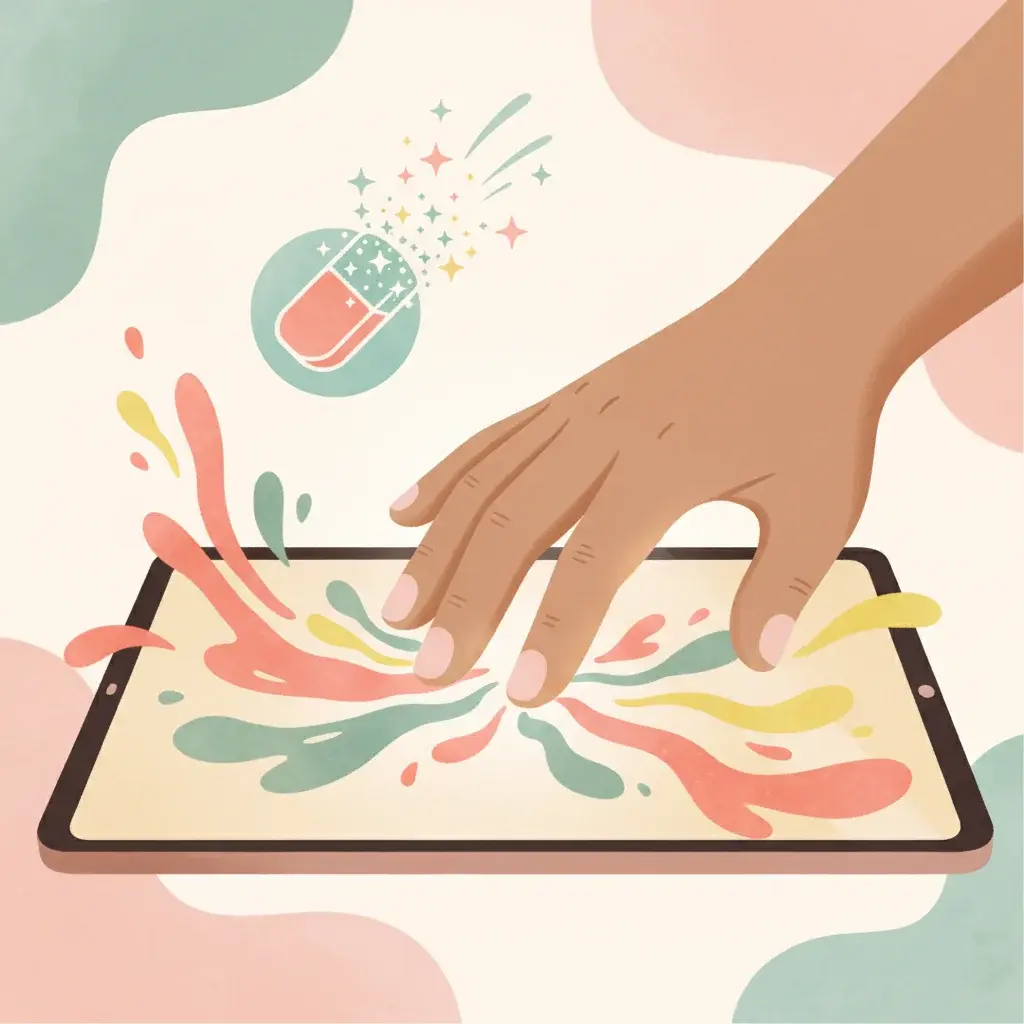
When you work on a digital canvas, every stroke can be undone. Every color can be changed. Every gesture can be erased and remade in a fraction of a second. This isn't just a software feature — it's a psychological safety net.
Amy Edmondson, a professor of leadership at Harvard Business School and the researcher who coined the term "psychological safety," defines it as a climate where people feel comfortable taking risks without fear of embarrassment or punishment. Her work, originally applied to teams and organizations, translates powerfully to creative expression: when the consequences of a "mistake" disappear, so does the inhibition that prevents you from making the first mark.
In a 2024 report, the American Psychological Association confirmed that psychological safety fosters creativity, innovation, and willingness to experiment — findings that align with what art therapists have long observed in clinical settings.
On a digital canvas, the undo button eliminates the "fear of the permanent mark" — the barrier that keeps non-artists frozen. The canvas becomes a playground, not a performance. There's nothing to ruin, because nothing is permanent.
This is the critical distinction between Daily Lemons and coloring apps like Calm or Colorfy. Coloring apps still have rules: stay inside the lines, choose the "right" palette, complete the pattern. There are lines to follow and a finished product to judge. Daily Lemons has no lines at all. The "Squeeze" gesture — the core interaction — is about releasing, not creating. There's nothing to "get right." You press, you move, you let go. The result isn't a picture to be evaluated. It's an art therapy process to be felt.
What is art therapy, really? It's a form of expressive arts therapy — a creative arts therapy approach that uses the bottom-up approach to healing, engaging the body and senses to process what the thinking mind can't reach. The therapeutic art isn't the output. It's the act itself.
Why "I Can't Draw" Is the Wrong Question
The question was never whether you could draw. The question is whether you can move your finger across a screen. If the answer is yes, you can do this.
Art therapy is not about artistic skill. It never has been. The American Art Therapy Association defines it as an integrative mental health profession that uses the creative process to improve physical, mental, and emotional well-being. Nowhere in that definition does the word "talent" appear.
In Daily Lemons, the gesture is closer to fidgeting than drawing for mental health. You're not being asked to think, plan, or compose. You're being asked to move — to let your fingers respond to what your body is feeling, not what your mind is directing. It's somatic, not aesthetic.
If you don't need to be good at drawing to benefit from art therapy, then skill was never the entry requirement. A pulse is. That's it. Does art therapy work for people who "can't draw"? That question misunderstands what art therapy for adults actually is.
For people with anxiety, this simplicity isn't a shortcut — it's the design. A stressed nervous system doesn't need more complexity. It needs less. One screen, one finger, no instructions. How to do art therapy in its simplest form? Open the app and move.
What a Session Actually Looks Like (No Talent Required)
If you're wondering how to start art therapy, here's what a three-minute Daily Lemons session involves:
You open the app. You choose an Intention Journey — a guided framework that matches a feeling or need, like "Grounding" or "Release." Then you place your finger on the screen and squeeze, stroke, or press. Colors bloom under your fingertip. The screen responds to your pressure, your speed, your direction. These are art therapy exercises stripped to their essence — no right answer, no grade, no audience.
No setup. No supplies. No cleanup. No yoga mat unfurled across the living room floor, no acrylic paint drying on your kitchen table, no special pencils to purchase. Just the device you already own and three minutes you'd otherwise spend scrolling.
This is what frictionless looks like. Traditional art therapy has extraordinary value, but it also has logistical barriers — materials cost money, studios need booking, and the physical mess can be its own source of stress for people who are already overwhelmed. Can you do art therapy without skills, without supplies, and without leaving your bed? On a screen, yes.
The tactile feedback matters too. The glass responds to your pressure, creating a sensory loop between finger and surface. You push harder, the color deepens. You lighten up, it softens. Your body is in conversation with the screen in a way that paper — which gives the same resistance no matter what — simply can't replicate.