He's tried everything. The breathing app that tells him to inhale for four counts and exhale for six. The CBT worksheet that asks him to identify the "cognitive distortion" in his thinking. The positive affirmations taped to his bathroom mirror. None of it stops the 3 AM spiral — the one where a minor work email replays on loop until it becomes evidence that he's failing at everything, simultaneously.
He's a product manager. Smart. Analytical. And completely stuck, because every tool he's been given asks his thinking brain to fix his panicking brain. That's like asking the fire to put itself out.
There's a different path. One that bypasses thinking entirely. It starts with your vagus nerve — and the most effective vagus nerve stimulation exercises might not be the ones you've read about. They might be in your fingertips.
Your Vagus Nerve: The Body's Built-In Panic Button
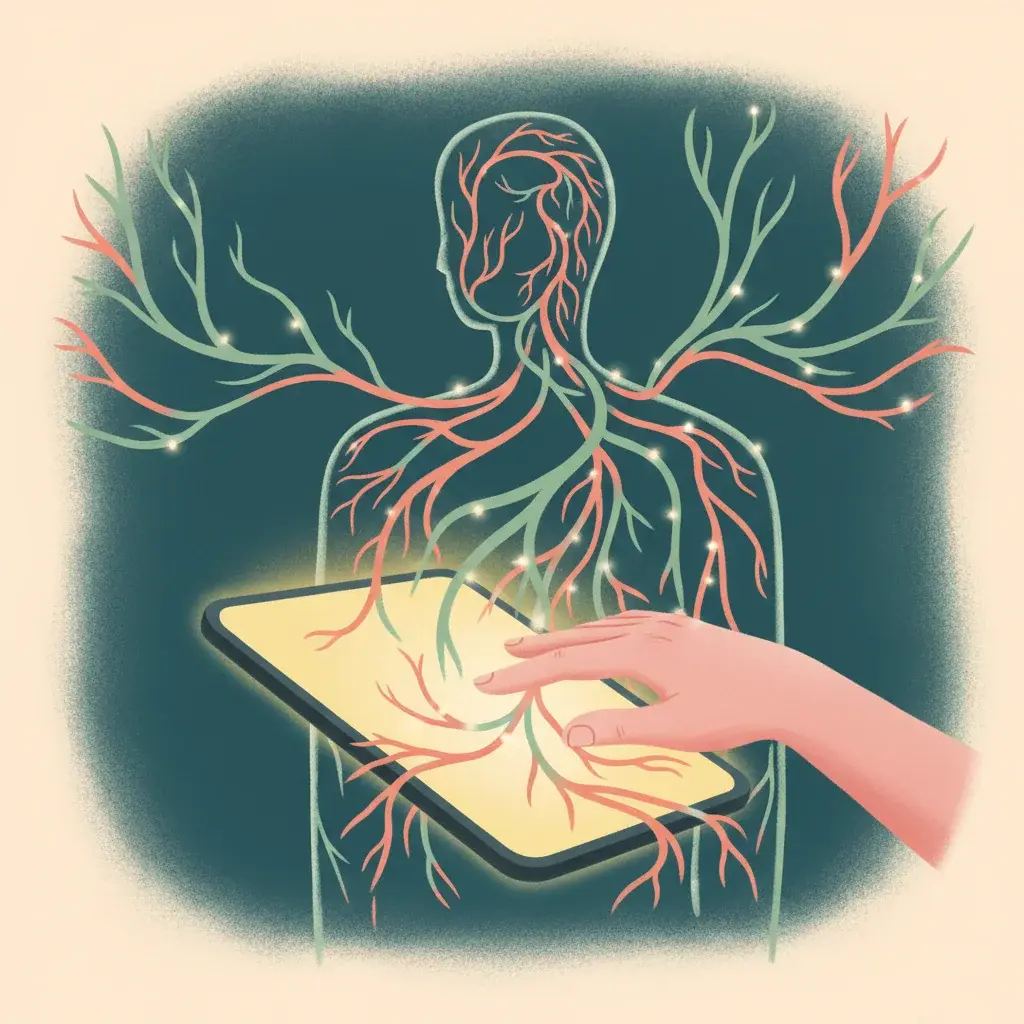
The vagus nerve is the longest cranial nerve in your body. It runs from your brainstem down through your neck, chest, and into your abdomen, connecting your brain to your heart, lungs, and gut. It's the primary channel of the parasympathetic nervous system — the "rest and digest" system that counterbalances the "fight or flight" response.
Stephen Porges, a neuroscientist at Indiana University, developed the Polyvagal Theory to explain how the vagus nerve governs three distinct states of the autonomic nervous system:
Safe and social (ventral vagal): you feel calm, connected, and able to engage with others. Your nervous system is regulated.
Fight or flight (sympathetic): you feel threatened. Heart rate accelerates, muscles tense, breathing becomes shallow. Your body is preparing to act.
Freeze (dorsal vagal): you feel overwhelmed or shut down. Energy drops, the body conserves resources, and you may feel numb or dissociated.
When you're panicking at 3 AM, your sympathetic nervous system is running the show. The vagus nerve is your off-switch — the pathway that shifts your body back toward safety.
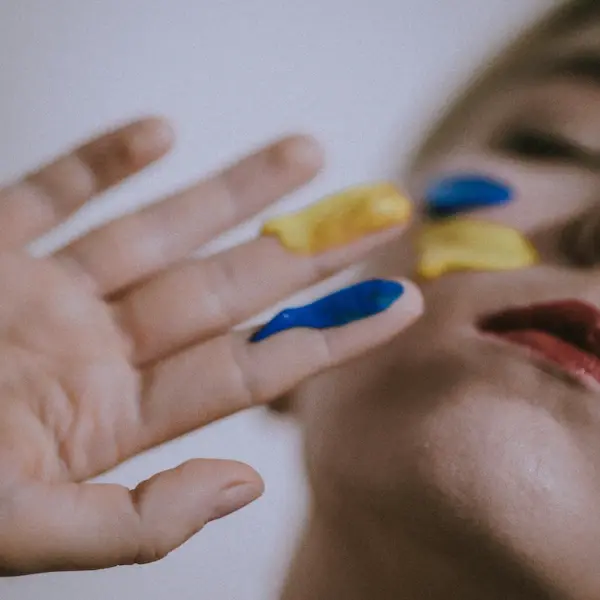
Most guides to vagus nerve stimulation will tell you to try cold water on your face, humming, gargling, or slow breathing. These all work. But there's an overlooked method backed by emerging research: repetitive tactile movement. Rhythmic finger strokes — the kind that activate the sensory-motor loop between your hand and your nervous system — can stimulate vagal tone in a way that requires no conscious breathing technique and no cognitive effort at all.
This is the foundation of sensory engagement in anxiety art therapy — and the mechanism behind why somatic grounding techniques are gaining traction among clinicians. It's a form of somatic therapy: a body-based therapy approach that works through sensation rather than conversation.
Why Touch Works When Thinking Fails
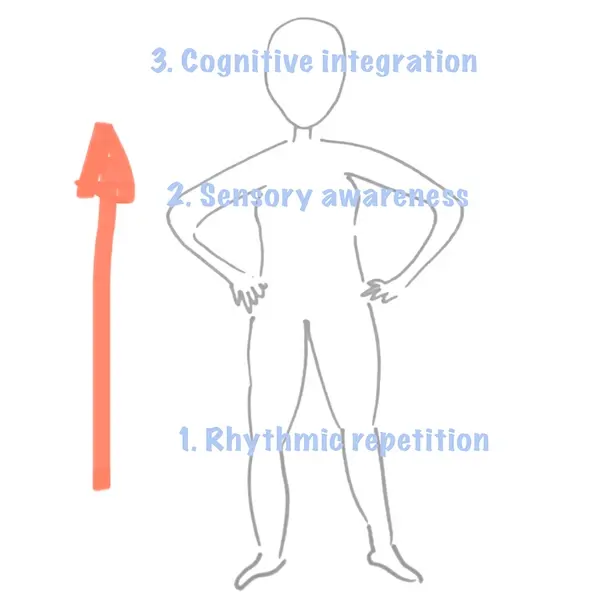
Here's the problem with most anxiety tools: they rely on top-down processing.
Top-down processing means using your prefrontal cortex — the brain's executive center for rational thought — to regulate the amygdala, the region responsible for fear and threat detection. This is what cognitive behavioral therapy does. It's what thought records, affirmations, and "rational" self-talk do. And under ordinary circumstances, it works well.
But during acute stress, the prefrontal cortex goes functionally offline. Research from Amy Arnsten's lab at Yale School of Medicine has demonstrated that even mild uncontrollable stress triggers a cascade of neurochemical changes — elevated catecholamines, altered signaling pathways — that weaken prefrontal network connections and shift executive control to the amygdala and other evolutionarily older brain structures (Arnsten, 2009, Nature Reviews Neuroscience). In plain terms: when you're panicking, the part of your brain that thinks shuts down, and the part that reacts takes over.
You cannot think your way out of a state where thinking has been disabled.
Bottom-up processing offers a different route. Instead of working from the mind down to the body, it works from the body up to the mind. Sensory input — touch, movement, rhythm — engages the motor cortex and somatosensory systems, which remain accessible even during acute stress. By calming the body first, you create the conditions for the prefrontal cortex to come back online.
This is what the bottom-up approach to healing looks like in practice. And it's the core principle behind art therapy for anxiety.
The Finger Stroke as Vagal Tonic
So how does moving your finger across a screen actually affect your nervous system?
Research on vagus nerve afferent stimulation — the sensory pathways that carry information from the body to the brain — shows that rhythmic tactile input activates vagal pathways and promotes parasympathetic regulation (Badran et al., 2018, Brain Stimulation). A study published in Behavioural Brain Research found that the specific characteristics of the tactile stimulus matter considerably: when vagus nerve stimulation was paired with brushing movements (rhythmic, directional strokes), the effect on sensory recovery was twice as large as when paired with static point pressure (Engineer et al., 2020).
The Daily Lemons "Squeeze" gesture uses exactly this kind of input: variable pressure, directional strokes, and self-paced rhythm. It's not tapping a "like" button. It's not scrolling passively through a feed. It's intentional, rhythmic, tactile movement — and the screen responds.
This is where digital proprioception comes in. The iPad's glass surface provides haptic feedback that paper cannot. When you press harder, the visual response deepens. When you lighten your touch, the color softens. The screen creates a sensory loop — a conversation between your finger and the surface — that engages proprioceptive systems in a way that flat, passive media doesn't.
Neuroscientists describe this kind of engagement as "dual attention" — the simultaneous focus on physical sensation and visual output. It's a mechanism similar to what powers bilateral stimulation art therapy — a technique that engages both brain hemispheres during trauma processing. It's one of the art therapy techniques that has roots in art therapy for trauma and EMDR. The finger moves. The screen responds. The nervous system listens.
And you don't have to think about any of it.
What the Overthinker Discovered at 3 AM
Let's return to the product manager. It's a Tuesday night. The email spiral has started again. He tried the breathing app — his mind wandered before the second exhale. He opened the CBT thought record — he couldn't focus long enough to identify the "distortion." His prefrontal cortex was offline, and every tool in his arsenal required it to be online.
He opened Daily Lemons instead. Not because he believed in it — because he was desperate enough to try something different. He chose the "Grounding" journey. Put his finger on the screen. Made a slow stroke. Then another.
Within 90 seconds, the tightness in his chest softened. Not because he "thought positive thoughts." Not because he "challenged the cognitive distortion." Because his vagus nerve responded to the rhythmic movement of his finger across glass. The motor cortex did the work that the prefrontal cortex couldn't.
He didn't understand the neuroscience in that moment. He didn't need to. His vagus nerve doesn't require an explanation — just a stimulus.
Right now, I'm feeling... Wired | Panicked | Heavy | I don't know
How to Start (It Takes Less Than You Think)
If you're wondering how does art therapy work, or whether art therapy for stress is really effective — the honest answer is that you don't need to understand the neuroscience for it to help. Your nervous system doesn't need a lecture. It needs input.
Here's what starting looks like: download Daily Lemons, choose a journey, and move your finger. No guided meditation voice telling you to "observe your thoughts." No journal prompt asking you to describe your feelings. No therapist appointment to schedule. Just movement and color.
The art therapy benefits aren't in the result — they're in the process. Among the many art therapy techniques for anxiety, the squeeze stands out because it asks nothing of the thinking mind. The rhythm of your finger. The pressure against the glass. The colors that emerge without you planning them. Your body processes while your mind rests.
If you want a complementary technique, mind mapping is another way to channel anxious energy through visual structure. But the beauty of the squeeze is its simplicity: no structure required. No artistic skill needed — even if you've never considered yourself creative.
Your nervous system responds to what your body does, not what your mind thinks. The vagus nerve is the bridge between touch and calm. And the reset is already in your hands.