A stress buster is a quick action that helps lower stress intensity in the moment. The best stress buster is usually the one you can do right away, such as a long exhale, cold water, a posture reset, or a simple grounding task.
Stress rarely asks for permission before it shows up. One minute you are fine, and the next your jaw is tight, your thoughts are racing, or your chest feels a little crowded. In that kind of moment, the best stress buster is not always the deepest one. It is often the one you can actually do right now.
This ranked list focuses on two things only: how little time a method takes, and how likely it is to help in the moment. Some options work through your breath. Others work through your body. A few give your mind a smaller, safer task. If you want a broader picture of ongoing relief, you can also read how to reduce stress. Here, the goal is simpler: quick steadiness, fast.
How this stress buster ranking works
This list is ranked by a blend of time to start and likely immediate effect. A method placed higher is usually easier to begin under pressure and more likely to create a noticeable shift within a few minutes. That does not mean it will be best for every person or every kind of stress.
For example, a body-based method may help faster when you feel keyed up, shaky, or physically tense. A mental focusing method may help more when the main problem is scattered thinking. If you are not sure whether what you feel is stress, anxiety, or something else, this guide on stress symptoms can help you sort out the pattern.
Signs you might need a stress buster (and when to get extra support)
A quick stress buster is most useful when your system is asking for an interruption, not a full life overhaul. If you are unsure whether you are at that point, a few common stress signals can help you recognize it sooner, before it snowballs.
A quick stress buster checklist of common stress signals
- Physical: tight jaw or neck, raised shoulders, stomach fluttering, shallow breathing, feeling hot or flushed, headache pressure, restless legs, clenched hands, chest feeling crowded.
- Mental: racing thoughts, looping worries, feeling scattered, blanking out, feeling like everything is urgent at once, difficulty deciding what to do next.
- Behavioral: snapping more easily, withdrawing, doom-scrolling, pacing, overchecking messages, procrastinating because your mind feels too loud to start.
If you recognize one or more of these, you might use a quick tool when you need a fast drop in intensity, a return to the present, or a small sense of control in the next five minutes.
When to seek help now
Some situations are bigger than a stress buster. If you have urgent physical symptoms like chest pain, trouble breathing, fainting, or severe weakness, treat that as medical urgency and contact local emergency services. If you feel unsafe, have thoughts of harming yourself, or panic feels like it is escalating beyond what you can manage, contact local emergency services or an appropriate crisis resource immediately.
When it may be time to book extra support
Quick tools can still be helpful, but consider reaching out for qualified support if stress is persistent, worsening, or regularly affecting sleep, work, relationships, eating, or daily functioning. If you are relying on quick relief many times a day just to get through routine moments, that is often a sign you deserve more support than a two-minute reset.
Match your stress buster signal to a tool type
When you are stressed, choosing can feel harder than doing. This quick mapping can help you pick faster.
- Body tension (jaw, shoulders, fists): posture release, mini muscle release, hand self-massage, gentle stretching.
- Heat, agitation, panic-like activation: cold water, a brisk walk, shaking out tension, a strong exhale pattern.
- Racing thoughts or mental spirals: 5-4-3-2-1, counting backward, naming the next one thing, simple repetitive music.
- Feeling spaced out or not fully present: sensory grounding, cold water, noticing color and texture in the room, a small tactile object in your hand.
Stress buster comparison
| Rank | Stress buster | Typical time | How fast you may feel a shift | Best for | Main caution |
|---|---|---|---|---|---|
| 1 | Physiological sigh | 30 to 60 seconds | Very fast | Sudden stress spikes, breath-holding, mental overload | May feel awkward in public |
| 2 | Cold water on hands or face | 30 to 90 seconds | Very fast | Heat, panic-like activation, sharp agitation | Not ideal if cold is physically uncomfortable for you |
| 3 | Unclench and drop your shoulders | 20 to 45 seconds | Fast | Jaw tension, neck tightness, desk stress | Easy to forget when very stressed |
| 4 | 5-4-3-2-1 sensory reset | 2 to 4 minutes | Fast | Racing thoughts, dissociation, overwhelm | Needs some attention and a workable environment |
| 5 | Fast walk or stair burst | 3 to 5 minutes | Fast to moderate | Restlessness, frustration, trapped energy | Not always possible in work or school settings |
| 6 | Box breathing | 2 to 4 minutes | Moderate | Steadying after the first spike | Can feel effortful if you are already breath-focused |
| 7 | Shake out tension | 1 to 3 minutes | Moderate | Stress stored in arms, hands, shoulders, legs | May feel self-conscious around others |
| 8 | Tiny creative scribble reset | 3 to 5 minutes | Moderate | People who hate blank-page journaling | Works better with a pen and paper nearby |
| 9 | Name the next one thing | 1 to 2 minutes | Moderate | Task overload, decision fatigue | Less helpful if the stress is mostly physical |
| 10 | Mini muscle release | 3 to 6 minutes | Moderate | Body tension at bedtime or after long sitting | Takes slightly longer than the others |
5-minute stress busters you can do anywhere
The ranking above helps you pick a tool. Sometimes you also need a tool that fits your setting. Here are short options for common moments, including alternatives if you cannot leave your seat.
Stress buster ideas at a desk or during work stress
- Hand self-massage (1 to 3 minutes): press your thumb into the center of your palm, then slowly trace around the base of each finger. Pair it with one slow exhale. This is subtle, and it targets the small muscles that often tighten during screen time.
- Shoulder release (30 to 60 seconds): lift your shoulders toward your ears, hold briefly, then drop them and open your hands. Repeat two times. It can help if you are stuck in a guarded posture.
- Music with headphones (2 to 5 minutes): one song can give your attention a single track to follow, especially if your mind is jumping between tasks. Choose something that feels steady rather than intense.
Stress buster ideas in public (transit, lines, waiting rooms)
- Counting backward (30 to 90 seconds): count backward from 50 by ones, or from 100 by threes if you want more focus. The goal is gentle attention, not perfection.
- Subtle sensory grounding (1 to 2 minutes): feel your feet inside your shoes, notice three colors in your field of view, and press your fingertips together once on each exhale. It is quiet, and it does not draw attention.
Stress buster ideas at bedtime or when you cannot sleep
- Gentle stretching (2 to 5 minutes): try a slow neck tilt, a shoulder roll, or a calf stretch against the wall. Keep it mild. Bedtime is usually not the moment to push range of motion.
- Mini muscle release (3 to 6 minutes): if your body feels wound up but you are too tired to move much, this is often more doable than a brisk walk.
If you cannot leave your seat
- Seated leg press (20 to 40 seconds): press your feet into the floor as if you are trying to stand without standing, then release. Repeat twice. It gives your body a sense of action without needing space.
- Cold cue without water (30 to 60 seconds): hold a cool drink, touch a cool surface, or step near a fan or air vent if available. A small temperature shift can still help.
- Micro-shake (15 to 30 seconds): shake one hand under a desk, then the other. It is a small version of the full shake-out.
Privacy, overstimulation, and physical limitations matter here. If a technique makes you feel more exposed, dizzy, or flooded, scale it down. Smaller is still valid, especially in a packed day.
1. Physiological sigh

This is a very short breathing pattern: inhale through the nose, take a second small top-up inhale, then exhale slowly and fully. It often helps because stress can shorten the breath without you noticing. A longer exhale may send your body the message that the immediate danger has passed.
Why it ranks first: it is fast, private enough, and does not require equipment or much focus. You can do one to three rounds almost anywhere. The main benefit is speed. The caveat is that some people dislike any breath practice when they already feel overly aware of breathing. For background on breathing and stress, the National Institute of Mental Health notes that stress can affect both mind and body.
2. Cold water on hands or face
A quick temperature shift can interrupt a stress spiral by giving your nervous system something strong and concrete to respond to. Cold water on your hands, wrists, or face may help you feel more present, especially if your stress feels hot, sharp, or panicky.
Why it ranks so high: the effect can be immediate, and the action is simple. It works especially well for people who need a physical reset more than a reflective one. The caveat is comfort. If cold feels jarring or unpleasant, a cool washcloth or even stepping into cooler air may feel better.
3. Unclench and drop your shoulders
Stress often hides in ordinary posture. Jaw gripping, raised shoulders, a tight tongue, locked knees, and clenched hands can quietly tell your body to stay on guard. A brief posture reset can soften that loop.
Why it ranks here: it takes almost no time and can be done during a meeting, on public transit, or while standing in line. Try relaxing your jaw, lowering your shoulders, opening your hands, and exhaling once. The caveat is that this works best if you catch tension early. If stress is already very high, you may need a stronger sensory tool first.
4. 5-4-3-2-1 sensory reset
This method guides attention outward: five things you can see, four you can feel, three you can hear, two you can smell, and one you can taste. The point is not to perform it perfectly. The point is to give your brain a structured task that is anchored in the present.
Why it ranks fourth: it is highly practical and often helpful when thoughts are looping or you feel far away from yourself. It may also help when you want a nonverbal way back into the room. The caveat is that it takes a bit more concentration than the top three options, so it may be harder during intense overwhelm.
5. Fast walk or stair burst
Some stress feels like trapped movement. If your legs feel buzzy, your chest feels crowded, or you want to pace, a brisk two- to five-minute walk can help discharge some activation. Stairs can work too if that feels safe and accessible for you.
Why it ranks well: moving your body gives stress somewhere to go. It can also break the feeling of being pinned to one place or one thought. The caveat is setting. It is not always practical during caregiving, class, or a packed workday. If you can step away, though, it may help faster than a purely mental technique.
6. Box breathing

Box breathing means inhaling, holding, exhaling, and holding again for the same count, often four counts each. It creates rhythm and can help you settle after the first edge of stress has come down.
Why it lands in the middle: many people find it steadying, but it usually asks a bit more of you than a simple long exhale. It can feel structured in a good way, especially if your mind needs order. The caveat is that breath retention does not suit everyone. If the holds feel uncomfortable, shorten them or skip this method.
7. Shake out tension
This is exactly what it sounds like. Shake your hands, arms, shoulders, or legs for a short burst, then pause and notice the difference. It may look a little silly. It can still work.
Why it ranks here: it is quick, body-led, and useful for agitation that feels stuck in your limbs. For some people, especially those who struggle to think their way out of stress, movement is easier than reflection. The caveat is privacy. If you feel self-conscious, even a subtle hand shake under a desk can be a gentler version.
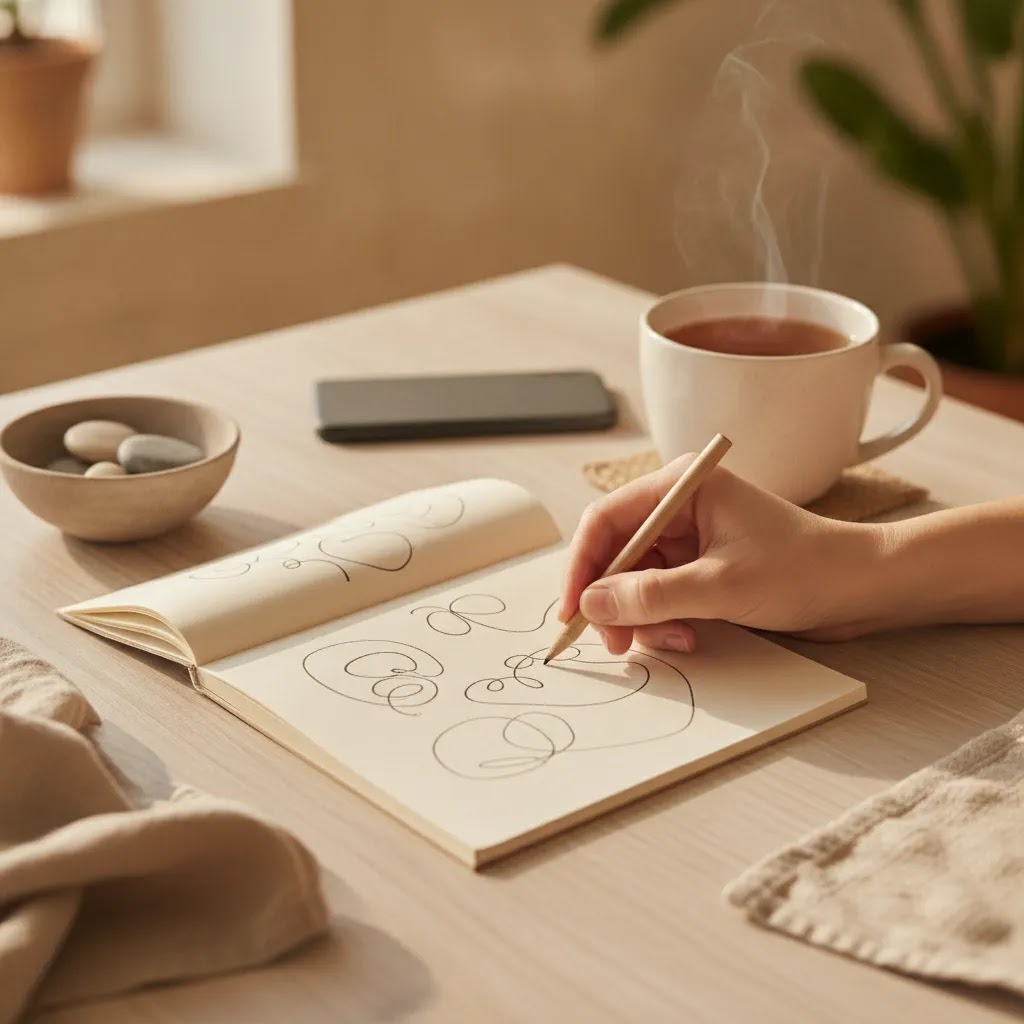
8. Tiny creative scribble stress buster
Take a pen and make quick marks for 20 to 30 seconds. Then turn one part of the scribble into a shape, object, or pattern. You are not trying to make art. You are giving stress a container and your attention a softer job.
Why it belongs on this list: it offers an active, nonverbal reset for people who do not want to sit still or write about their feelings. That is part of why many readers are drawn to topics like art therapy singapore, what is art therapy, and other creative support approaches. The caveat is access. This works best if paper or a notes app is close by.
9. Name the next one thing
Stress gets louder when everything feels equally urgent. Naming just one next action can reduce mental pileup. The step should be tiny and specific: send one email, fill one water bottle, open one document, stand by the window for one minute.
Why it makes the list: this can be surprisingly effective for overload that comes from too many decisions at once. It shrinks the field. The caveat is fit. If your stress is more physical than mental, a body-based stress buster may help first, followed by this one after you feel steadier.
10. Mini muscle release
Tense one area gently, such as your fists or shoulders, for a few seconds, then release. Repeat through two or three body areas. This is a shortened version of progressive muscle relaxation, which some people find helpful before bed or after long hours of sitting.
Why it still earns a place: it is reliable, simple, and good for body tension that has built up quietly over time. It ranks lower only because it usually takes a little longer and may feel less immediate than cold water or a fast exhale. Still, for evening stress, it can be one of the more comfortable options.
Stress buster pros and cons
Stress buster strengths
- Most quick stress busters can be done in under five minutes.
- Several options are private enough for work, school, or public settings.
- They offer different entry points: breath, movement, senses, posture, and focus.
- They can help lower the barrier to doing something supportive instead of freezing.
- They may work well as first-step tools before longer practices or conversations.
Stress buster considerations
- No single stress buster works for everyone or every kind of stress.
- Fast relief does not always address the cause of ongoing overload.
- Some techniques may feel uncomfortable if you are highly activated, overstimulated, or breath-sensitive.
- Environmental limits may make certain options harder to use in the moment.
Other stress busters that can work well (but did not make the top 10)
The ranked list focuses on a tight set of options that are easy to remember. Still, many people want a broader menu, especially for situations where breathing or walking is not the right fit. These can be useful additions, even if they are not always enough on their own for recurring stress.
Listen to music
Music can give your attention a single track to follow, which may help when your mind is spiraling or jumping between worries. It also sets a pace for your breathing and movement without asking you to do anything “correct.” The limitation is context. Music is not always available, and certain songs can intensify feelings rather than steady them.
Counting backward
Counting backward is a structured task that may pull you out of mental loops. You can count down by ones for simplicity, or by threes for more focus. The limitation is that it can feel frustrating if you are tired or distracted. If you lose your place, that is fine. Restarting is part of the tool.
Hand self-massage
Hands often carry stress quietly, especially if you type, grip a steering wheel, or clench without noticing. Slow pressure through the palm and fingers can be calming and private. The limitation is that it may not touch bigger waves of activation. It is often best as a small first step, or paired with a long exhale.
Chew gum
Chewing can be a simple sensory anchor, and it may help some people feel a little more grounded in public settings. The limitation is that it is not right for everyone, including people with jaw pain or people who find chewing overstimulating. It also tends to be subtle relief, not a full reset.
Step into sunlight or brighter light
Light can shift your state quickly, especially if you have been indoors, slumped at a desk, or feeling low-energy stress. Even a one-minute window break can be a useful cue that the moment is changing. The limitation is obvious. Weather, timing, and your environment may not cooperate, and light is not a substitute for addressing what is driving the stress.
Build a personal short list
If stress hits you in different ways, relying on only one technique can backfire. Many people do better with two to three options from different categories, such as one body tool (cold water or posture release), one attention tool (5-4-3-2-1 or counting), and one sensory or comfort tool (music or hand massage). That way, you have a backup when your usual go-to does not fit the moment.
How to choose the right stress buster
If you are new to this, it may help to match the method to the kind of stress you feel rather than searching for one perfect answer. A stress buster is simply a short action that may interrupt the stress response enough for you to regain a little space and choice.
Start with the signal your stress buster needs to meet
Start with your main signal. If the stress feels physical, such as tight muscles, buzzing energy, heat, or shallow breathing, begin with a body or sensory tool. Cold water, a fast walk, a shoulder drop, or a mini muscle release may feel more natural than a thinking exercise.
On the other hand, if the stress feels mental, such as looping thoughts, overwhelm, or too many tasks competing at once, try a structured attention tool. The 5-4-3-2-1 reset or naming the next one thing may help reduce internal noise.
If words feel far away, creative and visual methods can help you start without explaining everything. That is one reason some people explore resources in Digital Art Therapy & Apps or broader support for Anxiety, Stress & Emotional Wellness. A tiny drawing or scribble may be easier than a page of writing.
Build a bigger plan if you need more than a stress buster
If stress is becoming frequent, it may help to zoom out and look at patterns. You might explore how to reduce anxiety if your stress often carries dread or body alarm. You could also read how to manage stress if you want a more complete plan. Quick tools are useful, but they work best as part of a larger support picture when stress keeps returning.
Some days, sitting still to meditate or facing a blank journal page can feel like too much to ask of yourself, and that's where Daily Lemons hopes to help. Rather than pushing you toward stillness or words, it offers small, guided visual practices designed to feel more approachable when your feelings are hard to put into language. Take a look around the site if you're curious, you might find that this softer, more creative path suits your pace and your nervous system better than the usual routes.
Keep your stress buster practical and small
If you want one extra step that can make quick tools work better, try naming the stressor in one sentence, then naming one controllable move. For example: “I am stressed because I have too many messages to answer.” One controllable move could be: “I will reply to the easiest one, then take a two-minute walk.” This keeps the stress buster from becoming the only plan, and it gently reconnects you to choice.
Social support can matter too. If your nervous system settles faster around safe people, one stress buster could be sending a simple text like “Do you have five minutes?” or sitting near someone you trust. However, be cautious about coping methods that can create new problems, such as relying on alcohol, nicotine, or other substances for quick relief. They may change how you feel temporarily, but they often come with tradeoffs and can make stress patterns harder over time. For a broader overview of stress and daily coping, the CDC offers practical mental health resources.
Frequently Asked Questions
What is a stress buster?
A stress buster is a short action that may help interrupt stress and create a small sense of relief or control. It does not have to remove the cause of stress. It simply helps your body or mind shift enough to get through the next few minutes with a little more steadiness.
What is the best stress buster for beginners?
Beginners often do best with very simple options that take almost no setup. A long exhale, shoulder drop, cold water, or a brief sensory reset are usually easy starting points. The best choice depends on whether your stress feels more physical, more mental, or more like a mix of both.
How fast can a stress buster work?
Some stress busters may create a noticeable shift within 30 seconds to two minutes, especially body-based ones. Others work more gradually over three to five minutes. Fast help does not always mean you will feel fully calm. It may simply mean the intensity drops enough for you to think more clearly.
Can a stress buster help with anxiety too?
Sometimes, yes. Stress and anxiety can overlap in the body, especially through tension, shallow breathing, restlessness, or racing thoughts. A quick grounding or breathing tool may help in both cases. Still, ongoing anxiety may need a broader plan than momentary relief tools alone.
Why do body-based stress busters often work quickly?
Stress is not only a thought pattern. It can also show up as activation in the body. A physical action, such as cooling the skin, releasing tension, or walking briskly, may be easier to access when your mind feels too busy for reflection. For many people, action is a more available doorway than analysis.
Do stress busters replace therapy or medical care?
No. Quick stress busters are self-support tools, not a replacement for professional care. They may help with day-to-day stress or brief waves of overwhelm, but persistent distress, worsening panic, sleep problems, or safety concerns call for qualified support. If symptoms feel severe or urgent, seek immediate help.
What if breathing exercises make me feel worse?
That can happen. Some people become more uncomfortable when attention goes directly to the breath. If that is true for you, try a sensory or movement-based option instead, such as cold water, a fast walk, posture release, or a visual grounding task. You do not have to force one type of tool to work.
How do I know whether I need quick relief or a larger stress plan?
In a moment of overwhelm, a quick tool can genuinely help you catch your breath. But when stress keeps showing up night after night, chipping away at sleep, focus, relationships, or your ability to get through the day, that's usually a sign something bigger needs attention. It's worth pausing to look at the fuller picture: your routines, what's triggering the stress, how much you're carrying, the support around you, and whether you're getting real recovery time. Feeling steady in the moment matters, but so does tending to what's underneath it.
What are good stress busters?
Good stress busters are short actions that you can actually do under pressure. Many people respond well to a long exhale pattern (like the physiological sigh), a temperature shift (cold water), a posture release (drop shoulders and unclench), a sensory reset (5-4-3-2-1), or a short burst of movement. The best ones for you are usually the ones you will remember and use, not the ones that sound most impressive.
How to remove stress quickly?
You may not be able to remove stress instantly, especially if the cause is still present. What you can often do quickly is reduce the intensity. For a fast shift, try one to three rounds of a physiological sigh, cold water on hands or face, or a brief posture reset. If your mind is looping, structured attention tools like 5-4-3-2-1 or counting backward can help narrow the mental noise for a few minutes.
What are the signs you need a stress buster?
Common signs include jaw or shoulder tension, shallow breathing, a hot or buzzy feeling in the body, racing thoughts, trouble focusing, irritability, doom-scrolling, or feeling like you cannot start the next task. If you notice these early, a quick tool can help interrupt the build-up before it becomes a bigger spiral.
What is a stress buster (meaning)?
Stress buster is another way of saying a small, quick action that can “bust” a stress spike. It is not meant to solve everything. It is meant to help you shift state enough to make a clearer next choice.
How these stress busters were ranked
This ranking used two practical criteria: how quickly a method can be started, and how likely it is to create an immediate felt shift for an average reader under mild to moderate stress. Methods that needed no equipment, little privacy, and minimal cognitive effort scored higher.
The list also favors techniques that are easy to remember when you are already overloaded. That matters because a good stress buster is not only about theory. It needs to be usable in real life, including at a desk, between errands, after a difficult conversation, or before bed. Results may vary based on your stress level, environment, health, and personal preferences.
Quick stress buster recap
If you want the shortest path to relief, start with the top of the list: physiological sigh, cold water, or a quick posture release. If your thoughts are the loudest part, try 5-4-3-2-1 or naming the next one thing. If words feel heavy, a small creative reset may be the gentlest doorway.
| Rank | Stress buster | Best for | Typical time |
|---|---|---|---|
| 1 | Physiological sigh | Fastest all-around reset | 30 to 60 seconds |
| 2 | Cold water on hands or face | Sharp physical activation | 30 to 90 seconds |
| 3 | Unclench and drop your shoulders | Desk and posture tension | 20 to 45 seconds |
| 4 | 5-4-3-2-1 sensory reset | Racing thoughts | 2 to 4 minutes |
| 5 | Fast walk or stair burst | Restless stress energy | 3 to 5 minutes |
| 6 | Box breathing | Structured calming | 2 to 4 minutes |
| 7 | Shake out tension | Agitation in the limbs | 1 to 3 minutes |
| 8 | Tiny creative scribble reset | Nonverbal relief | 3 to 5 minutes |
| 9 | Name the next one thing | Decision overload | 1 to 2 minutes |
| 10 | Mini muscle release | Slow body unwinding | 3 to 6 minutes |
Key Takeaways
- The best quick stress buster is often the one that matches your current state, not the one that sounds most impressive.
- Body-based methods usually work fastest when stress feels physical or intense.
- Attention-based methods can help when your main struggle is mental overload.
- Creative, low-pressure tools may be easier than journaling for some people.
- Quick relief matters, but repeated or worsening stress may need broader support.
Conclusion
You do not need a perfect ritual to interrupt stress. You may only need one small action that feels possible in the moment. That is the real value of a quick stress buster. It gives you a way to respond before the spiral gets bigger.
If you are not sure where to begin, start with the top three and notice which kind of relief your system responds to most easily: breath, temperature, or posture. Then keep that option close. If words make stress harder, not easier, a gentle creative approach through Daily Lemons may be worth exploring in your own time, with no pressure to explain everything first.
A quick note before you read on: what's shared here is meant to inform, not to stand in for professional medical or mental health guidance. Everyone responds differently to stress-relief techniques, so what soothes one person might not do much for another, and that's okay. If what you're feeling, whether it's anxiety, panic, trouble sleeping, or emotional heaviness, sticks around, deepens, or starts making daily life harder to manage, please reach out to a licensed professional who can offer real support. And if things ever feel urgent, like chest pain, difficulty breathing, or thoughts of hurting yourself, don't wait: contact emergency services or a crisis line right away.