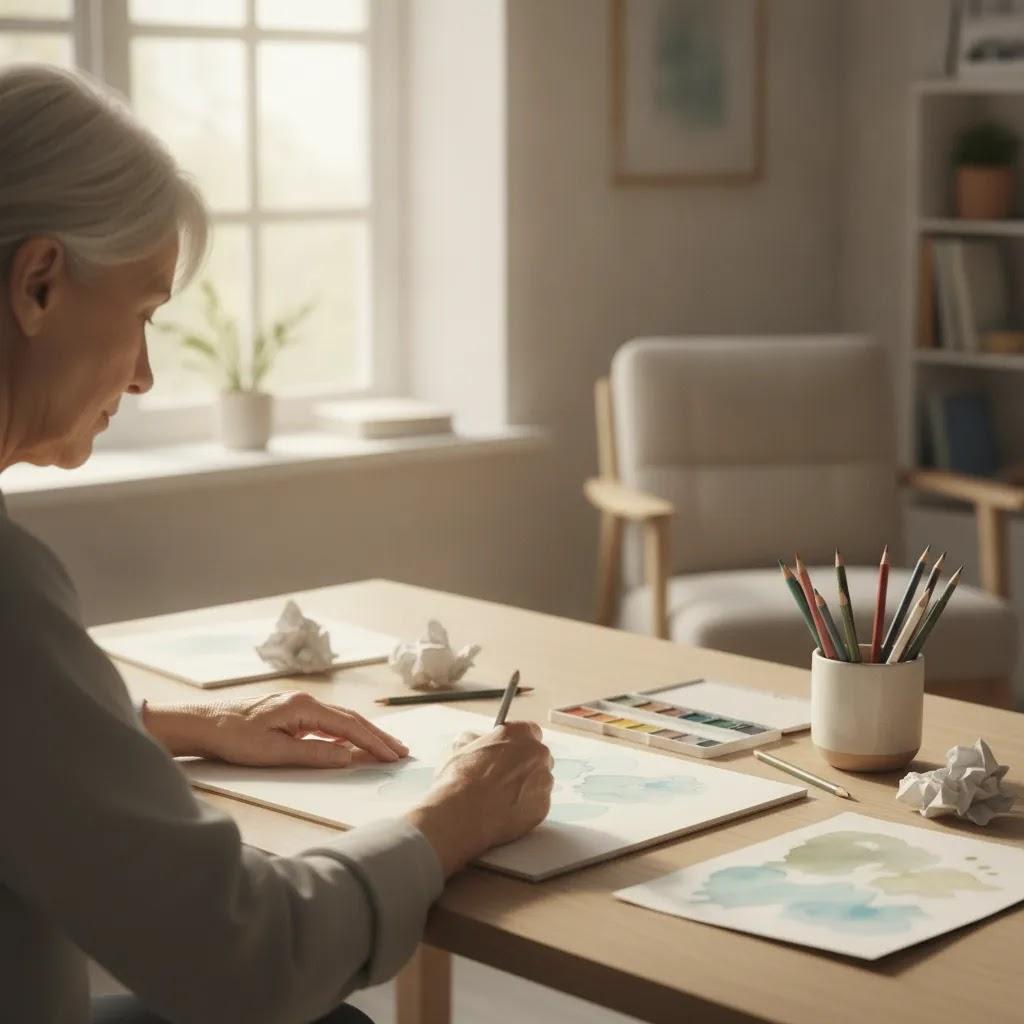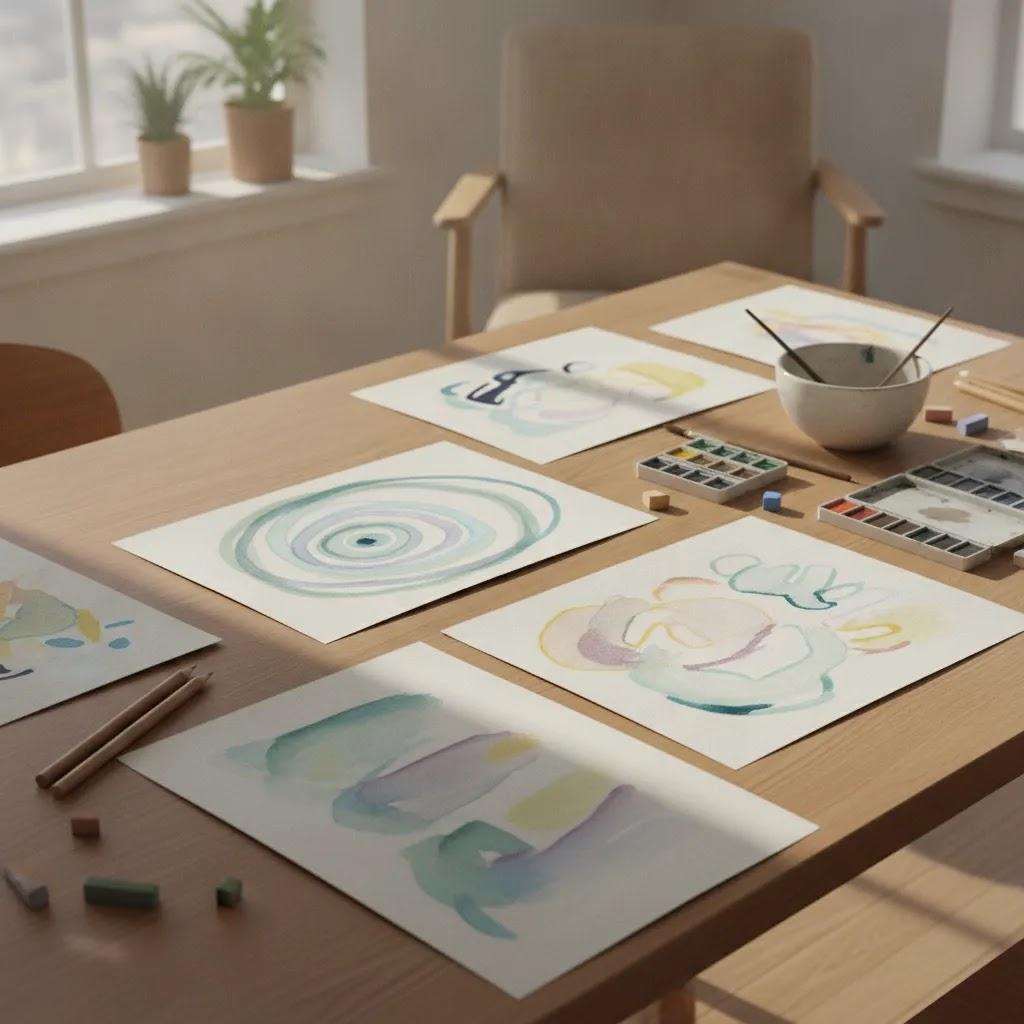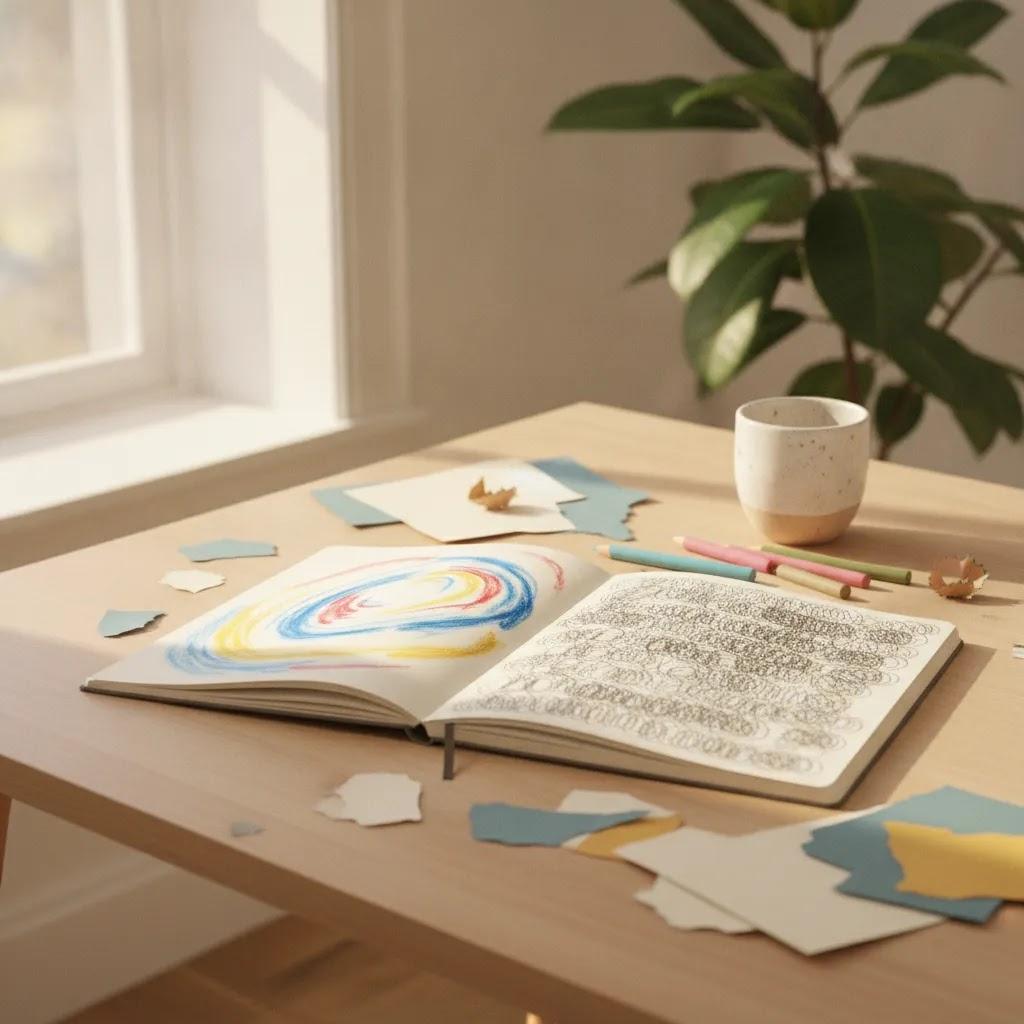
Art as therapy means using the process of making art to explore, express, and steady your inner experience, without needing to treat the artwork like a diagnosis or a clinical tool. In this non-clinical sense, the value is not in making something impressive. It is in giving shape to what you feel.
This idea is broader than formal therapy. It can include drawing to settle your breathing, using color to notice mood, or making a collage that helps you hold grief, stress, or confusion outside your body for a moment. If you are also curious about the professional role of an art therapist, that is a related but different question. Here, the focus is simpler: what people usually mean when they say art can be healing, even outside a clinical setting.
A plain-language definition
People often use the phrase art as therapy to describe art-making that supports emotional release, reflection, grounding, or self-understanding. It does not always mean a licensed therapeutic service. Often, it means the act of creating itself feels supportive.
That difference matters. Formal art therapy is a credentialed practice with trained professionals, goals, and ethical boundaries. Art as therapy, by contrast, is a philosophy of healing through creative process. It treats art less like a performance and more like a place to notice what is happening inside you.
This can look very ordinary. A page of repeated lines after a hard day. A swirl of dark color that helps anger move. A small drawing made before sleep because words feel too sharp. In that sense, art becomes a companion for feeling, not a test of talent.
For a broader view of methods in this area, you may also want to read about different art therapy approaches and explore the wider Art Therapy Fundamentals category.
Why making art can feel healing
The healing effect usually comes from process, not artistic quality. Many people find that visual expression asks less of them than talking or structured writing. You do not need to explain everything first. You can start with a mark, a color, or a shape.
Externalizing feeling
When a feeling goes onto paper, it may become more observable and less tangled. You are no longer carrying it only inside. Even a rough image can create a little space between you and the emotion.
Using the body, not just words
Art-making is physical. Your hand moves. Pressure changes. Breath may slow. Repetition can create rhythm. This is one reason some people reach for image-making when journaling feels too effortful or meditation feels too still.
Working through symbols
Images can hold meaning without forcing direct explanation. A storm, a cage, a bridge, a cracked teacup, a yellow corner of light. Symbolic language can feel gentler than saying everything outright, especially when experience is tender or unclear.
Inviting reflection after the moment
Art often helps twice. First while you make it, because attention has somewhere to go. Then later, because the image gives you something to return to. You may notice patterns, shifts, or needs you could not name at the time.
The core ingredients of art as therapy
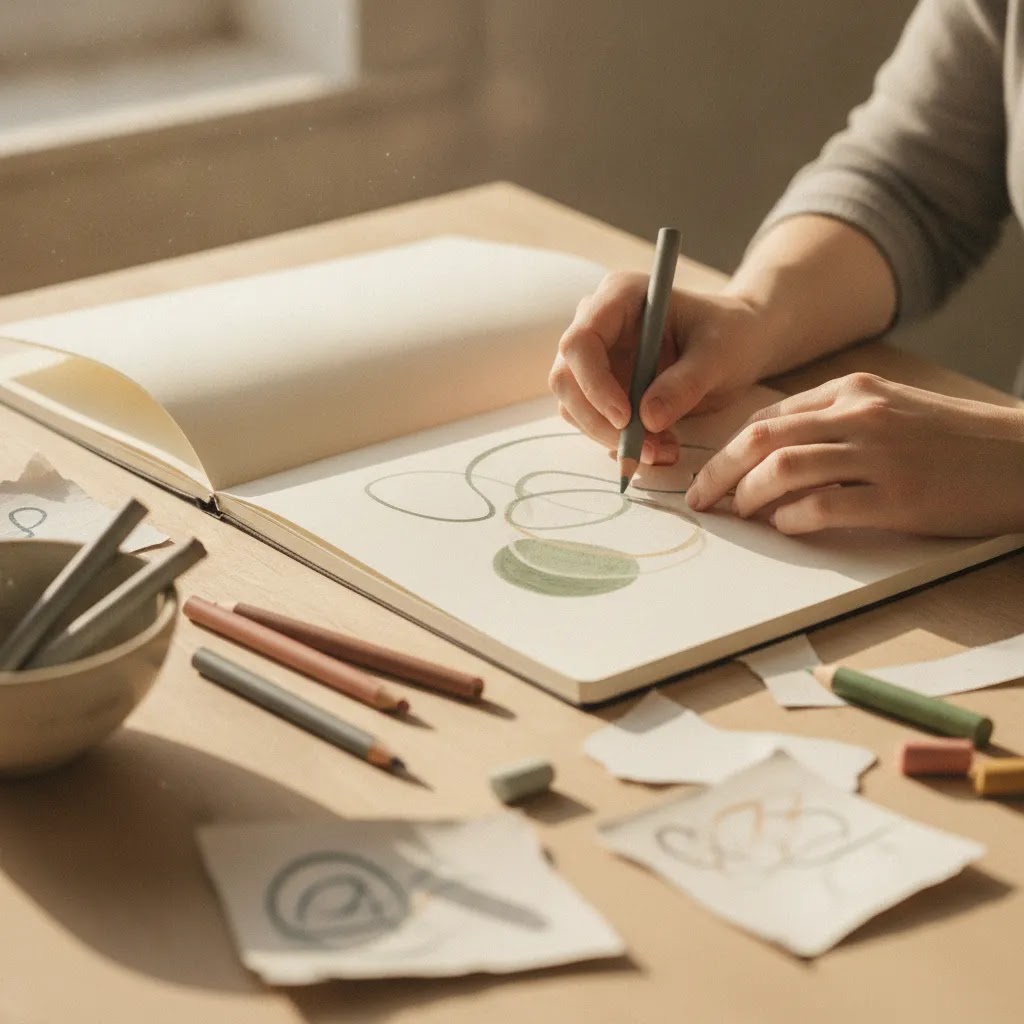
If you strip away the clinical language, art as therapy usually includes a few recognizable elements:
- Expression: giving mood, tension, memory, or energy a visible form
- Containment: placing difficult feeling inside a page, shape, border, or image
- Sensory focus: noticing texture, movement, pressure, color, and rhythm
- Meaning-making: seeing personal symbolism or emotional truth in what appears
- Permission: allowing mess, incompletion, or uncertainty without grading it
Mini glossary
- Externalization: putting an inner experience outside yourself in visible form
- Embodiment: using physical movement and sensory feedback as part of expression
- Symbolic language: showing something through metaphor or image rather than direct explanation
These ideas also overlap with expressive art therapy, though that term can include more than visual art alone. If you want a wider multi-modal view, you can also explore expressive arts therapy.
Why this idea matters in everyday life
Many people are not looking for a clinical label. They are looking for a way to be with what hurts without forcing a polished explanation. That is where art as therapy can matter.
It offers a softer entry point for stress, burnout, heartbreak, grief, insomnia, emotional overload, and the vague heavy states that are hard to describe. It may also feel more accessible for people who think visually, process slowly, or struggle to identify feelings in words.
That does not make it a cure. It is simply a humane method of contact. Sometimes that contact is enough to help you soften, organize, or notice what needs care next.
If you are curious about digital versions of this kind of guided practice, the Digital Art Therapy & Apps category may be a useful next stop. Daily Lemons itself is built around short, guided drawing experiences that support emotional exploration without pressuring you to perform or explain too much. If stress is the main thing bringing you here, you may also find support in this guide to anxiety and stress relief.
Art as therapy vs formal art therapy
These terms overlap, but they are not interchangeable.
- Art as therapy usually means self-guided or lightly guided healing through creative process.
- Formal art therapy refers to a professional service provided by a qualified practitioner.
One is a broad human practice. The other is a defined professional discipline. Both can matter. They simply serve different roles.
This also differs from wider multi-modal work. If you want that distinction spelled out, see expressive arts therapy vs art therapy. The short version is that art as therapy often centers the personal healing value of making visual art, while other approaches may include movement, music, drama, or a clinician-led treatment structure.
| Term | How the article describes it | Typical context |
|---|---|---|
| Art as therapy | Self-guided or lightly guided healing through creative process | Non-clinical personal practice |
| Formal art therapy | Professional service provided by a qualified practitioner | Defined therapeutic service |
| Art psychotherapy | Psychotherapy-centered work with art used as a primary way of communicating and processing | Structured therapeutic relationship over time |
Art as therapy vs art psychotherapy (and why words matter)
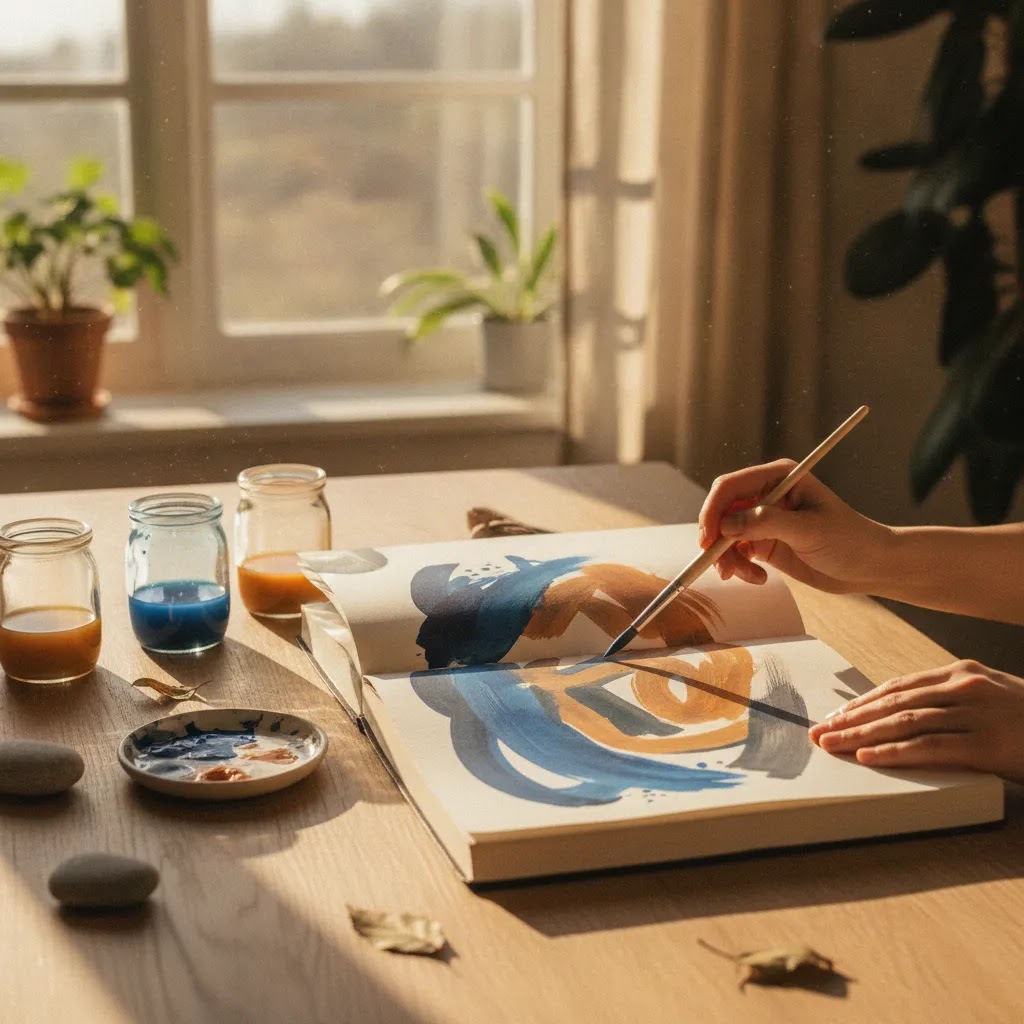
You may also see the phrase art psychotherapy. People sometimes use it casually, but it usually signals something more specific than self-guided art-making.
- Art as therapy is typically self-guided and non-clinical. The intention is personal regulation, expression, and reflection through making.
- Art therapy is typically clinician-led or delivered by a qualified professional within an explicit therapeutic service.
- Art psychotherapy usually places psychotherapy at the center, with art used as a primary way of communicating and processing. The art is not just an activity, it is part of deeper therapeutic work within a therapeutic relationship.
What tends to change when something becomes psychotherapy is not the materials. It is the container around the work. There is usually a defined relationship with clearer boundaries, confidentiality expectations, and a shared intention to work with emotional material in a structured way over time.
If self-guided art feels supportive and you can stay grounded while you create, that may be enough. If art-making regularly opens feelings that feel too intense to hold alone, if you are concerned about safety, or if you want support working through long-standing patterns, seeking a credentialed provider is often the safer next step.
Where you might encounter it
You may find art as therapy in quiet, ordinary places:
- at home after an emotionally loaded day
- inside a guided app session using shapes, color, and reflection
- in a support group, school, or community workshop
- as a between-session practice alongside counseling
- in grief rituals, recovery routines, or personal journaling habits
For beginners, the simplest approach is often best. One page. One feeling. One color family. One timer. No pressure to explain the result. The point is not to make “good art.” The point is to make honest contact.
What a professional art therapy session may look like
Professional sessions vary by provider, setting, and approach. Still, many follow a rhythm that helps people feel contained and not thrown into the deep end.
A first session often starts with orientation
In an initial meeting, there may be an intake conversation about what brings you in, what you hope for, and what feels difficult right now. A provider may also explain how sessions work, what confidentiality typically means in that setting, and what boundaries exist around contact, materials, and records.
Art-making may happen in the first session, or it may not. Some practitioners begin gently with simple directives. Others begin with conversation and invite art later, once trust is built.
Ongoing sessions often include art-making plus reflection
A common flow is a brief check-in, a period of making, and then optional sharing and reflection. Sometimes the art-making is timed. Sometimes it is open. The reflection can be as simple as naming what you notice: shapes you repeated, colors you avoided, where your body felt tense, what the image seems to want, or what you want to take with you after.
The therapist’s role is often less about interpreting your art and more about holding a safe container, pacing the work, and offering prompts that match your needs and capacity. Some sessions may feel calming and practical. Others may bring up more emotion. A qualified provider typically helps you slow down when needed, rather than pushing you past your edge.
Settings and formats can shape the experience
Art therapy can happen in individual sessions or in groups. You might encounter it in hospitals, clinics, schools, private practices, or community programs.
Group formats can be especially supportive for some people, but privacy looks different in a group. Confidentiality is usually discussed up front, and members are typically asked to respect each other’s stories. However, a group setting cannot offer the same level of privacy as one-to-one care.
Pros and Cons

Strengths
- Accessible for people who find words hard to reach in emotional moments
- Can support reflection without requiring artistic skill or polished output
- May help create distance from overwhelming feelings through externalization
- Works well in short, low-pressure sessions at home or on the go
- Can bridge body awareness and emotional insight in a gentle way
Considerations
- It is not the same as care from a qualified professional
- Some feelings may intensify during creative work, especially if material is tender
- Without structure, some people may feel unsure how to begin or what to do next
- It may be supportive on its own, but not always sufficient for severe distress or safety concerns
Regulation and credentials: how to check if someone is qualified
If you are looking for formal care, it helps to verify that someone is actually trained and permitted to provide it where you live. Requirements vary by region, and titles are not protected everywhere. So, a quick check can reduce risk.
A simple checklist you can use
- Ask what credentials and training they have, and what their scope of practice is in your location.
- Ask whether they are registered, licensed, or certified, and by which body.
- Confirm whether “art therapist” is a protected title where you live, and what it takes to use it.
- Ask how confidentiality works, and what the limits are, especially for groups or organizational settings.
- If you are unsure, look for a directory through a relevant professional association or regulator, and verify status directly.
United Kingdom (UK)
Picture this: you come across someone in the UK who introduces themselves as an "art therapist" or "art psychotherapist." It's worth pausing here, because these titles aren't just descriptive labels, they're legally protected. Anyone using them professionally is required to be registered with the Health and Care Professions Council (HCPC). If you'd like some peace of mind, there's a simple step you can take, look up their HCPC registration yourself to confirm they're recognised to work under that title. You'll find the register waiting for you at https://www.hcpc-uk.org/check-the-register/.
United States (US)
Say a practitioner in Ohio holds different credentials than one in California, that's just how it works here, since America doesn't have a single unified path into art therapy. Titles, training routes, and what's actually required can look quite different from state to state and setting to setting. A good first stop is a body like the American Art Therapy Association, but it's worth following up with your own state's licensing board too, as that's usually what shapes what a provider can bill for and how they're allowed to practice. And if you're ever unsure, just ask the person directly, what credential do they hold, and what does it let them do? There's no shame in checking. If you want a broader overview, the American Art Therapy Association's site (https://arttherapy.org/) is a reasonable place to begin.
A note for other regions
Outside the US and UK, regulation can look very different. If you are unsure what applies where you live, start by asking what body sets standards locally and whether the provider can be verified through a public register or professional directory.
In practice, the article names 2 regions with specific notes: the UK and the US. That small fact matters. It reminds you that rules can change across borders, even when the words sound familiar.
Frequently Asked Questions
What is art as therapy in one sentence?
Art as therapy means using the act of making art to express, explore, or steady inner experience, without needing the process to be clinical, diagnostic, or focused on artistic skill. The emphasis is usually on honest process rather than polished results.
Do you need to be good at art for art as therapy to help?
No. In many non-clinical art-based practices, artistic skill matters far less than willingness to notice and make. Simple marks, repeated lines, shapes, and color blocks can be enough. For many people, less skill pressure actually makes emotional access easier.
Is art as therapy the same as art therapy?
No. Art therapy is a professional discipline delivered by a qualified practitioner within a therapeutic relationship. Art as therapy is a broader idea that creative process itself may feel healing or regulating. The terms are related, but they are not identical.
Why can drawing feel calming?
Drawing can give your attention a physical rhythm. Your hand moves, your eyes track, and your breathing may settle as you focus on line, pressure, texture, or repetition. That sensory involvement can help some people feel more present and less mentally scattered.
Can art as therapy help with anxiety or stress?
It may help some people feel more grounded, expressive, or organized during stressful moments. Still, outcomes vary. It is best understood as a supportive practice rather than a guaranteed answer. If distress feels intense, persistent, or connected to safety, seek qualified help.
What are easy art as therapy techniques for beginners?
Gentle starting points include breath-linked line drawing, color-based mood mapping, collage from old magazines, filling a page with repeated shapes, or drawing a container for a difficult feeling. Short, finishable exercises often feel less intimidating than open-ended blank pages.
Can art as therapy be digital?
Yes. Digital drawing, guided visual exercises, and app-based reflection can all support nonverbal emotional exploration. Some people prefer the privacy and structure of digital tools. Others prefer paper and tactile materials. The best fit usually depends on comfort, sensory preference, and context.
When should art as therapy not be the only support?
If you feel unable to stay safe, are in severe distress, or are dealing with experiences that feel too intense to manage alone, creative self-help should not be your only support. In those situations, a licensed professional or urgent local resource is the safer next step.
How is art used as therapy?
Art is often used as therapy by giving you a nonverbal way to express what is hard to name, then reflecting on what you made with support and boundaries. A session may include a prompt or open art-making time, followed by gentle discussion about what you notice in the process, the materials you chose, and what the image seems to hold for you.
Which is better, EMDR or art?
Really, it comes down to what you need in the moment and what your nervous system can handle right now. Where EMDR follows a set structure guided by clinicians trained specifically in that method, creative approaches offer more range, sometimes a quiet, self-led way to unwind, other times a fuller therapeutic process with a trained practitioner. Some people find comfort in following clear steps, others need the unhurried rhythm of making something with their hands, and plenty of people move between both depending on what a given day calls for. When the concerns are heavier or trauma is involved, it's worth checking in with a qualified professional first, they can walk you through what each path actually involves, what risks to consider, and which one might genuinely fit where you are.
What are the 7 psychological functions of art?
You may see lists that describe common functions art can serve for inner life. In plain language, art often helps people: express feelings, communicate when words are hard, regulate and soothe the body, explore identity, create meaning from experience, connect with others, and practice imagination and problem-solving. Different writers number and name these slightly differently, but the core idea is that art can support both expression and stability.
Does art help with Alzheimer’s?
For someone living with Alzheimer's or another form of dementia, picking up a paintbrush or simply looking at a piece of art isn't about talent or skill, it's about the small, quiet moments it can create: a flicker of engagement, a lifted mood, a sense of being present with another person. These moments matter, but they look different for everyone, and creative activities aren't a treatment or a stand-in for proper medical guidance. If you're caring for someone experiencing cognitive changes, gentleness goes a long way, keep things simple, let go of any "right way" to create, and lean on trusted clinical and caregiving resources to make sure expectations stay realistic and safety stays front and center.
Key Takeaways
- Art as therapy usually means the healing value of making art, not a clinical service.
- The process can help through expression, sensory focus, symbolism, and reflection.
- You do not need artistic talent for the practice to feel meaningful.
- It is different from formal art therapy with a qualified practitioner.
- For some people, it offers a gentle first step when words feel unavailable.
Conclusion
Art as therapy is, at heart, a simple idea: sometimes making something helps you meet yourself more gently. A page can hold what your body is carrying. A shape can say what a sentence cannot. That does not require a diagnosis, a polished style, or a perfect insight. It only asks for a little space and a little honesty.
If you want to keep exploring this world, you might browse Daily Lemons’ resources on art-based emotional care and related creative practices. You can start small. One color, one line, one feeling at a time may be more than enough for today.
Before we continue, a soft note: this content is here to offer information, not to replace medical, psychiatric, or crisis support. Many people discover that working through emotions creatively, through art, can open a helpful door, though the experience is deeply personal and what resonates for one person may not for another. Please don't treat anything shared here as a stand-in for care from a licensed professional. If you ever feel unsafe, are in crisis, or find yourself overwhelmed by distress in this moment, reach out right away to emergency services, a crisis hotline, or a trusted professional in your area. If you're considering formal art therapy, it's worth pausing to check a provider's credentials, get clear on what they're qualified to offer, and look into the guidelines set by the appropriate regulatory bodies. Folks in the U.S. might begin with the American Art Therapy Association or their state licensing board as a starting point.