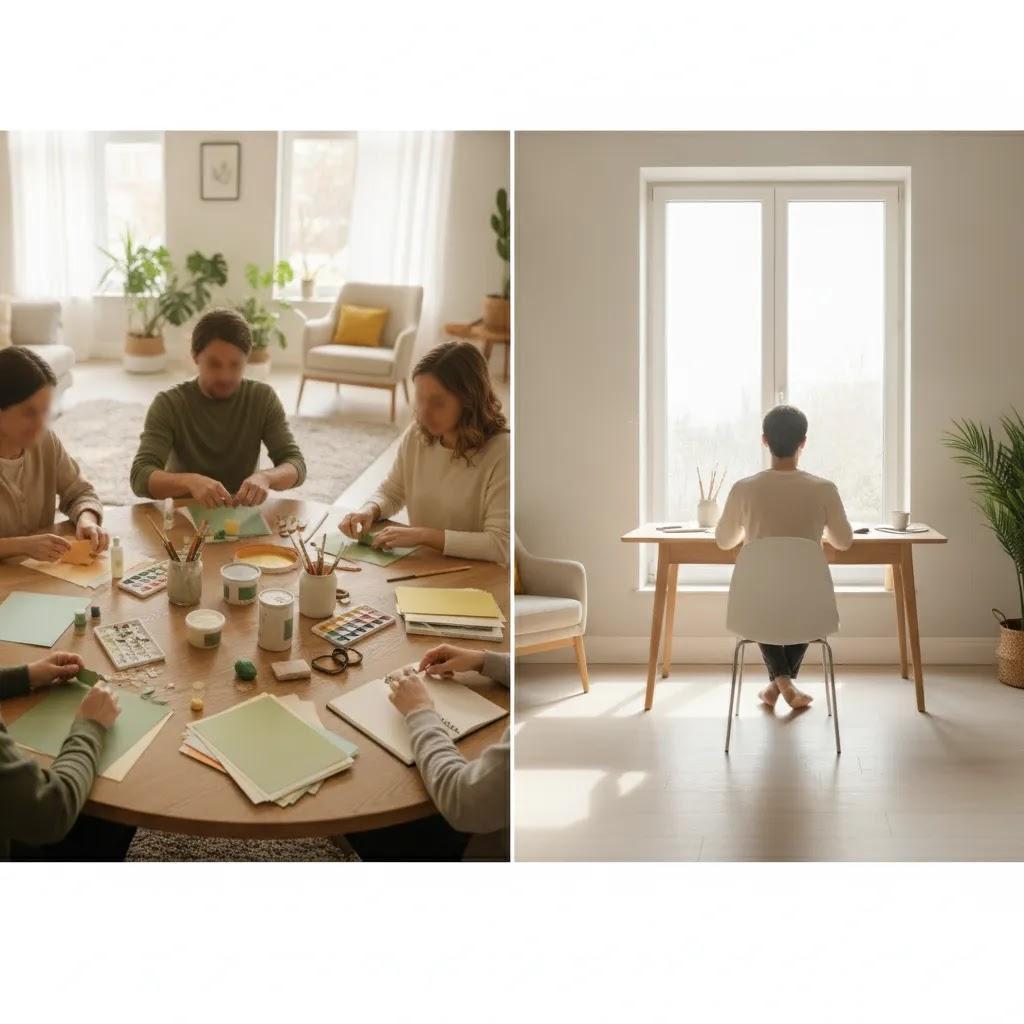
Group art therapy benefits often include connection, shared perspective, and the relief of not feeling alone, while solo art therapy often supports privacy, pacing, and deeper one-to-one focus. Neither setting is better for everyone. The best fit depends on what helps you feel safe enough to create, reflect, and stay present.
That question comes up often, especially if you feel curious about art therapy but also unsure how much interaction feels helpful right now. One setting may offer shared understanding and social connection. The other may offer quiet, privacy, and more room for individual depth.
This guide compares outcomes and session dynamics so you can see how group art therapy benefits show up in real life, where solo work may fit better, and how to think about adults, teens, and families. If you want broader context first, you can also read about the benefits of art therapy for adults.
Group art therapy benefits vs solo at a glance
If you are comparing options, the key difference is not whether one setting is universally better. It is what kind of support you need most right now. Some people need privacy and gentle structure. Others need the relief of not feeling alone. The table below compares a self-guided solo option with a group-support resource through that lens.
| Product | Brand | Price | Rating | Best for | Key strength | Main drawback | Format |
|---|---|---|---|---|---|---|---|
| Daily Lemons | Daily Lemons | , | 4.7/5 | Solo emotional regulation and reflection | Short, guided, nonverbal sessions that reduce pressure to explain feelings | Not a live therapy group and not a substitute for clinical care | Digital art therapy app |
| The Guide of Art Therapy for Covid-19 patients | Digital Art Therapy | , | 3.8/5 | Supportive use with quarantined or isolated groups | Designed to psychologically support senior citizens, hospitalized patients, and people in quarantine | Guide format offers less personalization and no ongoing interactive pacing | Downloadable guide |
Why group art therapy benefits differ by setting
Art therapy is not only about what you make. It is also about who is present, how safe the setting feels, and what the process allows you to do. Group sessions often add witness, community, and shared structure. Solo sessions offer privacy, individualized pacing, and more room for one-to-one attention.
In a group, progress may come from resonance. You may hear someone describe a feeling you could not name. You may also notice that your image does not need a perfect explanation to be understood. As a result, shame can soften. Isolation can soften too.
Solo work supports a different kind of progress. You may move more slowly, stay with a difficult image longer, or explore a theme that feels too personal to share. If you tend to mask, freeze, or compare yourself in groups, solo sessions may create better conditions for honesty. Readers comparing modalities may also find our piece on expressive arts therapy vs art therapy helpful for understanding the format itself.
Neither setting guarantees stronger results for everyone. Instead, a gentler question often helps more: what makes you feel safe enough to engage, and supported enough to stay with what comes up?
Group art therapy techniques that build cohesion (and why they work)

Group sessions can feel vague from the outside. You might imagine that everyone simply makes art together and sees what happens. In practice, many groups use specific activities that make connection safer and more predictable.
The activity is not just a craft prompt. It acts as a container. It shapes how much you share, how exposed you feel, and how much you get to be with other people without needing perfect words.
Here are group-friendly approaches that are commonly used to support communication, emotional regulation, and belonging. If you want a broader overview first, you can also explore art therapy benefits.
Group art therapy benefits in a collaborative mural or shared canvas
Everyone contributes to one surface, sometimes in separate sections and sometimes overlapping. This can support cohesion because the focus is shared and external. People can feel part of something without needing to speak much. It may also build tolerance for shared space, negotiating boundaries, and noticing how it feels when your mark sits beside someone else’s.
Shared-theme prompts (same prompt, different images)
The facilitator offers one prompt, such as “a place I feel steadier,” “what I wish other people understood,” or “what I carry and what supports me.” Participants create individually, then choose whether to share. This structure can create a sense of togetherness without forcing sameness. It often supports perspective because you see how many different forms one theme can take.
Response art to another person’s image
One person shares an image, and someone else creates a response, such as colors that echo the mood, a companion image, or a “what I heard in your picture” sketch. Done carefully, this can strengthen attunement and help people feel witnessed. It works best when the group agrees on a non-interpretive stance. In other words, responses describe what people notice and feel rather than labeling what the other person “means.”
Group collage and resource boards
Collage can reduce performance pressure because the material is already there. Groups might build a collective “coping collage” or “community supports” board using images, words, and textures. This can support emotional regulation by giving people a menu of cues that feel grounding. It may also support belonging because people often discover unexpected overlaps in what comforts them.
Paired witnessing and reflection (with opt-in sharing)
Participants work in pairs. One person creates while the other quietly witnesses, then reflects back simple observations, such as colors, shapes, energy, and what stood out. This can support communication skills and nervous system settling because it offers attention without critique. It may also feel easier than sharing with the whole room, especially for beginners.
What good facilitation looks like in practice
The same activity can feel supportive or stressful depending on how it is facilitated. Skilled facilitation often looks simple from the outside, but it is doing a lot quietly.
- Clear structure: start time, end time, an explanation of the prompt, and what comes next.
- Opt-out options: permission to pass on sharing, change the prompt, or work privately.
- Confidentiality reminders: what is shared in the group should stay in the group, within the limits of local rules and safety requirements.
- Non-critique stance: no judging art quality, no “fixing,” and no forced interpretation.
- Pacing and grounding: enough time to settle, with gentle transitions if emotions rise.
- Respect for boundaries: the facilitator checks consent before inviting feedback, touch, or close viewing of someone’s work.
If this, then that: choosing a group format that matches your comfort
Group art therapy benefits do not come only from being in a room with others. They also depend on how much exposure you can tolerate while still staying present. If you are working on regulation, this guide on emotional regulation may help you notice what supports you.
- If you fear being judged, consider low-sharing formats first, such as collage, shared-theme prompts where sharing is optional, or working with your back to the room.
- If you want connection but feel shy, paired witnessing may offer closeness without the intensity of a full-group share.
- If you want belonging and teamwork, collaborative murals or group collage projects can create togetherness through a shared task.
- If you get overwhelmed easily, ask whether the group uses predictable timing, quiet creating periods, and clear boundaries around discussion.
- If you want help naming feelings, shared-theme prompts and gentle reflection circles may offer language and perspective without forcing you to perform.
1. Daily Lemons: best for guided solo practice between sessions
Picture someone who freezes up at the thought of journaling or sitting still for a guided meditation, words just don't come easily when emotions are running high. Daily Lemons was built with exactly that person in mind. Rather than pushing you to narrate what you're feeling, this therapist-informed app leans on short, low-verbal drawing exercises that give your emotions somewhere to go, help your body settle, and offer a small, steady thing to focus on.
For the group-versus-solo question, Daily Lemons fits most clearly on the solo side. Its strength is not community processing. Its strength is low-pressure private use. That can matter if you feel emotionally flooded, ashamed of being seen while creating, or simply too tired to participate in a group dynamic. Short sessions, typically around ten minutes, may also work well between therapy appointments, after conflict, before sleep, or during stressful work or school periods.
The tradeoff is equally important. This is not the same as a facilitated art therapy group, and it does not provide live interpersonal feedback. If shared witness, peer validation, or relational repair are central goals, a group setting may still offer something this format cannot. Daily Lemons works best as a solo support tool, a gentle starting place, or an adjunct alongside professional care rather than a replacement for therapy.
If you are exploring art making through repeated structures, you may also like reading about mandala art therapy benefits and the broader Digital Art Therapy & Apps category.
2. The Guide of Art Therapy for Covid-19 patients: best for supportive group-facing guidance
Think of an elderly person passing quiet hours in quarantine, or a patient sitting with nothing but silence in a hospital bed, the Guide of Art Therapy for Covid-19 Patients was shaped with exactly these moments in mind. It's a free, downloadable resource offering gentle psychological support to seniors, hospitalized individuals, and anyone navigating isolation. This focus matters, because being cut off from others often reshapes what a person needs from creative expression. When someone is quarantined or confined to a hospital room, approaches that emphasize shared support and connection with others can help bring back a feeling of rhythm, companionship, and being emotionally seen.
Compared with a solo app, this guide appears more informational and situational. Its value is in offering a focused supportive resource for populations dealing with separation, confinement, or disrupted daily life. That could make it useful in care environments, family support settings, or community contexts where people need a shared starting point rather than highly personalized ongoing use.
The limitation is that a guide is still a guide. It may help structure support, but it does not automatically create the live dynamics that make groups effective, such as mutual reflection, facilitator pacing, or in-the-room attunement. It also may not adapt as closely to one person's emotional rhythm as an individualized format can.
If your main question is whether group conditions themselves help, this resource points toward one real answer: they can, especially where loneliness and separation are part of the distress. But the quality of facilitation and the fit of the group still matter as much as the format on paper.
What group art therapy benefits improve most in groups vs solo

Group art therapy benefits often appear most clearly in belonging and perspective. People may feel less alone, more understood, and more able to witness emotion without shutting down. A group can normalize feelings that once felt private or embarrassing. For teens, this may be especially useful when peer understanding matters deeply. For caregivers, it may help to compare this with the benefits of art therapy for children, where developmental fit and comfort often shape outcomes as much as the method itself.
Solo sessions often help most with emotional specificity, privacy, and pacing. If someone needs to approach grief, trauma, heartbreak, or identity questions carefully, one-to-one or self-guided solo work may feel safer. It can also reduce the pressure of social comparison. Some people create more honestly when they know nobody else is watching the page form.
There is also a practical difference in what each setting can teach. Groups may strengthen communication, boundary awareness, and tolerance for being seen. Solo work may strengthen self-observation, internal regulation, and the ability to notice patterns without outside influence.
Results may shift over time as well. A person might begin with solo work to build safety, then move into a group once sharing feels less threatening. Another might use a group for support and use solo digital practice in between to stay connected to what came up. That blended path is often more realistic than treating group and solo as opposites that must compete.
Who group art therapy benefits most (and how setting changes what to expect)
Group art therapy is often discussed as a general option, but it can play a particularly steadying role for certain people and contexts. That does not mean it is best for everyone. It means the group structure itself, showing up, making something, and being around others, can meet needs that are hard to meet alone.
Older adults and seniors
For older adults, group art therapy may support routine, social contact, and a sense of purpose. The art process can also offer gentle cognitive engagement, such as planning a sequence of steps, choosing colors, or recalling imagery. For some people, having “hands busy” can make the mind feel a little steadier, especially when conversation is tiring or emotions are hard to describe.
Groups in senior centers or community settings may also address loneliness directly. Even without deep personal disclosure, creating near others can reduce the sense of being alone with everything. If this age group is your focus, you may also want to read about art therapy benefits for seniors.
Medical settings: hospitalization, chronic illness, and rehabilitation contexts
In hospitals or medical programs, creative groups may help restore a small sense of agency in an environment where so much is scheduled and monitored. The benefit is often not only emotional. Art-making can involve fine-motor use, coordination, and dexterity, depending on the materials. For some participants, that physical engagement can be grounding, though it should be adapted to energy level and comfort.
Medical contexts also change what “progress” looks like. A good group in a hospital might focus on brief relief, connection, and getting through a hard day, not on deep exploration. For example, the CDC notes how isolation and illness can affect emotional well-being in care and recovery settings.
Dementia-related support contexts and caregiver groups
Some programs use group art-making to support connection for people experiencing memory changes, often alongside caregiver support. Visual expression may offer a way to participate without relying on complex verbal recall. For family caregivers, groups can reduce isolation and provide a place where emotional reality is understood without a long explanation.
Grief, loneliness, and life transitions
Grief can be uniquely isolating, even when you have people around you. A group may help by letting grief exist in the room without being “fixed.” Shared prompts, memory-based collage, or simple color work can give shape to feelings that are difficult to speak. For loneliness, the structure matters: you are not just socializing, you are sharing a regulated activity with boundaries, which can feel safer than open-ended conversation.
Adapting expectations by setting (and accessibility considerations)
Where the group happens often shapes what it can realistically offer.
- Community center groups may focus on ongoing connection, skill-building, and a consistent rhythm over weeks.
- Hospital or rehab programs may focus on shorter sessions, immediate comfort, and accessibility, with flexibility for fatigue and pain.
- Family or caregiver groups may prioritize validation, emotional containment, and practical support alongside art-making.
Accessibility is not a side detail. It is often the difference between a group that feels supportive and one that feels exhausting. If mobility, fatigue, sensory sensitivity, or pain is part of your reality, it can help to ask about seating options, lighting, noise level, scent use, material alternatives, and whether you can take breaks without drawing attention. A well-run group usually plans for those needs without making you justify them.
Pros and Cons of group art therapy benefits vs solo support
Strengths
- Group settings may reduce isolation by showing you that other people hold difficult feelings too.
- Solo settings may support deeper privacy, which can help with vulnerable or highly personal material.
- Groups can build confidence in sharing, listening, and being witnessed without needing perfect words.
- Solo formats can lower social pressure for people who mask, compare themselves, or feel overstimulated in groups.
- Digital solo tools like Daily Lemons may be easier to start in real-life moments of stress because they are brief and structured.
- Group-oriented resources may be especially meaningful where quarantine, hospitalization, or loneliness are part of the struggle.
Considerations
- Group participation does not feel safe or helpful for everyone, especially early on.
- Solo work can be private and flexible, but it may not offer the relational feedback some people need.
- A guide or app can support reflection, but it is not the same as licensed, individualized therapy.
- Outcomes depend heavily on facilitator skill, emotional readiness, and the fit between the person and the setting.
Which setting may fit your group art therapy benefits goals best

If you want shared understanding, gentle accountability, and relief from feeling alone, group art therapy may be the stronger fit. This can be especially true if isolation is one of the hardest parts of what you are carrying. Groups may help you borrow language, courage, and perspective from others until your own begins to feel easier to access.
If you want quiet, privacy, and freedom to move at your own pace, solo work may fit better. That includes people who feel exposed in groups, neurodivergent users who prefer lower social load, and anyone approaching emotionally tender material that feels too raw to share yet.
If you are unsure, a blended path often makes sense. You might use a solo digital tool to build familiarity with art-based reflection, then try a group later. Or you might attend a group and use private image-making between meetings. Daily Lemons can fit that in-between space as a light, structured resource for personal practice. If you want more foundation on the topic itself, the Art Therapy Fundamentals category can help you keep exploring at your own pace.
Group art therapy benefits for kids vs play therapy
Parents and caregivers often search for group art therapy benefits because they want the right kind of support for a child, not just the right format. Two modalities that can sound similar, but often feel very different in practice, are art therapy and play therapy.
How they tend to differ
Art therapy typically centers on visual making, such as drawing, painting, collage, or working with clay. For some kids, having a picture to point to can make feelings less overwhelming. It can also help children who prefer structured tasks or who feel pressure to talk.
Imagine a child working through big feelings not with words, but with a dollhouse, a sandbox, or a made-up story acted out mid-play. That's often how play therapy works, leaning on toys, movement, pretend scenarios, and imagination as the main channel of expression. For little ones who aren't ready to sit still with a worksheet, this kind of play can feel far more natural, almost like their first language. And the beauty of it is that symbolic play lets big themes surface gently, without asking a child to put words to something they may not yet know how to explain.
How group formats change the experience
Group settings add extra developmental demands. Kids may need to manage turn-taking, noise, sharing materials, and being observed by peers. That can be supportive for social learning, but it can also become too much if the child is already overwhelmed, easily distracted, or highly sensitive to comparison.
Art groups often work best when the structure is predictable, materials are accessible, and sharing is optional. Play therapy groups may include more movement and interaction, which can be helpful for some kids and dysregulating for others.
Decision cues that can help caregivers choose
- If your child is very young or prefers pretend play, play therapy may feel more natural than sitting to create an image.
- If your child likes drawing, building, or making things with their hands, art therapy may offer a clearer entry point.
- If your child becomes distressed when watched or corrected, a smaller group or a solo setting may be kinder at first.
- If your child seeks peers and enjoys shared projects, a group with shared-theme prompts or collaborative art may support connection.
- If separation is difficult, ask whether caregiver involvement is part of the model, and whether there is a gradual transition plan.
- If sensory preferences are strong, ask about materials, noise level, and whether alternatives are available.
What to ask before enrolling a child in a group
The provider’s answers can matter as much as the modality label.
- How many kids are in the group, and what is the age range?
- Is the group closed (same members each time) or open (new members can join)?
- What does a typical session look like, including arrival and transition time?
- How is sharing handled, and can kids pass without pressure?
- Are caregivers involved, and if so, how?
- What materials are used, and can the group adapt for sensory needs, allergies, mobility, or attention differences?
- How does the facilitator handle conflict, teasing, or emotional escalation?
A child does not need to be “good at art” or “good at sharing” to benefit. The more important question is whether the group is designed in a way that helps them stay regulated enough to participate.
Frequently Asked Questions
What is group art therapy?
Group art therapy is a shared creative setting where several participants make art within a guided structure. The benefit often comes from both the art process and the presence of others. People may gain emotional expression, connection, and perspective through creating alongside peers, though the exact experience depends on the facilitator, the group goal, and how safe the environment feels.
Is group art therapy more effective than solo art therapy?
Not always. Group settings may work better for connection, normalization, and learning through others. Solo settings may work better for privacy, pacing, and more personal exploration. Better results usually depend on the person, the reason they are seeking support, and whether the setting helps them participate honestly rather than feel pressured or exposed.
What are the main group art therapy benefits for beginners?
The main group art therapy benefits for beginners often include feeling less alone, seeing that there is no single right way to create, and getting gentle encouragement from others. A group can make the process feel less mysterious. Still, some beginners feel safer starting solo first, especially if being observed raises anxiety or self-criticism.
Who may do better in solo art therapy?
Solo formats may suit people who need privacy, who become overstimulated by group settings, or who want to explore very personal themes. They may also help people who freeze socially or spend too much energy managing other people's reactions. The private setting can make it easier to notice what you feel before you worry about how it will be received.
Can teens benefit more from groups than adults?
Sometimes, but not automatically. Teens may respond strongly to peer connection and shared experience, which can make group work meaningful. Still, some teens feel guarded around peers and may open up more in one-to-one or private creative settings. Age matters, but fit matters more. The emotional climate of the group often shapes outcomes as much as the participant's age.
Are digital solo tools a replacement for group art therapy?
No. A digital tool may help with grounding, emotional expression, and between-session reflection, but it does not fully replace group dynamics or professional facilitation. It can be a useful complement, especially for people who want a gentler entry point or a way to stay connected to the process between appointments. It may also be more accessible during stressful everyday moments.
How do I choose between group and solo art therapy?
Start with your current needs, not an abstract idea of what should work best. Ask whether you need privacy or connection, flexibility or live support, low stimulation or shared witness. It can also help to notice what usually blocks you. If talking feels hard but being seen feels okay, a group may help. If being seen feels like too much, solo may be kinder.
What is the biggest benefit of group therapy?
For many people, the biggest benefit is realizing you are not alone in what you feel. A well-facilitated group may reduce shame, offer perspective, and create a sense of belonging. It can also help you practice being seen in small, manageable ways, which may build confidence over time.
What is a major advantage of group therapy is that clients can what?
A major advantage is that clients can learn from each other. You can notice how others cope, borrow language for feelings you could not name, and practice giving and receiving support. In art therapy groups, that learning may happen through images as much as conversation.
What is the major benefit of group therapy?
The major benefit is often shared experience. A group can hold emotion in a way that feels less isolating, and it can normalize reactions that felt private or “too much.” The benefit tends to be strongest when the group has clear structure, respectful boundaries, and a non-judgmental tone.
Is art therapy good for CPTSD?
Some people with complex trauma histories may find art-based approaches supportive because images can express what feels hard to say. Still, trauma-related work can bring up intense emotions and body sensations, and not every group setting is the right container for that. If you are considering art therapy for CPTSD, it is usually safest to look for a qualified, trauma-informed, licensed professional and ask how they handle pacing, consent, grounding, and emotional safety. Group formats may or may not be appropriate depending on triggers, stability, and the specific structure of the group.
Is art therapy safe for everyone?
Art-based reflection may be supportive for many people, but it is not automatically the right fit in every situation. Strong feelings can arise during creative work. If distress feels intense, persistent, connected to trauma, or linked to safety concerns, support from a qualified licensed professional is the safer route. For formal art therapy, check current credentials and local regulatory standards. You can review professional guidance through the American Art Therapy Association.
Key Takeaways
- Group art therapy benefits often center on connection, normalization, and being witnessed.
- Solo settings often support privacy, pacing, and deeper individual reflection.
- Daily Lemons is strongest as a guided solo support tool, not as a substitute for live group therapy.
- Group-facing resources may be especially useful where loneliness, quarantine, or separation shape the emotional context.
- The best setting is usually the one that helps you engage safely and honestly, not the one that sounds best in theory.
Quick recap on group art therapy benefits
If you want the shortest answer, neither setting wins for every person. Group often helps most with connection. Solo often helps most with privacy and pacing. These picks reflect those different strengths.
| Rank | Product | Best for | Price |
|---|---|---|---|
| 1 | Daily Lemons | Guided solo emotional support and between-session practice | , |
| 2 | The Guide of Art Therapy for Covid-19 patients | Supportive guidance for isolated or quarantined populations | , |
Conclusion
Group and solo art therapy are not really fighting for one winner. They offer different kinds of help. Group settings may ease loneliness, build trust through shared experience, and help you feel less strange in your feelings. Solo settings may give you privacy, steadiness, and space to notice what is true before anyone else enters the room.
If you are still unsure, starting small is often enough. A short, private practice can tell you a lot about whether image-making feels supportive. From there, you may feel more ready for a group, or you may realize solitude is part of what helps. If you want a gentle way to explore solo art-based reflection, Daily Lemons is one place to begin whenever it feels right.
Please note that everything you read here is meant to inform, not to diagnose or treat, think of it as a gentle starting point rather than clinical guidance. How art therapy unfolds for any one person can shift depending on who's involved, the setting, the facilitator's approach, and the goals being worked toward. Daily Lemons exists to offer wellness-minded, art-therapy-informed support, and while it can sit alongside professional care, it was never meant to stand in for it. Thinking about pursuing formal art therapy? It's worth taking a moment to check a provider's credentials, understand their scope of practice, and look into the regulatory standards that apply where you live, in the U.S., groups like the American Art Therapy Association can be a helpful starting point for that kind of information. And if you or someone you care about is struggling to stay safe or is in real distress, please reach out right away to local emergency services, a crisis line, or a licensed professional, you don't have to carry that alone.