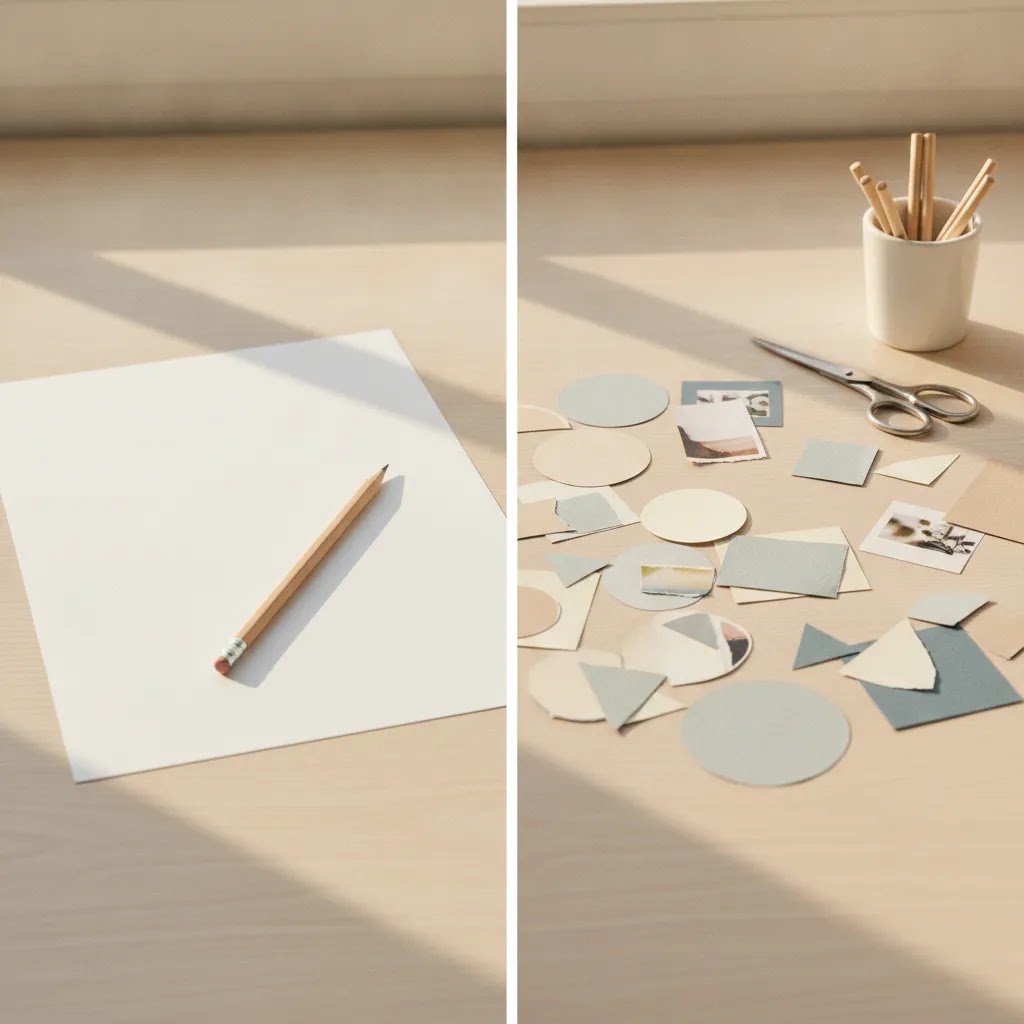
Collage art therapy benefits often include easier starting, more room for mixed feelings, gentler distance from painful material, and a stronger sense of choice. If a blank page feels like too much, collage can offer a softer place to begin.
A blank page can feel strangely demanding. Draw something. Paint something. Know what you feel. For many people, that is exactly the problem.
Collage offers a different doorway. Instead of producing an image from scratch, you gather, sort, cut, place, remove, and rearrange. As a result, emotional expression may feel more reachable, especially when words are thin or self-judgment is loud.
In this article, you will find a ranked list of five collage-specific therapeutic effects that often get less attention than drawing or painting benefits. The goal is not to say collage is better than every other modality. Instead, it is to show where collage may do something distinct. If you want broader context first, this companion piece on the benefits of art therapy for adults can help frame the bigger picture.
Collage Art Therapy Benefits: Comparison Snapshot
Because this article focuses on therapeutic effects rather than product shopping, the table below compares the five collage-specific effects by what they tend to help with, where they stand out, and what to watch for. A simple downloadable guide is included as a reference point for how collage and art-based support may be presented in digital formats.
| Effect or Resource | Type | Best for | Key strength | Main drawback | Practical cue | Price |
|---|---|---|---|---|---|---|
| Lowering blank-page pressure | Collage effect | Perfectionism, shutdown, fear of starting | Uses choosing instead of inventing | May still feel overwhelming if there are too many options | Start with 5 to 10 images only | , |
| Holding mixed feelings | Collage effect | Ambivalence, grief, transitions | Lets opposites exist side by side | Can feel messy before it feels clarifying | Use separate sections or layers | , |
| Creating safe distance | Collage effect | Hard memories, overwhelm, indirect expression | Works through symbols and borrowed images | Indirect work may feel too vague for some people | Choose metaphor before explanation | , |
| Building identity through selection | Collage effect | Life changes, self-exploration, adolescence | Shows values and self-image through curation | May trigger self-editing around what is “acceptable” | Include images you are unsure about | , |
| Practicing change through rearrangement | Collage effect | Feeling stuck, decision fatigue, low agency | Allows visible revision without starting over | Some materials feel less flexible once glued down | Dry-place pieces before attaching | , |
| The Guide of Art Therapy for Covid-19 patients | Downloadable guide | Psychological support context for senior citizens, hospitalized patients, and people in quarantine | Designed around emotionally difficult settings | Very limited public detail on structure and use | Reference resource rather than interactive process | , |
Collage Basics for Collage Art Therapy Benefits
If collage feels appealing but also a little mysterious, it helps to name the building blocks. These are not rules. Instead, they are handles you can grab when you want the page to feel clearer, calmer, or more honest.
1. Image
Images can carry emotion fast, sometimes faster than language. They can also hold complexity without needing a single explanation.
2. Text
Words, headlines, and single phrases can add precision, conflict, or permission. This can help when you cannot yet say something in your own voice.
3. Color
Color can signal mood and intensity. It can also create containment by limiting the emotional volume of the page to a smaller palette.
4. Texture
Texture often lands in the body before it lands in meaning. Because of that, a collage can feel grounding, agitating, soothing, or raw without needing to “solve” it.
5. Shape
Shapes can create boundaries, protection, openness, or sharpness. In practice, they often change how safe a subject feels to approach.
6. Space and Placement
Where something goes can matter as much as what it is. Central placement may feel like emphasis. Edges may feel like distance. Empty space may feel like breathing room or loss.
7. Layering and Overlap
Layering can show contradiction, protection, and time. It can also let you keep something present while partially hidden, which can be emotionally useful.
Material-wise, magazines tend to be easy for beginners because they offer variety without requiring printing. Personal photos can feel powerful, but they can also feel more exposing. Fabric, tissue, wrapping paper, and natural materials like leaves can add body-level texture if you want less “story” and more sensation.
If you share your collage online, keep copyright and privacy in mind. Using recognizable photos of other people, private documents, or copyrighted images may create risks you did not intend. For example, the U.S. Copyright Office FAQ is a useful starting point for basic copyright questions.
1. Collage art therapy benefits that lower the pressure to make something from nothing
This is the collage benefit many beginners feel first. Drawing can ask for generation. By contrast, collage asks for selection. That difference matters if your mind goes blank under pressure or if you become critical the moment you try to produce an image yourself.
Therapeutically, collage may reduce the performance layer that can block expression. You do not have to create a perfect symbol for sadness or stress. You can notice that one torn scrap, one texture, or one photo fragment already feels close enough. That often helps the nervous system settle just enough to begin.
The effect is strongest for people who freeze at open-ended prompts, including some neurodivergent users and people dealing with burnout. However, too many source materials can backfire. A smaller pile often works better than a huge one. If you are comparing modalities, this is one place collage may feel more accessible than drawing-focused exercises in Digital Art Therapy & Apps.
2. Collage art therapy benefits for holding mixed feelings at once
Some emotional states do not come in a single clear lane. Grief may sit next to relief. Love may sit next to anger. Hope may sit next to fear. Collage is unusually good at letting contradiction stay visible without forcing a tidy answer.
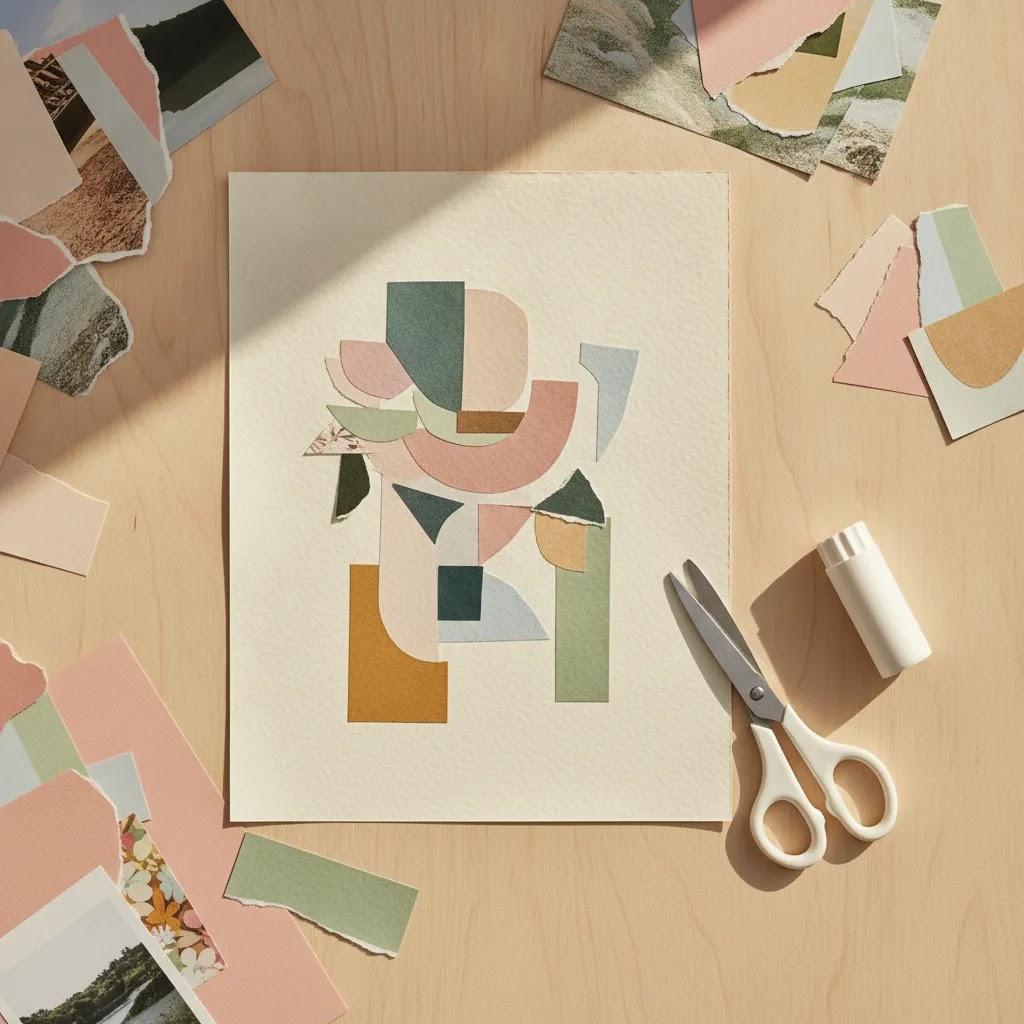
Why? Because collage is built from parts. You can place soft and harsh images together. You can divide the page into zones. You can overlap one image with another and let both remain partly visible. That physical structure mirrors emotional complexity in a way many single-medium approaches may not.
This is one reason collage can be useful during transitions, heartbreak, caregiving stress, and adolescence. Children may also respond well to this layered form of expression, though the process often needs age-appropriate pacing and materials, as explored in these benefits of art therapy for children. The caution here is simple: the page may look chaotic before it feels meaningful. That is not always a problem. Sometimes the mess is part of the truth.
3. Collage art therapy benefits that support safe distance from painful material
Collage can help you approach hard material sideways. That may sound small, but it is often a major therapeutic advantage. Instead of drawing a direct scene or writing a full explanation, you can work with metaphor, fragments, colors, found text, or images that feel emotionally adjacent.
This creates a useful middle distance. You are not forcing yourself into raw exposure, but you are not avoiding the feeling entirely either. A storm image, an empty chair, a ripped edge, or a crowded background may carry enough emotional charge to be honest without becoming too intense.
That kind of symbolic distance is one reason collage may help people who feel flooded by words or who do not want immediate interpretation. It also fits the broader art therapy principle of externalizing experience so it can be seen, held, and reflected on more safely. If you are curious how this differs from broader multimodal work, this article on expressive arts therapy vs art therapy gives useful context. If distress becomes severe or you feel less safe while creating, pause and seek qualified support rather than pushing through alone.
The Psychology Behind Collage Art Therapy Benefits
Collage often works through fragmentation and integration. You are literally breaking a visual field into parts, then choosing which parts belong together. For many people, that mirrors how emotional experience actually arrives: not as one clean story, but as pieces of sensation, memory, and meaning that do not automatically line up.
A collage can become a place where complexity is allowed to be complex, without needing a single linear narrative. Visual processing and symbolism also matter. Images can communicate quickly, and metaphor can create a workable distance.
You might not be ready to say “I am scared,” but you can place an image of a narrow hallway, a locked door, or a small animal under a large shadow. That is not avoiding the truth. Instead, it gives the truth a shape you can approach.
What to notice while you make a collage
If you want a simple way to stay curious without over-analyzing, these are a few things to notice while you create:
- Repeating themes: certain colors, settings, objects, or types of faces that keep showing up.
- What gets hidden or covered: pieces you bury under other pieces, blur with texture, or push behind text.
- What stays central: images or words you keep returning to, even if you try to move them away.
- What gets pushed to the edges: elements that feel important but also feel like “too much” to place in the middle.
- Where the page feels tight versus open: crowded clusters, empty areas, and abrupt borders.
None of these cues need a definitive interpretation. A collage can be honest even if you do not know why you chose something. If meaning shows up, it can. If it does not, the process may still feel regulating because it gives your attention a paced, physical task. If you want more support around this idea, you can also read what emotional regulation is and why it matters.
4. Collage art therapy benefits for identity and self-story
Collage is not only about emotion release. It can also support identity building. The act of choosing images, words, shapes, and spatial relationships often reveals what draws you, what repels you, what feels missing, and what you want closer.
This is different from being asked, “Who are you?” in plain language. Selection can show identity before you can explain it. That makes collage especially relevant in periods of change, including adolescence, motherhood, grief, relocation, recovery, or career transition.
The therapeutic effect comes from curation. You are not just expressing a feeling. You are building a visual field of values, roles, memories, tensions, and possibilities. Mandala-based work may offer a different kind of structure through containment and repetition, and if that sounds closer to what you need, these mandala art therapy benefits may be worth exploring too. With collage, the main drawback is social conditioning. People may censor their choices if they imagine being judged. Privacy helps.
5. Collage art therapy benefits that make action feel possible through rearrangement

Collage is one of the few art processes where revision is built into the method. You can move a piece, rotate it, cover it, remove it, or place it in a new relationship to everything else. That tactile flexibility may offer a quiet lesson: a stuck feeling is not always fixed in one position.
This is why collage can support agency. You do not need to erase the whole page to try another arrangement. You can experiment with change in a low-risk way. For people dealing with indecision, low confidence, or emotional paralysis, that matters.
It can also reveal patterns. Maybe all the hopeful images end up at the edge. Perhaps protective symbols keep covering vulnerable ones. The page gives you something to notice and respond to. DailyLemons often approaches creative emotional care through gentle, structured, nonverbal tools, and readers who want a broader foundation can explore Art Therapy Fundamentals for related concepts. The caveat is practical: if you glue too early, you lose flexibility. Staying in the arrangement stage a little longer often deepens the benefit.
Collage Art Therapy Benefits: Pros and Cons
Strengths
- May feel easier to start than drawing or painting because it relies on choosing and arranging.
- Can hold contradiction well, which helps with complex or mixed emotional states.
- Supports symbolic distance, which may make difficult material more approachable.
- Offers visible flexibility through moving and layering pieces before committing.
- Can support identity exploration without demanding long verbal explanations.
- Works for many skill levels because aesthetic talent is not the point.
Considerations
- Too many materials may create decision fatigue instead of relief.
- Found images can bring up unexpected feelings or social comparison.
- Some people may want more direct emotional release than collage naturally offers.
- Glue, cutting, and setup can create friction if you need something very immediate.
How to Choose Collage Well for Collage Art Therapy Benefits
If you are wondering whether collage is the right fit, a few criteria matter more than artistic skill.
1. Your starting state. If you are overwhelmed, numb, perfectionistic, or tired of word-based tools, collage may be a gentle entry point. If you already know exactly what you want to draw, another medium might feel more direct.
2. The amount of structure you need. Some people do best with a clear prompt such as “make a page that shows what safety looks like.” Others prefer free selection. If blank-page pressure is high, set a boundary: one theme, ten images, fifteen minutes.
3. Your relationship to imagery. Collage works best when images help you think and feel. If outside images feel distracting, a more internally generated modality may suit you better. There is no single best medium for everyone.
4. Your tolerance for indirectness. Collage often communicates through metaphor and juxtaposition. That can feel safe and rich. It can also feel vague if you want fast verbal clarity. Some people use collage first, then add a few reflective notes after.
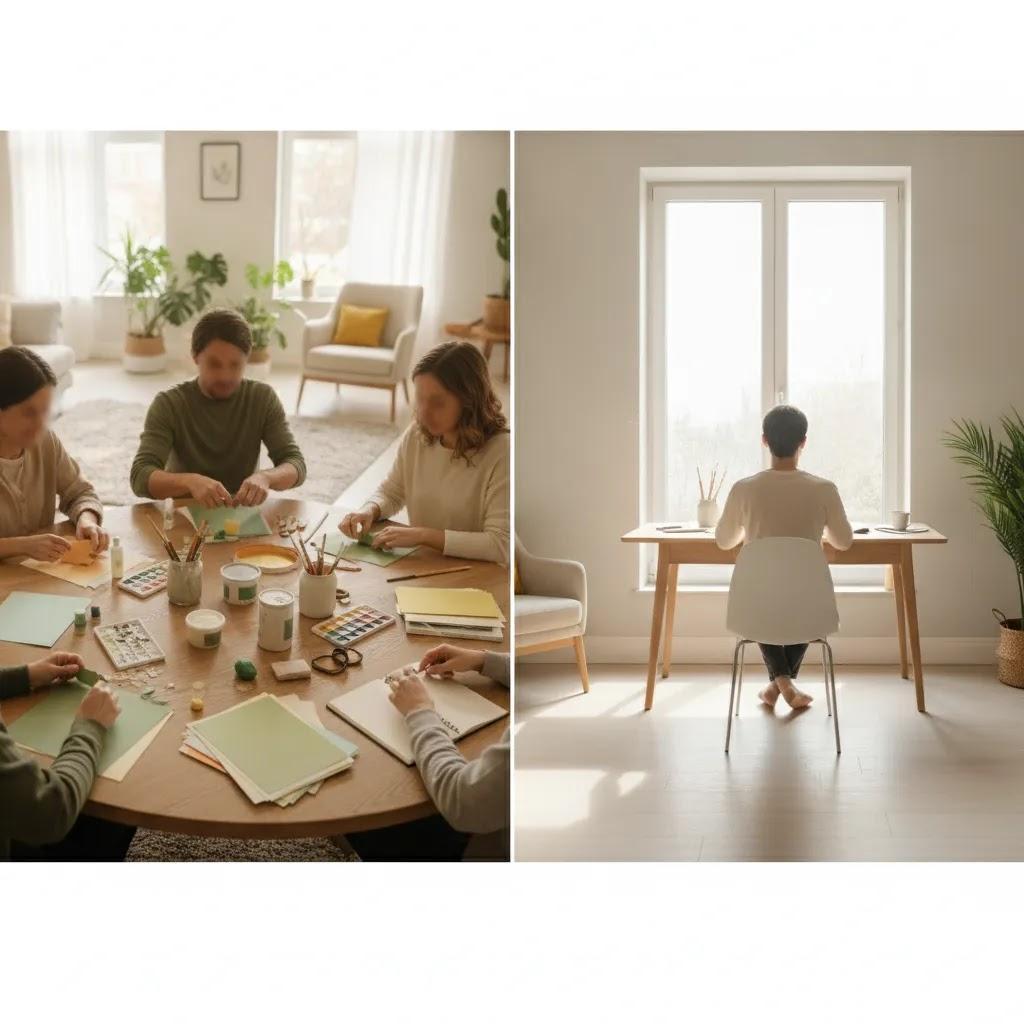
5. The setting. Privacy, pacing, and emotional support matter. A calm space with limited materials often works better than a rushed, cluttered setup. If you are using digital tools, guided formats may help lower friction for beginners. For related topic areas, readers sometimes also explore resources under Anxiety, Stress & Emotional Wellness. You might also like these emotional regulation skills if you want simple follow-up practices.
Collage can stir up feelings even when it looks simple from the outside. If you notice rising distress, dissociation, panic, or a sense that you cannot stay grounded, stop the exercise and reach for human support. Creative practices can help, but they are not always enough on their own. In the United States, the American Art Therapy Association can help you learn more about the profession and training standards.
Collage Art Therapy Prompts (Beginner-Friendly Ideas)
If you want collage to feel supportive rather than sprawling, a prompt can act like a container. You are not trying to make “good art.” You are giving your attention one place to rest for a short amount of time.
A simple way to stage a session (10 to 20 minutes)
Gather (2 to 4 minutes). Choose a small pile of sources: one magazine, a few printed photos, scraps of paper, or a limited camera roll if you are working digitally.
Select (3 to 5 minutes). Pull 5 to 10 images or words that match the prompt in any way, even loosely.
Arrange (3 to 7 minutes). Dry-place your pieces first. Rotate, overlap, group, or create zones. If you are unsure, make two clusters: “this feels true” and “this feels complicated.”
Glue or commit (2 to 3 minutes). Attach only when the page feels steady enough. Leaving a few pieces unglued is also allowed.
Reflect (2 minutes). Write one or two sentences, or answer a single question: “What part of this page feels loudest?” or “What would I want to protect here?”
10 collage art therapy benefits prompts you can start with
- My safe place. Build a page that shows what “safe enough” looks like for you, not what it is supposed to look like.
- What I need right now. Choose images that match needs rather than plans, rest, clarity, comfort, space, support, quiet.
- Stress vs support. Split the page into two sides, or two layers, one for what drains you, one for what steadies you.
- Boundaries. Make a collage about what you let in, what you keep out, and what you want more choice around.
- Future self (gentle version). Instead of “goals,” focus on the feeling-tone you want to live inside: steadier, freer, softer, more rooted.
- Inner critic vs kinder voice. Give each voice its own images and words, then notice which one takes up more space.
- Where I feel stuck. Use shapes and placement to show pressure points, blocked paths, or crowded corners.
- What I am carrying. Choose weights, bags, weather, textures, or repeating objects that mirror your current load.
- Self-portrait without a face. Represent yourself using colors, objects, textures, places, and words, no literal portrait needed.
- Before and after (without forcing a happy ending). Create two panels, “before” and “after,” where “after” simply means “what I want to be true next.”
Some prompts can brush up against heavy memory, grief, trauma, or relationship pain. If a prompt suddenly spikes distress, brings a sense of panic, or makes you feel unsteady, stop and return to grounding basics: look around the room, feel your feet, drink water, or step outside. You can also shift to a safer prompt like “my safe place” or “what helps” and consider reaching out to a trusted person or a licensed professional rather than trying to push through alone.
Frequently Asked Questions About Collage Art Therapy Benefits

What is collage art therapy in simple terms?
Collage art therapy uses selection, cutting, arranging, and combining images or materials to support emotional expression and reflection. The therapeutic value often comes from the process, not the finished page. You do not need art training. Many people find collage helpful because it offers a visual language when writing or talking feels too demanding.
What makes collage different from drawing in therapy?
Collage usually begins with existing materials rather than a blank page. That may lower self-criticism and make starting easier. It also allows layering, contrast, and rearrangement in ways that naturally support mixed feelings and shifting perspectives. Drawing can be powerful too, but collage often feels more accessible for people who freeze under performance pressure.
Do collage art therapy benefits only help beginners?
No. Beginners often notice the accessibility first, but collage art therapy benefits may also help experienced creators who want less perfectionism and more emotional honesty. In some cases, people with strong art skills need a medium that interrupts the habit of evaluating technique. Collage can do that by moving attention toward choice, meaning, and relationship between parts.
Can collage help with anxiety or overwhelm?
It may. Choosing, sorting, tearing, and arranging can create a paced, sensory process that feels more manageable than staring at a blank page. The structure may also help externalize racing thoughts. Still, outcomes vary. If anxiety feels intense, persistent, or tied to safety concerns, collage is better viewed as one supportive practice rather than a substitute for qualified care.
Why do found images feel emotionally powerful?
Found images can bypass the pressure to invent and go straight to recognition. You may see something that feels unexpectedly close to a memory, mood, fear, or hope. That quick recognition can be useful, but it can also be activating. Go slowly, especially if certain themes or visuals tend to bring up strong reactions for you.
Is digital collage useful, or does it need to be physical?
Both can be useful. Physical collage adds texture, tearing, and hand-based sensory feedback. Digital collage may be easier to start, store, and revise. The better fit depends on your preferences, access, and current energy. If setup friction keeps stopping you, digital options may remove enough barriers to help the practice actually happen.
How long should a collage session be?
It does not need to be long. Many people begin with 10 to 20 minutes, especially if they are tired, anxious, or unsure. A short, bounded session often feels safer and more repeatable than a long open-ended one. You can also split it into stages: gather, arrange, pause, then reflect later if that feels gentler.
Do I need to explain what my collage means?
No. Meaning can unfold slowly. Sometimes the first useful step is simply noticing what you chose, what you avoided, and where items landed on the page. A brief reflection such as “this part feels crowded” may be enough. If you are working with a professional, interpretation should stay collaborative rather than imposed.
What are the 7 elements of art collage?
A practical way to describe collage elements is: image, text, color, texture, shape, space and placement, and layering or overlap. You can use them intentionally, for example, limiting color for calm, using space for breathing room, or layering to show protection and complexity. They are tools, not requirements.
What is the psychology of collage?
Collage often supports people through visual symbolism and a parts-based process. Cutting and selecting can make complex experience feel more workable, and arranging parts can help you hold contradictions without forcing a single storyline. The meaning does not have to be “decoded” to be useful; sometimes the paced, sensory process is the benefit.
What are the positive effects of art therapy?
Art-based practices may support emotional expression, self-understanding, stress relief, and a greater sense of perspective. Some people find they can approach feelings more safely through images than through direct conversation. Effects vary by person and situation, and art-based practices are best viewed as supportive tools, not guarantees.
Why is collage art important?
Collage matters because it gives you a way to build meaning from what already exists. That can lower pressure, make mixed feelings easier to represent, and create a safer distance from difficult material through metaphor. It can also be more accessible than techniques that require strong drawing skills or a clear verbal narrative.
Key Takeaways
- Collage may lower the pressure of starting because it relies on selection rather than inventing from scratch.
- Its layered structure makes it especially good at holding mixed or contradictory feelings on one page.
- Borrowed images and metaphor can create helpful distance from painful material without fully shutting it down.
- Collage often supports identity work because choices and arrangements reveal values, roles, and tensions.
- Rearranging pieces may strengthen a sense of flexibility and agency when life feels stuck.
Quick Recap of Collage Art Therapy Benefits
If you only want the short version, these are the five collage-specific effects worth remembering first.
| Rank | Effect | Best for | Price |
|---|---|---|---|
| 1 | Lowering blank-page pressure | Starting when words or ideas feel blocked | , |
| 2 | Holding mixed feelings | Ambivalence, grief, and life transitions | , |
| 3 | Creating safe distance | Difficult material that needs metaphor | , |
| 4 | Building identity through selection | Self-exploration and role changes | , |
| 5 | Practicing change through rearrangement | Low agency and feeling stuck | , |
Conclusion
Collage does not need to replace other art therapy methods to be worth your attention. Its value often lives in the small differences: less pressure to perform, more room for contradiction, safer symbolic distance, clearer identity cues, and a hands-on experience of rearranging what feels fixed.
Those are not minor perks. For some people, they are the very reasons creative emotional work becomes possible in the first place. If you want a softer, structured way to explore visual self-expression, DailyLemons offers gentle art-based resources that may help you begin without needing perfect words. You can also keep exploring related topics through our art therapy content whenever it feels useful.
Please note that everything shared here is meant to inform, not to serve as medical, psychiatric, or crisis guidance. Working with collage and similar creative practices can gently support self-reflection and help with emotional regulation, but this kind of activity isn't a substitute for professional mental health treatment, especially when what you're feeling is intense, ongoing, or tied to your safety. If you're struggling to stay safe, are in the middle of a crisis, or simply need help right now, please reach out immediately to emergency services, a crisis line, or a licensed professional near you. Thinking about pursuing art therapy in a more formal way? It's worth taking a moment to confirm a provider's credentials, understand their scope of practice, and check the standards that apply in your area, in the U.S., groups like the American Art Therapy Association can be a helpful starting point. As with most things related to healing, what works and how well it works will look different from person to person, depending on individual circumstances and the kind of support available.