Digital art therapy activities are simple, guided drawing exercises you do on a phone, tablet, or computer to support grounding, emotional expression, and reflection. They are not about making polished art. Instead, they help you give feelings a shape, slow things down, and begin gently when words feel hard.
What do you do in a session when talking feels slow, pressured, or simply out of reach? A hands-on digital exercise can give you somewhere to begin. For example, you might use color, line, or symbols to externalize emotion and notice patterns with less pressure.
That can be useful in personal reflection, between therapy appointments, or inside guided sessions with an art therapist. The ten activities below are ranked for session use, with an emphasis on low barrier, emotional safety, and practical usefulness. In addition, you will see what each activity is for, why it helps, and when it may fit best. If you are new to this area, you may also want to explore Art Therapy Fundamentals for broader background.
Digital art therapy activities: a side-by-side look at the 10 options
These activities were ranked by how usable they tend to be inside a real session: low setup, clear structure, emotional containment, and flexibility for different ages and communication styles. The last entry is a published guide rather than a single exercise, so it serves a different role.
Why these digital art therapy activities were compared this way
In practice, the most helpful exercise is often the one you can start without too much effort. Therefore, this comparison focuses on ease, containment, and flexibility rather than novelty alone.
| Activity | Brand | Price | Rating | Best for | Key strength | Main drawback | Format |
|---|---|---|---|---|---|---|---|
| Breath-Linked Line Drawing | Daily Lemons | — | 4.9/5 | Acute stress, settling at the start of a session | Very low verbal demand | May feel too simple for deeper meaning-making | guided digital exercise |
| Feeling Weather Map | Daily Lemons | — | 4.8/5 | Naming mixed emotions | Turns vague feelings into visible symbols | Can stay broad if reflection is rushed | guided digital exercise |
| Worry Container Sketch | Daily Lemons | — | 4.8/5 | Overwhelm and racing thoughts | Adds containment, not just expression | Less useful if you want playful exploration | guided digital exercise |
| Color-in-the-Body Scan | Daily Lemons | — | 4.7/5 | Body awareness and sensory tracking | Connects emotion with physical cues | May feel exposing for some trauma-impacted users | guided digital exercise |
| Two-Panel Before and After | Daily Lemons | — | 4.7/5 | Change over time, grief, transitions | Makes shifts easier to notice | Can invite over-analysis | guided digital exercise |
| Safe Place Image Build | Daily Lemons | — | 4.6/5 | Grounding and resourcing | Useful before harder emotional work | Not everyone relates to the idea of “safe place” | guided digital exercise |
| Parts of Me Visual Map | Daily Lemons | — | 4.6/5 | Inner conflict and identity themes | Shows competing feelings clearly | Needs a bit more reflection time | guided digital exercise |
| Boundary Circles Exercise | Daily Lemons | — | 4.5/5 | Relationships and emotional distance | Concrete visual structure | Can feel abstract for younger users | guided digital exercise |
| Scribble Transformation | Daily Lemons | — | 4.4/5 | Perfectionism and creative shutdown | Invites play and flexibility | Less targeted for specific themes | guided digital exercise |
| The Guide of Art Therapy for Covid-19 patients | Digital Art Therapy | — | 3.8/5 | Support planning for quarantine-related contexts | Specific audience focus | Guide format is less hands-on in-session | downloadable guide |
How these digital art therapy activities were ranked
This list focuses on what tends to help in the moment, not what sounds most impressive on paper. The strongest digital art therapy activities usually do four things well. They lower the pressure to explain, give the hands something simple to do, create enough structure to feel containing, and leave room for reflection afterward.
That emphasis matters because digital art work can sit across different art therapy approaches. Some exercises lean more toward regulation and grounding. Others support symbolism, identity work, or relational insight. If you are sorting out definitions, the difference between expressive art therapy and broader creative practices can also shape what you expect from a session.
Digital art therapy activities setup and tools
The best setup is the one that removes friction. You can do most digital art therapy activities on a phone, tablet, or computer, as long as you can make marks and see them clearly.
- A device: phone, tablet, or computer
- A drawing tool: finger, mouse, or stylus (optional)
- Headphones (optional) if audio guidance helps you stay with the exercise
- A notification-free window: airplane mode, focus mode, or at least silence alerts for the activity
- Basic privacy: avoid shared screens, disable screen recording, and decide in advance whether you will save, export, or delete the image afterward
If you want a plain drawing app that is not therapy-specific, many people use tools like Adobe Photoshop Sketch, MediBang, Fire Alpaca, Autodesk Sketchbook, MyPaint, ibis Paint X, and Krita. Any simple tool can work, as long as it lets you draw, erase, and use color without a lot of setup.
Digital can also feel safer for beginners because you can undo, erase without leaving marks, and use layers to separate “what I feel” from “what I want to show.” If privacy is part of your emotional safety, consider naming a plan before you start: save to a private folder, export and password-protect, or delete the file once you have finished reflecting.
Ultimately, the goal is to help you feel more in control of what stays and what does not. If you want a broader overview of tools and practice, you can also read art therapy fundamentals.
1. Breath-Linked Line Drawing
This is the easiest activity to begin with when your system feels activated. You draw one continuous line, or a series of slow lines, in rhythm with breathing. On a tablet or phone, that may be as simple as tracing long curves during exhale and shorter marks during inhale.
Why it matters: the exercise gives attention a physical anchor. Instead of trying to “calm down” by force, you follow motion, tempo, and visual repetition. That can make it more reachable than silent meditation for people who need active focus.
Its main benefit is accessibility. It works well at the start of a session, before sleep, or after conflict. The caveat is that it is more regulating than exploratory, so it may need a follow-up prompt if you want insight rather than settling alone.
2. Digital Art Therapy Activities for Feelings: Weather Map
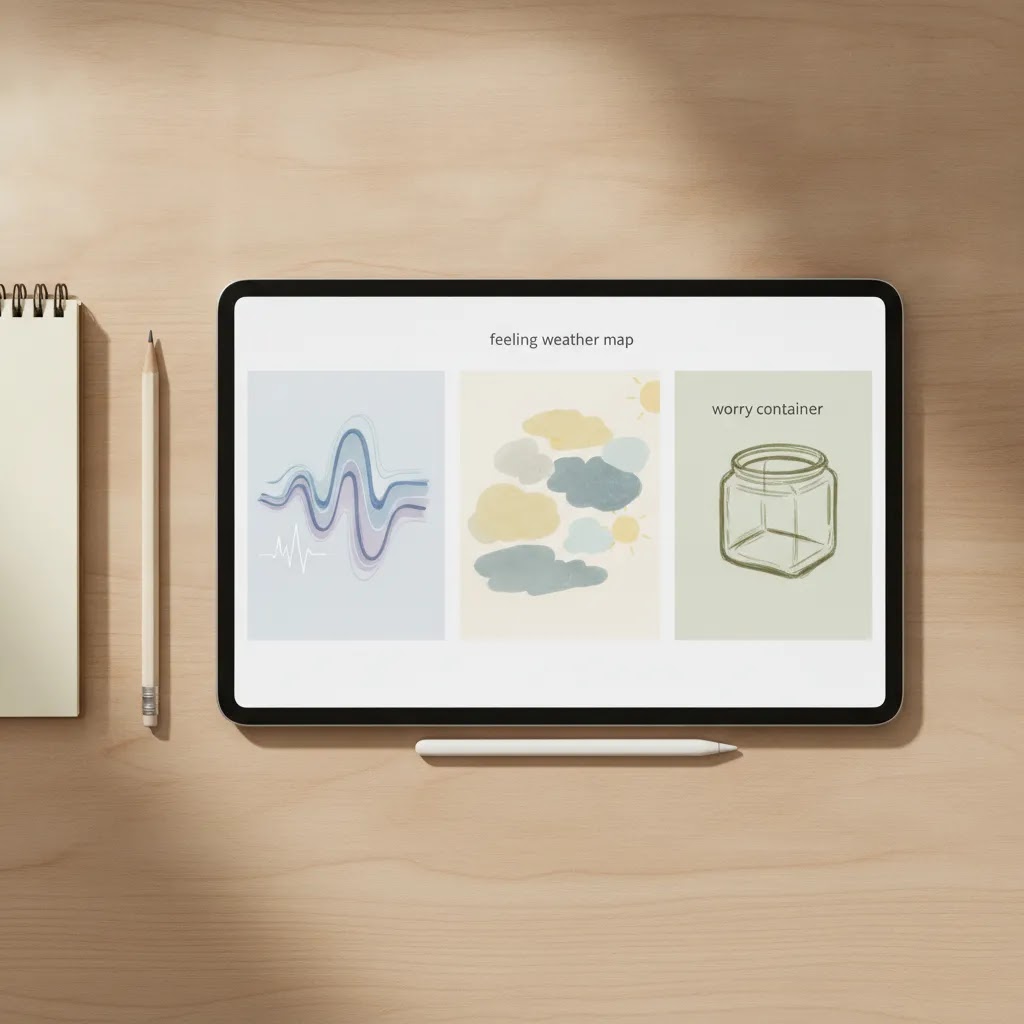
You turn your emotional state into weather symbols, colors, and zones on a digital page. A knot in the stomach might become lightning. Sadness could show up as fog. Relief may look like a patch of clear sky.
Why it matters: many people do not feel one clean emotion at a time. This exercise makes mixed states visible without forcing perfect labels. It can be especially helpful if words like “fine” or “bad” are doing too much work.
The key benefit is emotional granularity, which means noticing more detail in what you feel. However, a quick weather sketch can stay descriptive unless you pause to ask what each symbol needs, changes, or affects.
Digital art therapy activities for beginners: mood-as-landscape prompt
If weather metaphors work for you, a landscape metaphor often goes one step further. You imagine a landscape that matches how you feel today, then draw it. It can be literal or symbolic. The point is to give your inner state an outer shape you can look at.
A 2-minute version for low energy: choose 2 colors, then place 3 simple shapes on the page. A hill, a lake, a wall, a path, a sun, a heavy cloud. Stop there and notice what you made.
A deeper version when you have more room: add foreground and background, then decide what the “weather” is doing inside the landscape. You can include paths, obstacles, shelters, edges, or open areas. Many people find it useful to add one element that represents support, even if it feels small.
Reflection is what keeps the landscape from staying purely descriptive. A few questions that tend to open meaning gently:
- What in this landscape needs space right now, and what needs protection?
- Where is movement possible, and where does it feel blocked?
- If one part of this scene could change by five percent, what would shift?
- What would “support” look like here: a bridge, a boundary, a light source, a map, a place to rest?
If the prompt pulls up more feeling than you expected, scale it down. Use fewer colors, make the canvas smaller, or set a shorter timer. The goal is a workable image, not an emotional deep end.
3. Worry Container Sketch
This activity asks you to draw a box, jar, room, envelope, or other container, then place worries inside it using shapes, marks, or brief words. Digitally, layers and colors can help separate what feels loud from what feels distant.
Why it matters: some exercises open emotion, but this one also adds boundary. That makes it useful when thoughts feel scattered or intrusive. You are not pushing feelings away. You are giving them a visible place.
The strongest part of this exercise is containment. It can support panic-prone moments, bedtime overload, or pre-session organization. The caveat is that it may feel a little structured for people who want freer self-expression first.
4. Color-in-the-Body Scan
You sketch a simple body outline and add colors, density, or texture where sensations show up. Heavy shoulders might become dark blocks. A buzzing chest could appear as jagged yellow lines. Calm may barely register, and that is useful information too.
Why it matters: this connects feeling with sensation. For many people, especially those who shut down emotionally, the body notices stress before the mind can explain it.
The benefit is clarity around patterns such as tension, numbness, heat, restlessness, or collapse. The caveat is pacing. If body-focused work feels intense, shorter timing and gentler prompts may be a better fit, especially within trauma-informed care. For additional context, you might also explore art therapy for anxiety.
5. Two-Panel Before and After
This activity uses two frames. In the first, you draw how things feel now. In the second, you draw a small shift, not a perfect ending. That second image might show more space, softer edges, steadier color, or one supportive element added in.
Why it matters: change can be hard to notice when you feel stuck. Two side-by-side images make movement visible, even if the movement is only five percent.
The benefit is perspective. It works well for grief, heartbreak, burnout, or session review. However, some people may jump too quickly into “better” imagery. Gentle pacing helps keep the second panel honest rather than performative.
6. Safe Place Image Build

You create a digital image of a place, scene, or symbolic setting that feels steady enough to return to. It does not have to be realistic. It can be a room, shoreline, color field, garden, or even an imagined shelter made of shapes and light.
Why it matters: a resourcing exercise can help before difficult material, after a hard conversation, or during emotionally crowded days. The image becomes something you can revisit instead of rebuilding from scratch every time.
Its value is repeatability. The caveat is that not everyone connects with “safe place” language. For some, “steady place” or “less overwhelming place” may feel more believable. If you are comparing modalities, this also overlaps with themes in expressive arts therapy vs art therapy.
7. Parts of Me Visual Map
This exercise maps different inner voices or roles as shapes, symbols, colors, or sections of the screen. One part may be tired, one protective, one angry, one hopeful. You do not need formal parts work language to use it.
Why it matters: inner conflict often feels confusing because everything speaks at once. A visual map separates those strands without asking you to decide which one is “right.”
The benefit is self-understanding with less judgment. It can be strong for identity questions, caregiving strain, school pressure, and relationship tension. The caveat is that it usually needs more time than a quick grounding exercise, so it fits best in sessions with room to reflect.
8. Boundary Circles Exercise
You place yourself in the center of a digital page and draw circles, zones, or distances to represent people, responsibilities, demands, and supports. Color, size, and placement help show who feels close, draining, welcome, or unclear.
Why it matters: boundaries can be difficult to explain abstractly. A visual map quickly reveals crowding, emptiness, or mismatched closeness.
The benefit is concrete relational insight. It is often useful after conflict or before a conversation where you need more clarity. The caveat is that it may feel conceptual for younger users unless the prompt is simplified with icons or very plain language.
9. Scribble Transformation
You begin with a loose scribble and slowly turn it into something else by tracing, shaping, or finding images inside it. On a screen, undo and layering features can reduce pressure and invite experimentation.
Why it matters: this activity interrupts perfectionism. There is no blank page problem because the page is already messy. Your job is only to respond.
The benefit is play, flexibility, and creative re-entry. It can be helpful for teens, tired adults, and anyone who freezes when an exercise feels too loaded. As a result, it works best as an opener or pressure-release tool, even though it is less targeted than the higher-ranked activities.
10. The Guide of Art Therapy for Covid-19 patients
This entry is different from the rest. It is a downloadable guide designed to psychologically support senior citizens, hospitalized patients, and other people in quarantine. That specific focus gives it value in care settings shaped by isolation, illness, or restricted movement.
Why it matters: guides can help practitioners or caregivers think through structured support when direct session options are limited. The population focus is its strongest feature.
The limitation is format. A guide is not the same as a ready-to-run hands-on digital exercise, so it ranks lower for immediate session use. It may still be helpful as a reference point, especially if you are exploring the broader space of Digital Art Therapy & Apps.
Pros and cons of digital art therapy activities

Strengths of digital art therapy activities
- Digital art therapy activities can lower the pressure to find the right words.
- Many exercises are short enough to use in real-life moments of stress.
- Visual structure can help teens, beginners, and neurodivergent users engage more easily.
- Activities can support both regulation and later reflection.
- Digital formats may feel more private and accessible than paper-based work for some users.
Considerations for digital art therapy activities
- Not every exercise is suitable when distress is intense or safety is a concern.
- Some body-based or memory-linked prompts may feel activating if pacing is too fast.
- Digital tools can support care, but they do not replace qualified human help where deeper support is needed.
Choosing digital materials by emotional goal
Even on a screen, “materials” matter. A controlled pencil brush can feel very different from a wet paint brush, a spray texture, or a blurred airbrush. Collage and layers can also change the emotional tone because you are building meaning by arranging, covering, revealing, and reworking.
Here is a simple way to choose tools based on what you need most in the moment:
- Regulation: repetition-friendly tools often help. A consistent pencil, a single brush size, a limited palette, or a simple pattern can make the activity feel steady and predictable.
- Expression: messier brushes, larger strokes, and higher contrast can help if you feel blocked. Big gestures and rough texture sometimes give emotion a place to go without needing a perfect story.
- Containment: frames, boxes, masking tools, and clear boundaries can help if you feel flooded. You can literally decide where marks are allowed to go, and where they stop.
- Meaning-making: symbols, stamps, collage layers, and small detail work can help when you want insight. Arranging images can be a gentler step than writing paragraphs, especially if your feelings are complex.
A gentle risk flag is worth naming here. Certain textures, colors, or body-linked imagery can feel unexpectedly activating for some people, especially if there is trauma history or if you are already near your edge.
If you notice intensity rising, scale down rather than push through: use a smaller canvas, choose fewer colors, switch to a simpler brush, or set a shorter timer. Stopping is allowed. Containment and pacing are part of the work.
How to choose the right digital art therapy activity for your next session
Start with your state, not with what sounds most creative. If you feel flooded, a low-demand exercise such as breath-linked lines or a worry container usually makes more sense than a deeper identity prompt. If you already feel fairly steady, you may have room for mapping parts, boundaries, or transition images.
Next, notice how much language you have available. Some days you can reflect in full sentences. Some days even naming one feeling feels like work. Activities with metaphor, color, and shape can bridge that gap. That is one reason digital drawing can sit well alongside broader expressive methods, including themes often discussed in expressive arts work.
Also think about the session goal. Are you trying to settle, express, organize, understand, or prepare for conversation? Each goal points toward a different exercise. Grounding and containment are not the same as meaning-making. Both matter, just at different moments.
One more factor is repeatability. The most useful activity is often the one you can return to without dread. A simple practice repeated several times may be more helpful than an ambitious prompt you avoid. If you want a broader sense of related pathways, the category pages on Anxiety, Stress & Emotional Wellness and digital art therapy can offer more context.
Daily Lemons fits into this space as a gentle, therapist-designed digital art therapy app built around short guided drawing exercises, a calm voice-guided structure, and low-verbal prompts. If you are exploring options, it can be one useful example of how therapeutic structure translates into digital practice without requiring art skill or long written reflection.
Frequently Asked Questions
What are digital art therapy activities?
They are guided creative exercises done on a phone, tablet, or computer to support emotional expression, grounding, reflection, or relational insight. They often use color, shape, rhythm, symbols, and simple drawing tasks. The goal is usually not artistic quality. It is to help you notice and externalize inner experience in a more manageable form.
Do I need to be good at drawing to use them?
No. Most effective activities are intentionally simple. Lines, blocks of color, circles, containers, and rough symbols are often enough. In many cases, being less focused on artistic outcome makes the work easier. The exercise is there to help you observe and express, not to produce something polished or impressive.
Are digital art therapy activities only for therapy sessions?
No. They can be used in formal sessions, between appointments, or as part of a personal reflective practice. The main difference is support level. In a session, a qualified professional may help with pacing and reflection. On your own, it may be be best to choose shorter, more containing activities if you are feeling stretched.
What is the best activity for beginners?
Breath-linked line drawing is often the easiest place to start because it has very low pressure and almost no decision load. A feeling weather map is another good beginner choice if you want a little more emotional exploration. Both can be done quickly and do not require art knowledge or long written reflection.
Can these activities help with anxiety or stress?
They may help some people feel more settled, focused, or emotionally clear, especially when the activity matches the moment. Exercises that use rhythm, repetition, and containment can be useful for anxious states. Still, results vary, and digital self-help is not a substitute for crisis care, emergency support, or individualized professional care.
How is this different from regular drawing apps?
Regular drawing apps usually give you tools. Digital art therapy activities add therapeutic structure, such as a clear prompt, emotional intention, pacing, reflection, and boundaries around the task. The difference is not the stylus or screen. It is the purpose and design of the exercise.
Can kids or teens use these activities?
Some can, especially simple and visual prompts like weather maps, scribble transformation, or safe-place imagery. Younger users may need shorter timing and very concrete instructions. Adults supporting children should pay attention to privacy, pacing, and whether the activity seems to soothe or stir up more than the child can comfortably hold.
Are digital art therapy activities evidence-based?
Art-therapy-informed digital practices draw on established ideas about externalization, embodiment, symbolic expression, and reflection. Research in digitally delivered arts therapies is still developing, so claims should stay careful. These activities may be useful tools, but they should not be framed as guaranteed outcomes or replacements for qualified treatment.
What is digital art therapy?
Digital art therapy is art-therapy-informed work that uses a digital medium such as a tablet, phone, or computer for image-making. In formal settings, it is typically facilitated by a credentialed professional who uses digital tools as part of a therapeutic process, including pacing, reflection, and emotional safety. Outside formal care, people sometimes use the term to describe structured self-guided activities that support emotional expression and grounding through digital drawing.
What is better, EMDR or art?
They are different tools for different needs, and “better” depends on your goals, your history, and the kind of support available. EMDR is a specific, clinician-delivered psychotherapy approach that includes structured protocols and specialized training. Art-based approaches can support expression, regulation, and meaning-making, and they may feel more accessible when words are limited. If you are choosing between modalities, a licensed clinician can help you assess fit, readiness, and pacing, especially if trauma is part of the picture.
What are the 3 C’s of art?
People use “3 C’s” in different ways, so you may see more than one version depending on the context. In therapy-adjacent creative work, a practical way to think about three helpful C’s is: create (make something), contain (give it boundaries so it feels manageable), and connect (reflect on what it relates to in your life). If a specific clinician, program, or classroom uses a different definition, it is worth asking what they mean so you are working from the same language.
What are some art therapy activities?
Common art-therapy-informed activities include drawing feelings as weather, making a worry container, mapping boundaries, creating a safe or steady place image, and transforming scribbles into recognizable forms. Collage, symbol drawing, and two-panel “before and after” images are also widely used because they support both expression and reflection without requiring detailed artistic skill.
How we approached this list
This ranking centers on session usability. The highest-ranked activities are the ones most likely to help a person start, continue, and complete an exercise when energy, focus, or words are limited. We gave more weight to low setup, clear emotional purpose, and gentle containment than to novelty.
We also considered fit across different users, including beginners, teens, adults under stress, and people who prefer non-verbal tools. Activities that can flex between self-use and guided use ranked better. Reference materials and guides were included where relevant, but ranked lower if they were less direct for hands-on session work.
Quick recap of digital art therapy activities
If you want the shortest path into this topic, the top activities on this list are the ones that ask the least from you while still creating useful emotional movement. A few are best for settling. Others are better for clarity, boundaries, or identity work.
| Rank | Activity | Best for | Price |
|---|---|---|---|
| 1 | Breath-Linked Line Drawing | Fast grounding | — |
| 2 | Feeling Weather Map | Mixed emotions | — |
| 3 | Worry Container Sketch | Containment | — |
| 10 | The Guide of Art Therapy for Covid-19 patients | Reference use in quarantine-related settings | — |
Key Takeaways
- Digital art therapy activities work best when they match your current state and session goal.
- Simple, hands-on exercises often help more than complex prompts when you feel overwhelmed.
- Activities that combine expression with containment tend to be especially useful for session work.
- Digital formats can support emotional exploration, but they are not a replacement for human care when more support is needed.
- Begin with one low-pressure exercise and notice what feels slightly easier, steadier, or clearer afterward.
Conclusion
The best digital art therapy activities are not necessarily the most elaborate ones. They are the ones that help you begin. A steady line, a weather map, a container, or a simple two-panel image can create enough structure to make feeling more bearable and reflection more possible.
If you are curious about this area, you might explore a few activity types and notice which ones feel grounding, which ones feel expressive, and which ones feel like too much for today. Daily Lemons is one gentle place to keep exploring digital art therapy through short, guided visual exercises designed for real-life emotional moments and between-session support.
This article is for educational purposes only and does not provide medical, psychiatric, legal, or crisis advice. Digital art therapy activities may support reflection and emotional regulation, but they do not replace care from a qualified licensed professional. If an exercise increases distress, stop and seek appropriate support. If you or someone else may be at risk of harm or feels unable to stay safe, contact local emergency services, a crisis resource, or a qualified professional right away. For formal art therapy in the United States, you may review professional information through organizations such as the American Art Therapy Association and applicable state licensing or credentialing bodies. For crisis and suicide prevention support in the United States, you can also review 988 Lifeline. Product details, availability, and pricing may change over time and should be verified directly with the provider.