Art Therapy for Teens (2026 Guide)
What helps a teenager talk when talking feels like too much? Sometimes it is not another question. Sometimes it is a page, a pencil, a torn piece of paper, or a color choice that says, “this is what it feels like inside.” That is why interest in art therapy for teens keeps growing. Adolescence brings fast emotional, social, and physical changes, and not every teen wants to explain those changes out loud. This guide is for parents, caregivers, professionals, and teens themselves who want a grounded starting point. You will learn what art therapy for teens means, where it may help, what approaches tend to fit adolescent needs, and how to tell whether a therapist, program, or digital support option feels appropriate. If you want the broader context first, you can start with Art Therapy Fundamentals.
Who this guide is for and what teens may need
This guide is written for beginners and intermediate readers. If you are a parent trying to support a shut-down teen, a counselor looking for a clearer overview, or a teen wondering whether this is “for people like me,” you are in the right place.
Teen years are not simply a smaller version of adulthood. Emotional needs can look sharper, faster, and more changeable. Identity, body image, friendships, school stress, family conflict, social media pressure, grief, and anxiety may all overlap at once. A teen may want privacy and support at the same time. They may resist direct advice but still need structure.
Art therapy can meet that tension well because it gives space for expression without requiring polished language. It may help a teen show patterns, feelings, and internal conflicts that feel hard to name. It also creates a shared object, like a drawing, collage, or visual journal page, that can make difficult conversations feel less confrontational.
What you’ll learn
- What art therapy for teens means in plain language
- Why adolescence needs a different approach than adult emotional care
- Which emotional challenges may respond well to art-based work
- How individual, group, school-based, and digital formats differ
- What therapeutic techniques often work best with teenagers
- What real strengths and limitations to expect
- How to choose a safe, age-appropriate provider or support option
- How art therapy may sit alongside other supports, including mental health apps for teens
Why adolescence changes the art therapy conversation
Teenagers often live in contradiction. They may want independence but also reassurance. They may feel intensely self-aware and still have trouble identifying what they feel. They may care deeply about being understood while pushing away adult attempts to help.
That matters because support that feels useful for an adult can feel intrusive, flat, or embarrassing to a teen. Art therapy for teens usually works best when it respects autonomy, avoids over-interpreting everything, and allows emotional distance. A teen can draw a storm, build a mask image, or make a collage about “pressure” without having to confess every detail directly.
Adolescent development also brings identity work to the front. Questions like “Who am I?”, “How do people see me?”, and “Where do I belong?” often sit underneath the surface. Art-based work can help with these questions because teens can explore symbols, styles, and themes in a way that feels less forced than a direct conversation.
Another difference is pace. Teen emotions can shift quickly, and their willingness to engage may vary from week to week. A good approach leaves room for that. It does not treat reluctance as failure. It treats resistance as information. Is the prompt too exposing? Is the setting too adult-led? Is the teen worried about judgment? Those questions matter more than whether the artwork looks “meaningful.”
If you are comparing age groups, the needs are distinct. Adults may enter art therapy with more stable insight or more choice in seeking help. Teens often arrive through school concerns, family worry, or stress that has built up quietly. That is one reason articles on the Art Therapy Fundamentals topic can be helpful, but adolescence still deserves its own lens.
What art therapy for teens actually looks like
Art therapy is a guided emotional support process that uses creative activity as part of exploration and reflection. For teens, this may include drawing, painting, collage, comics, photography, visual journaling, clay, mixed media, or digital image-making. The goal is not artistic skill. The goal is expression, perspective, and emotional processing.
Common session formats
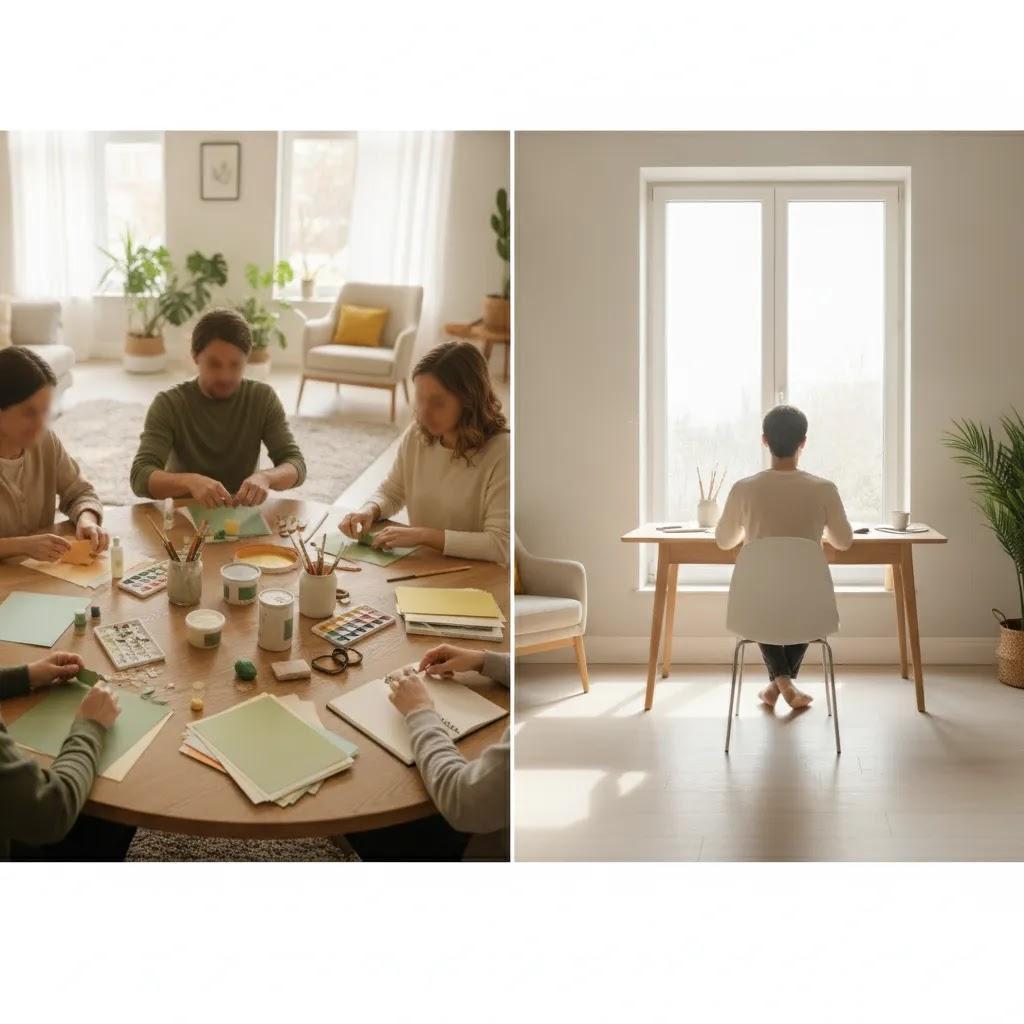
A teen might meet one-on-one with a therapist, join a group, participate through a school setting, or use structured digital creative tools between sessions. Each format changes the experience.
- Individual sessions may suit teens who need privacy, deeper trust-building, or room to work through personal themes.
- Group sessions may help with isolation, social confidence, and peer understanding, though shy teens may need time to warm up.
- School-based support can improve access, but privacy and scheduling can affect comfort.
- Digital supports may feel easier to start at home and can work well as a bridge, especially for teens who already think visually.
What happens in a session
A therapist may begin with a gentle prompt such as “show what your week felt like in colors” or “make an image of what stress looks like on the outside and the inside.” After creating, the teen is usually invited to reflect. The therapist may ask open questions, notice themes, or help the teen connect the image to situations, relationships, or body sensations.
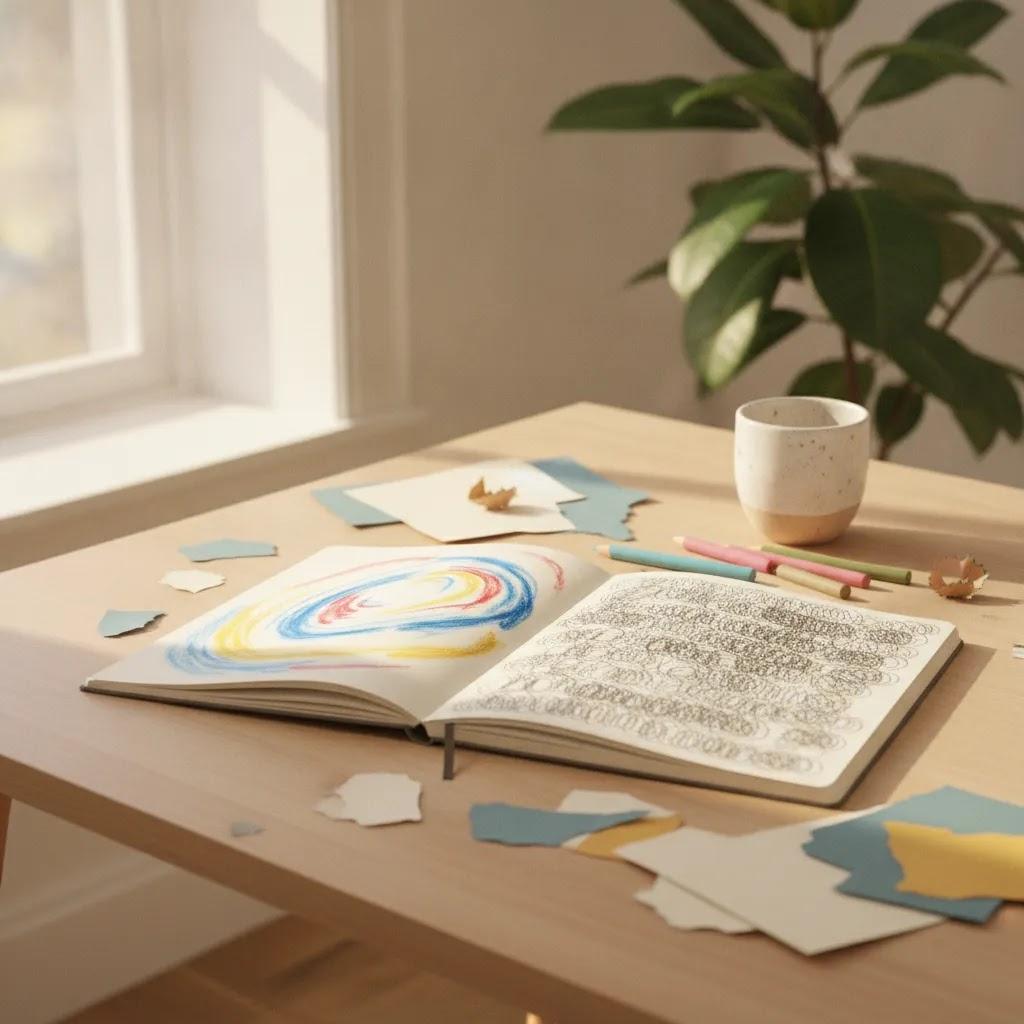
The artwork does not need a hidden meaning. Sometimes a page is simply a safe way to release pressure. Other times, repeated symbols, blank spaces, torn edges, or changing color choices may help a teen notice patterns over time.
What it is not
It is not an art class. It is not a test. It is not a demand to “open up” on command. And it is not always enough by itself. Some teens benefit from it as one part of broader support, especially if anxiety, family conflict, or school refusal are also present. If anxiety is central, you may also want to read art therapy for anxiety.
Art therapy activities and prompts for teens (optional, at-home friendly)
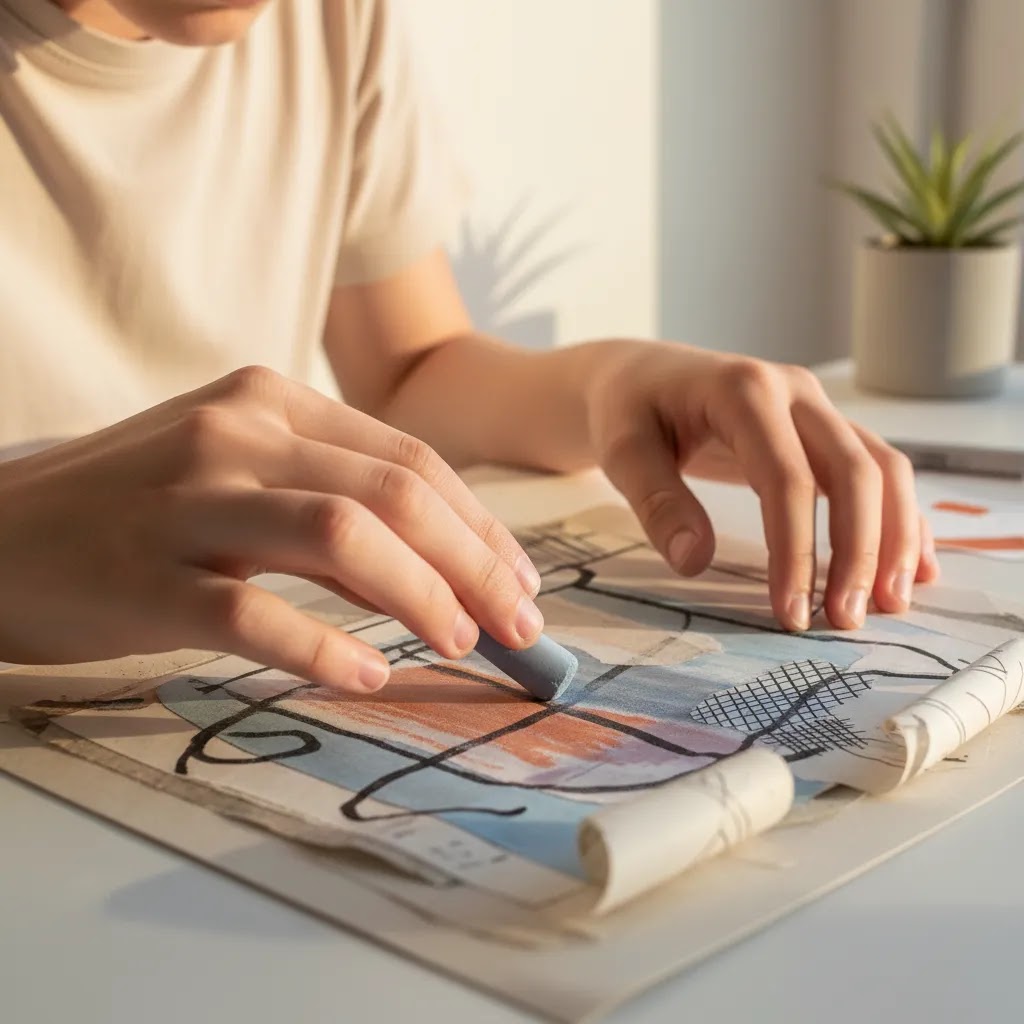
Here’s the thing: you do not need to be a therapist to offer a teen a gentle creative option at home. You do need to keep it autonomy-first. These prompts are best framed as experiments, not assignments. A teen should be able to choose a different prompt, change the rules, or pass entirely without consequences.
If a teen is already working with a therapist, at-home art can also be a between-session support. Still, it is usually wise to keep the goal simple: expression and release, not “figuring everything out.”
Teen-appropriate prompts that tend to work well
Consider this as a small menu. You can offer two or three options and let the teen pick, or invite them to invent their own version.
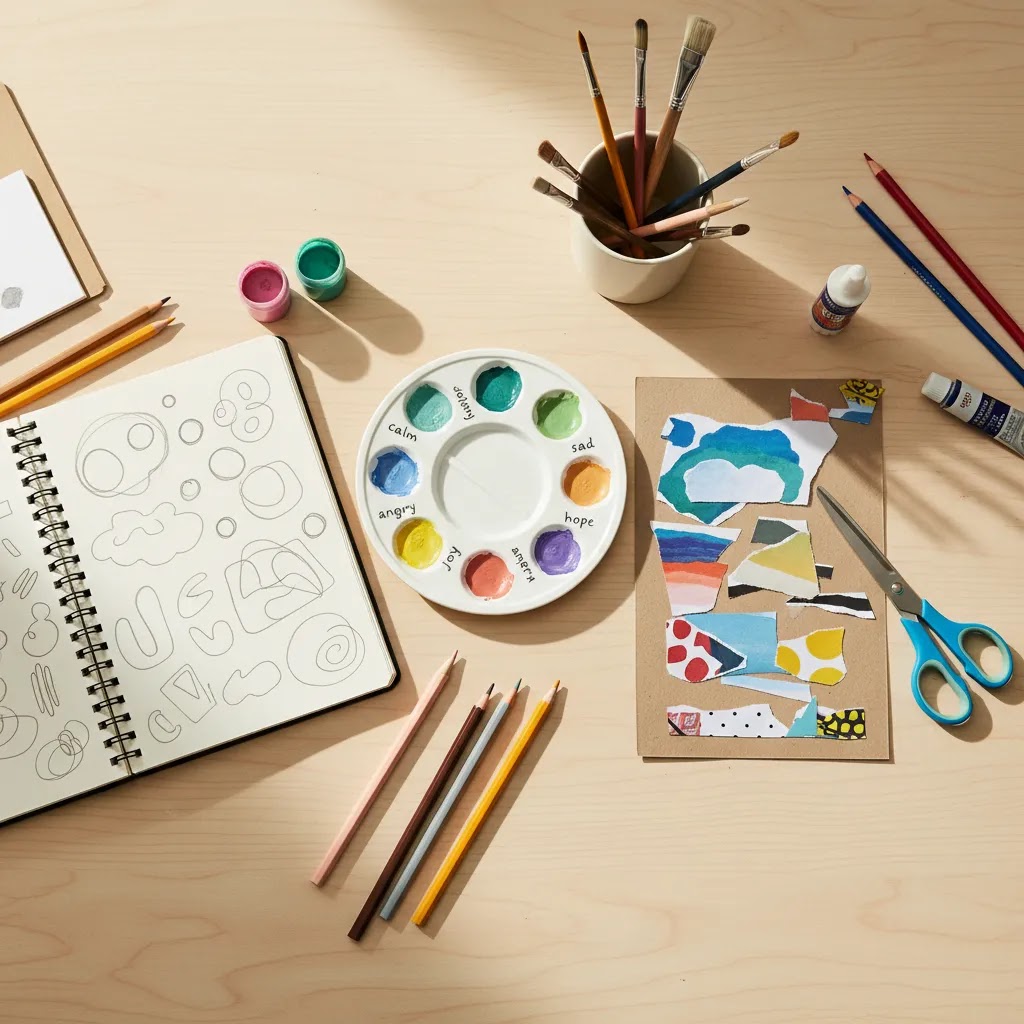
- Feelings in color map: Pick 3 to 6 colors that match how you feel today. Fill a page with shapes, blocks, gradients, or scribbles. You can label the colors if you want, but you do not have to.
- Inside vs. outside: Split a page in half. On one side, draw how you look to other people this week. On the other, draw what it actually felt like inside.
- Mask or self-portrait (real vs. performed): Make a mask image, a face, or a silhouette. Add what you show, what you hide, and what you wish people would understand.
- Identity collage: Use magazine scraps, printed words, old photos (or just handwritten words) to build a page of “things that are me” and “things people assume about me.” It can include music, aesthetics, interests, roles, and contradictions.
- Emotion wheel, but personal: Draw a circle. Divide it into slices and fill each slice with the feeling you had most often this week, using a color, symbol, or texture. If the teen hates naming emotions, the slices can be “tight chest,” “too much,” “blank,” “buzzing,” or any language that feels real.
How to choose a prompt based on the teen’s energy
From a practical standpoint, the “best” activity is often the one that matches what the teen can actually tolerate that day.
- If they feel overwhelmed, choose something repetitive and containing, like color mapping, filling shapes, or creating a simple border and staying inside it. Lower the demand for details.
- If they feel numb or blank, try collage, photography, or “find and paste” activities. Sometimes choosing images is easier than generating images.
- If they feel angry, consider bigger movements and bolder tools, like large paper, thick markers, or clay. Prompts like “draw anger as weather” can create distance without shutting it down.
- If they feel exposed, choose symbolic prompts rather than personal ones. A storm, a landscape, a comic character, or an abstract pattern can be safer than a self-portrait.
What many people overlook is that choice is part of the support. A teen who picks the prompt, picks the materials, and decides whether to talk about it is often more engaged, even if they say very little.
How to debrief safely (and avoid over-interpreting)
If the teen wants to talk about what they made, gentle questions can help. If they do not, that can be respected too.
- Questions that are usually safer: “What title would you give this?”, “What part feels most true?”, “What was it like to make this?”, “If this had a soundtrack, what would it be?”, “Is there anything you want me to know about it, or should we just let it be?”
- Questions that often backfire: “What does that symbol mean?”, “Is this about your dad?”, “Are you trying to tell me something?”, “Why did you use black?”, “So you’re depressed?”
The reality is that art can hold a lot at once. A color choice might be about mood, or it might just be the marker that still worked. Try not to treat the artwork like evidence in a case. Treat it like a doorway the teen can choose to walk through, at their pace.
Adolescent emotional challenges art therapy may help address
Art therapy may support a wide range of teen emotional needs, but the fit depends on the teen, the setting, and the quality of support. The strongest use case is often not “fixing” a single problem. It is creating a safer path for expression, regulation, and reflection.
Stress, pressure, and perfectionism
Many teens carry academic pressure, performance anxiety, and fear of disappointing others. Art-making can interrupt that loop because it offers process over performance. A teen who feels trapped in grades and expectations may benefit from a space where there is no single right answer.
Identity confusion and self-image
Teens often use visual symbols naturally. A self-portrait exercise, mask project, or future-self collage may help them explore identity, gender expression, belonging, and self-worth with more safety than direct questioning.
Grief, loss, and family changes
Separation, divorce, relocation, death, friendship breakups, and major life transitions can leave teens emotionally flooded or numb. Art can help hold mixed feelings at once. A memory box image, timeline piece, or layered collage can make room for sadness, anger, relief, and confusion together.
Anxiety and emotional overwhelm
For some teens, verbal processing increases pressure. Art tasks that focus on lines, textures, repetition, or visual mapping may help slow things down enough for reflection. For a deeper look at anxiety-specific use, see art therapy for anxiety.
Social struggles and isolation
Group art therapy can sometimes help teens who feel alone in what they are experiencing. Shared creative work may lower the intensity of direct social interaction while still building connection.
Shut-down communication
Some teens answer every question with “I don’t know.” That does not always mean they have nothing to say. It may mean language feels unreachable, risky, or too slow. Art-based work can offer another route. You can also compare teen-specific outcomes with the broader benefits of art therapy for adults to see how developmental needs shift across age groups.
Therapeutic approaches that often fit teens best
The most helpful approach usually depends on the teen’s personality, comfort level, and emotional goals. A good provider or platform adapts the process rather than forcing one style.
Low-pressure directive prompts
Some teens do better with a simple prompt than with complete freedom. Prompts like “draw your social battery,” “make a map of your safe places,” or “show what anger looks like if it had weather” can create enough structure to get started without feeling controlling.
Choice-based creative work
Other teens need more autonomy. Giving options in materials, themes, pace, and whether to discuss the artwork can increase buy-in. Autonomy matters a lot in adolescence, especially for teens who already feel overmanaged.
Identity-centered projects
Visual journaling, collage, photography, and mixed media can work well for identity exploration because they allow complexity. A teen can hold contradiction, humor, uncertainty, and experimentation on the page without needing to resolve it immediately.
Body-aware creative exercises
Some art therapy techniques ask teens to locate feelings physically, such as drawing where stress sits in the body or using color to show energy shifts. This can be especially useful for teens who say they feel “fine” while their body tells a different story.
Digital and app-supported options
Digital creative tools may be easier for teens who are already comfortable using tablets or phones for expression. These supports can be especially useful between sessions or as a gentle first step for teens who are not ready for in-person care. If that is relevant, explore mental health apps for teens as a parallel option rather than a replacement for qualified support.
What “best” really means here
The best art therapy for teens is rarely the flashiest program. It is the one that matches developmental stage, respects privacy, uses age-appropriate prompts, and does not confuse compliance with progress. If you want a deeper look at likely outcomes, the article on benefits of art therapy for teens can help.
Materials and mediums: how tools can shape the experience
Now, when it comes to teens, materials matter more than many adults expect. Not because each tool has a fixed meaning, but because different materials can change how safe, controlled, messy, private, or intense the experience feels. That can affect whether a teen engages at all.
Think of it this way: some teens need structure to feel calm. Others need a little mess to feel release. The tool can support either, without forcing a big conversation.
What different tools can bring out
- Pencil and pen: Often feels controlled and precise. It can suit teens who are anxious, perfectionistic, or wary of “making a mess.” It can also support comic strips, mapping, and journaling.
- Markers: More immediate, bold, and less fussy than colored pencils. Markers can make it easier to express intensity quickly, but they can also feel “too loud” for a sensitive teen.
- Paint: Can feel freeing, sensory, and less controlled. For some teens, that is the point. For others, it can feel exposed or stressful because it is harder to undo. Watercolor can be a softer middle ground than acrylic.
- Collage: Great for teens who feel stuck, numb, or self-conscious about drawing. Choosing images and arranging them can be expressive without requiring art “skill.”
- Clay or modeling materials: Hands-on and body-based. It can help with grounding, releasing tension, or building a sense of agency. It can also be a good fit for teens who dislike sitting still and talking.
- Digital tools: Can feel familiar and private, especially for teens who already make edits, mood boards, or digital sketches. It can also reduce the fear of “ruining” a page because undo buttons exist.
What many people overlook is that a teen’s preference may change day to day. A teen might choose pencil when they feel raw, and paint when they feel restless. That is not inconsistency, it is self-regulation.
A teen-friendly starter kit (low cost, low mess)
If you are setting up supplies at home or in a school counseling office, a small kit can be enough. You do not need expensive materials to make the process meaningful.
- Sketchbook or plain printer paper
- Pencils, eraser, black fineliner or gel pen
- Basic marker set or colored pencils
- Glue stick, scissors, tape
- A small stack of old magazines, printed words, or scrap paper for collage
- An envelope or folder for “private pages” that the teen does not want displayed
Privacy is part of practicality. If a teen worries that a sibling or parent will stumble across their pages, they may not use the materials at all. A simple storage box, folder, or agreed-upon private drawer can make the difference.
Safety notes (and a reminder about meaning)
Use non-toxic supplies when possible, especially with paints, glues, and markers. If scissors, craft blades, or sharp tools are part of the setup, adult supervision and safe storage matter. If the teen is using digital art, consider basic privacy and consent, such as not posting personal work publicly, being careful with usernames, and understanding who can view shared files.
The reality is that materials are about comfort, not decoding. A teen choosing black does not automatically “mean” anything. Often it just means black felt right, or black was closest, or black was less annoying than explaining.
Pros and Cons
Strengths
- It gives teens a nonverbal way to express feelings that may feel hard or embarrassing to say out loud.
- It can reduce the pressure of direct conversation, which may improve engagement for shut-down or skeptical teens.
- It often supports identity exploration in a developmentally appropriate way.
- It can be adapted for different settings, including private practice, schools, groups, and digital support formats.
- It may help adults and teens discuss difficult topics through a shared creative reference point rather than through confrontation alone.
Considerations
- Some teens may initially resist anything that feels childish, forced, or overly interpretive.
- Access varies by location, cost, school availability, and provider training.
- Art therapy may not be enough on its own for severe distress, safety concerns, or complex family situations.
- Progress is often uneven, especially during adolescence, and buy-in can change from week to week.
Who this kind of support may fit best
Art therapy for teens may be a strong fit for adolescents who struggle to explain emotions, feel overwhelmed by direct questioning, or connect more naturally through images, music, design, or sensory expression. It may also suit neurodivergent teens, teens experiencing stress or grief, and teens who want emotional privacy without total isolation.
It may be less appealing for teens who strongly dislike visual expression or who feel pushed into participation by adults. In those cases, the issue may be the format rather than the teen. A flexible provider can often adjust the medium, pace, or level of discussion to make the experience feel more respectful and relevant.
A gentle DailyLemons option alongside therapy
Not every teen is ready for formal support right away. Sometimes a softer first step helps. DailyLemons can sit alongside therapy, school support, or family conversations as a low-pressure space for emotional reflection through creative, non-clinical exploration. That may be especially useful for teens who shut down with traditional journaling or find direct self-expression too exposing at first.
If you are exploring options, it may help to move gradually. Start with broader context in Art Therapy Fundamentals, then compare age-specific outcomes through benefits of art therapy for teens. If anxiety is part of the picture, Anxiety, Stress & Emotional Wellness offers a wider lens. And if you are assessing local in-person pathways, art therapy singapore may help readers comparing regional access models.
How to choose art-based support for a teen
Choosing support for a teenager can feel delicate because the wrong fit may lead to fast disengagement. A few criteria can help you evaluate options more calmly.
1. Developmental fit
Look for age-appropriate language, prompts, and materials. Teen-oriented support should not feel like elementary-school crafts, but it also should not feel like adult insight work repackaged with brighter colors. Good programs respect adolescent privacy, humor, and complexity.
2. Emotional safety and trust
Ask how the provider handles confidentiality, parent communication, group boundaries, and a teen’s right to pass on certain prompts. Emotional safety matters more than any single technique. Teens usually engage better when they know they will not be judged, rushed, or analyzed at every turn.
3. Flexibility of medium
Some teens prefer drawing. Others prefer collage, clay, photography, or digital formats. A flexible approach increases the chance of authentic participation. If a teen resists one medium, that does not automatically mean art therapy is the wrong fit.
4. Clarity about goals
Support tends to work better when the purpose is clear enough to feel relevant. Is the goal stress expression, identity exploration, grief support, school adjustment, or emotional communication? The answer does not need to be perfect, but a loose aim helps adults choose the right setting.
5. How it fits with other support
Art therapy may work well on its own, but often it helps most when coordinated with wider care. That could include school counseling, family support, or digital reflection tools. A teen might also benefit from resources within Art Therapy Fundamentals while exploring whether ongoing support feels right.
6. Practical access
Consider schedule, transportation, privacy at home, technology needs, and cost. The best support on paper may still fail if it is too hard to attend or too stressful to maintain.
What a qualified art therapist is (and what to ask before starting)
What many people overlook is the difference between “art that feels therapeutic” and art therapy as a professional service. Both can be valuable, but they are not the same thing.
Art therapy is typically provided by a clinician with specialized training to use art-making as part of emotional support. Other supportive roles can include art teachers, studio facilitators, mentors, and coaches. Those roles may offer structure and encouragement, but they do not necessarily offer the same clinical oversight, confidentiality practices, or crisis planning that a licensed provider may have.
If you are evaluating providers, it can help to look for clear professional credentials and a scope of practice that matches what your teen needs. In the United States, professional information is often tied to state licensing boards, and some art therapists may also hold credentials associated with professional art therapy organizations.
Screening questions that can clarify fit quickly
You do not need to interrogate a provider, but a few concrete questions can prevent confusion later.
- Training with teens: “What experience do you have working with adolescents, especially around privacy, motivation swings, and identity issues?”
- Confidentiality with parents: “What stays private, what would you share with caregivers, and in what situations would you have to break confidentiality for safety?”
- Goals and expectations: “How do you set goals with a teen who is not sure what they want yet? How do you know whether the work is helping?”
- How progress is tracked: “Do you track progress through themes, self-report, functional changes like school attendance, or something else?”
- What happens if the teen refuses a prompt: “How do you handle ‘no’ or shutdown moments? What does choice look like in your sessions?”
- Crisis and referral pathways: “If you become concerned about safety, what is the plan? Do you coordinate with other providers or refer out when needed?”
The reality is that teens often test for safety before they participate. A provider who can describe how they work with resistance, not against it, is usually a better sign than a provider who focuses only on compliance.
Access formats: in person, school-based, and telehealth
Access is not one-size-fits-all, and each format has tradeoffs.
- In-person private practice: Often offers the most controlled environment and material options. It may also be the hardest to access due to cost, transportation, and scheduling.
- School programs: Can improve access and reduce logistics. The main questions tend to be privacy, how records are handled, and whether the teen feels comfortable being seen going to sessions.
- Telehealth art therapy: This can be a real option for some teens, especially when local providers are limited or the teen feels safer at home. Still, it requires practical planning, such as a private space, basic supplies, and a plan for what happens if the session becomes emotionally intense.
If you are considering telehealth, ask directly about privacy, platform security, caregiver involvement, and what the provider recommends keeping on hand. It can also help to discuss how sessions will work if the teen does not want to show their art on camera, or if they want to create off-screen and share only parts.
Common mistakes adults make when introducing art therapy
Adults usually mean well, but a few common habits can make teens pull back.
- Overselling it as something that will quickly solve everything.
- Describing it in a way that sounds childish or overly cheerful.
- Pressuring the teen to explain every image immediately.
- Treating resistance as laziness instead of useful feedback about fit, safety, or timing.
- Assuming that “good art” equals better emotional insight.
- Ignoring digital formats that may feel more natural to some teens.
A more helpful stance is curiosity. What medium feels easiest? What feels cringeworthy? What level of privacy would help the teen feel less exposed? Small adjustments can change the whole experience.
Where to go from here

If this topic feels relevant, the next step does not need to be dramatic. You might continue with the teen-specific article on benefits of art therapy for teens to see where this support may help most clearly. If your teen is more comfortable with digital tools, review mental health apps for teens. If your question is more about the foundations of this practice overall, the Art Therapy Fundamentals category is a calm place to keep reading.
Frequently Asked Questions
What is art therapy for teens in simple terms?
It is a guided emotional support approach that uses creative expression, such as drawing, collage, painting, or visual journaling, to help teens explore feelings and experiences. It is less about making good art and more about creating a safer way to express what may be hard to say directly.
How is art therapy for teens different from regular art classes?
Art classes focus on technique, projects, and artistic skill. Art therapy focuses on expression, reflection, and emotional meaning. A teen does not need talent or experience to participate. The art activity is used as part of guided support rather than as a performance or graded outcome.
What age counts as “teen” for art therapy?
Most people use “teen” to mean roughly ages 13 to 19, but developmental stage matters more than the exact number. A 12-year-old and a 17-year-old may need very different prompts, privacy boundaries, and ways of discussing artwork. Good support adapts to maturity, not just age.
How does art therapy help teens?
It may help teens by offering a lower-pressure way to express and explore what is happening inside, especially when words feel risky, embarrassing, or unavailable. The art-making can support emotional regulation, identity exploration, and communication with a trusted adult. Results vary, and the strongest impact usually comes from a good fit between the teen, the approach, and the provider.
What are the benefits of art therapy for teens?
Benefits may include easier emotional expression, lower pressure than direct talk, support with stress or identity questions, and better communication with trusted adults. Outcomes vary. For some teens, the main value is simply having a tolerable way to show what is happening internally without needing perfect words.
Can art therapy help a teen with anxiety?
It may help some teens with anxiety by giving shape to worries, slowing down emotional intensity, and creating a more manageable way to explore pressure. It is not a guaranteed answer and may work best alongside other supports. The fit depends on the teen’s preferences, needs, and available care.
What are therapeutic art activities for teens?
They are creative activities that support emotional expression and reflection, without requiring a teen to explain everything directly. Examples can include feelings-in-color pages, inside vs. outside drawings, collage identity boards, mask images, or personal emotion wheels. The key is choice and emotional safety, not getting the “right” meaning from the artwork.
Do teens have to talk about their artwork?
No. A healthy process usually includes choice. Some teens talk a lot. Others begin by making images with very little discussion. Over time, the artwork may make conversation easier, but forcing explanation too early can increase resistance and reduce trust.
Is digital art therapy a real option for teens?
Digital creative support can be a very practical option, especially for teens who already use visual tools naturally. It may feel more private, familiar, or accessible. Still, digital tools vary in depth and are not always a substitute for qualified human support when a teen is struggling significantly.
Can art therapy be done through telehealth for teens?
Yes, telehealth can be an option for some teens, depending on local regulations, provider licensing, and the teen’s ability to have privacy at home. Practical details matter, such as having basic supplies available, a plan for showing or not showing artwork, and clarity on what happens if a session becomes emotionally intense. For some teens, telehealth feels safer. For others, it may feel too exposed at home.
How do I know if a teen is a good fit for art therapy?
A teen may be a good fit if direct conversation feels difficult, emotions come out more easily through images or sensory expression, or they seem more comfortable creating than explaining. Even then, success depends on timing, trust, and whether the approach feels age-appropriate rather than forced.
What if a teen says art therapy sounds childish?
That response is common. Often the issue is presentation, not the whole idea. Teens may respond better to language like visual journaling, mixed media, image-making, or creative emotional support. Respecting their preferences and offering real choices can make the option feel less patronizing.
Which is better, EMDR or art therapy?
Neither is universally better, they are different approaches that may fit different needs. EMDR is a structured therapy method that some licensed clinicians use for specific types of distress, while art therapy uses creative work as part of emotional exploration and regulation. A teen’s preferences, the provider’s training, and the specific goals matter a lot. In some cases, a teen may use more than one approach over time, but coordination should be handled by qualified professionals.
When is extra help needed beyond art therapy?
If a teen seems unable to stay safe, shows severe distress, withdraws sharply from daily life, or the situation feels urgent, art therapy alone may not be enough. In those moments, seek support from a qualified licensed professional, local emergency services, or an appropriate crisis resource as soon as possible.
Glossary
- Art therapy: A guided support approach that uses creative expression as part of emotional exploration.
- Directive prompt: A therapist-provided starting idea, such as drawing stress as a landscape or making a collage about identity.
- Visual journaling: A reflective practice that combines images, color, symbols, and sometimes words in a journal format.
- Mixed media: Creative work that uses more than one material, such as paper, paint, markers, photos, and collage pieces.
- Emotional regulation: The process of noticing, expressing, and managing feelings in a more workable way.
- Developmental fit: How well a support method matches a teen’s age, maturity, interests, and emotional needs.
Key Takeaways
- Art therapy for teens is most useful when it respects adolescent privacy, identity development, and changing motivation.
- It may help with stress, anxiety, grief, self-image, and shut-down communication, but it is not a one-size-fits-all answer.
- The best approach is usually the one that feels age-appropriate, flexible, and emotionally safe.
- Digital tools may work well as a starting point or between-session support for some teens.
- If safety concerns or severe distress are present, more immediate professional support may be needed.
Conclusion
Teen emotional life can be vivid, private, confusing, and hard to translate. Art therapy for teens matters because it offers another language, one that may feel more natural than explanation alone. A drawing, collage, or visual journal page will not tell you everything, but it may open a door that ordinary conversation has not. If you are weighing options, keep the focus on fit: age-appropriate support, emotional safety, flexibility, and the teen’s own comfort with the process. If you want to keep exploring gently, start with benefits of art therapy for teens or browse the wider Art Therapy Fundamentals resources when it feels right.
This article is for educational purposes only and is not medical or mental health advice. Art therapy may support emotional expression, but outcomes vary by teen, setting, and practitioner. If you are considering therapy, check a provider’s current credentials, scope of practice, and local professional standards. In the United States, professional information may be available through organizations such as the American Art Therapy Association and relevant state licensing boards. If a teen may be at risk of harm, feels unable to stay safe, or is experiencing severe distress, contact a licensed professional, local emergency services, or an appropriate crisis resource right away.