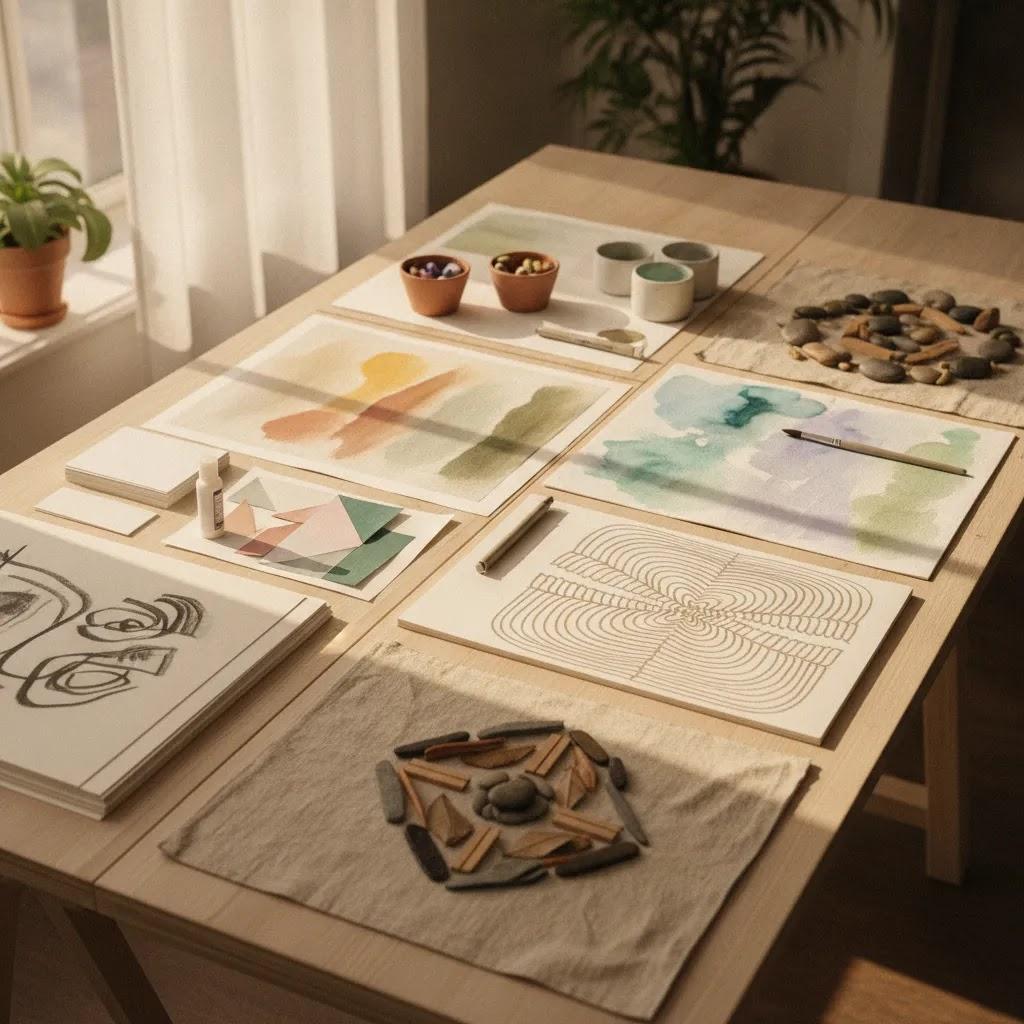
Art therapy approaches are different ways of using drawing, color, rhythm, and reflection to meet different emotional needs. Some art therapy approaches help you feel steadier first. Others support insight, story-making, or skill-building. The best fit usually depends on what you need right now.
Not every method helps in the same moment. One style may feel grounding when your body is buzzing. Another may help more when you are trying to understand a loss, a relationship pattern, or a shift in identity. That is why a single “best” method is rarely the point.
Instead, a better question is often: what kind of support fits what you are carrying right now? This guide compares six common art therapy approaches by when they tend to apply best, so you can compare art therapy approaches more clearly. If you want broader professional context first, you may also want to read about what an art therapist does and how formal practice differs from casual creative coping.
Why comparing art therapy approaches matters
People often use the phrase “art therapy approaches” as if it means one fixed method. In reality, art therapy approaches include several ways of using image-making, color, rhythm, metaphor, and reflection to support emotional processing.
Some approaches lean more bottom-up. That means they begin with sensation, movement, repetition, and nervous system settling. Others are more reflective and meaning-focused. They may help you notice patterns, externalize beliefs, or explore personal story.
This distinction matters because the same person may need different entry points on different days. If words feel far away, a sensory or containment-based exercise may be more reachable. If you already feel steady enough to reflect, a symbolic or narrative approach may offer more insight. If you are still sorting out how expressive art therapy relates to broader creative methods, it also helps to compare definitions before choosing a style.
Theoretical art therapy approaches you may hear about
“Approach” can mean two slightly different things, and that is where confusion often starts. One meaning is what this guide ranks: the state you are in and the goal you need most right now, such as stabilization, regulation, skill-building, or meaning-making. Another meaning is the therapist’s theoretical orientation, the counseling tradition that shapes how they understand change and how they structure sessions.
In real practice, many art therapists blend orientations. A session can include a stabilizing warm-up, a more reflective image, and a skills-based closing. So the label you hear in a directory is often a home base, not a rigid rule.
Psychodynamic art therapy approaches
- What it tends to focus on: recurring themes, inner conflict, attachment patterns, unconscious material, and how past experiences echo into the present.
- How it often looks in art: working with metaphor, dreams, repeated symbols, image dialogue, and noticing what feels “charged” in the picture.
- Where it maps here: commonly aligns with #3 Symbolic and psychodynamic work, and sometimes supports #5 Narrative and identity-based approaches when the focus is meaning over time.
Humanistic art therapy approaches
- What it tends to focus on: self-acceptance, personal meaning, authenticity, values, and a respectful, collaborative therapeutic relationship.
- How it often looks in art: open-ended image-making, reflective prompts, exploring identity themes, and emphasizing your lived experience rather than “correct” interpretation.
- Where it maps here: often overlaps with #5 Narrative and identity-based approaches, and can support #6 Play, experimentation, and mastery-focused work when the goal is less self-judgment and more permission.
Cognitive-behavioral art therapy approaches
- What it tends to focus on: noticing thought patterns, practicing coping skills, building emotion labeling, and creating repeatable tools for everyday moments.
- How it often looks in art: visual thought maps, coping cards, feeling thermometers, step-by-step prompts, and structured reflection.
- Where it maps here: most closely aligns with #4 CBT- and DBT-informed art therapy, and can also support #1 Trauma-informed stabilization when structure helps pacing.
Developmental and play-based art therapy approaches
- What it tends to focus on: how people grow and learn over time, how play supports emotional development, and how skills build gradually through experience.
- How it often looks in art: exploratory materials, playful constraints, incremental challenges, and activities tailored to age, attention span, and sensory needs.
- Where it maps here: frequently overlaps with #6 Play, experimentation, and mastery-focused work, and can connect to #2 Sensory regulation and rhythmic mark-making when repetition and movement support regulation.
Art psychotherapy vs art as therapy
You may also hear language like “art psychotherapy” versus “art as therapy.” This is less about which one is “real,” and more about where the work sits on a spectrum.
- Art psychotherapy typically emphasizes the relationship with a trained professional, careful pacing, and deeper processing. The art is part of a broader therapeutic conversation.
- Art as therapy often emphasizes self-guided creative practice for coping, regulation, and reflection in everyday life. The focus is frequently on process and relief rather than clinical interpretation.
Both can be valuable. However, the safer choice usually depends on what you are working with. If your nervous system gets overwhelmed easily, or if symbolic material becomes intense fast, more professional structure may be supportive. For professional background, the American Art Therapy Association offers credential and field information.
Full art therapy approaches comparison table
| Rank | Approach | Best for | Main aim | What it often looks like | Main strength | Main drawback |
|---|---|---|---|---|---|---|
| 1 | Trauma-informed stabilization | Overwhelm, fear, emotional flooding, fragile safety | Containment and pacing | Safe-place imagery, borders, containers, resource drawings | Usually gentler for activated states | May feel too indirect if you want deep interpretation right away |
| 2 | Sensory regulation and rhythmic mark-making | Stress, agitation, insomnia, racing thoughts | Downshifting arousal through movement and repetition | Breath-linked lines, gradients, bilateral drawing, repetitive patterns | Low verbal demand | May not answer larger meaning questions on its own |
| 3 | Symbolic and psychodynamic work | Recurring themes, dreams, inner conflict, grief imagery | Exploring symbolism and unconscious material | Metaphor drawings, image dialogue, recurring symbols | Can reach material that is hard to say directly | Could feel intense without a skilled guide |
| 4 | CBT- and DBT-informed art therapy | Rumination, emotion labeling, coping skills practice | Structure, reflection, and skill-building | Thought maps, feeling scales, coping cards, container drawings | Clear and teachable | May feel too structured for people who resist worksheets |
| 5 | Narrative and identity-based approaches | Life transitions, heartbreak, role changes, self-understanding | Meaning-making and self-story | Life maps, identity collage, chapter drawings, future-self imagery | Helpful for integrating experience over time | Less useful in acute distress |
| 6 | Play, experimentation, and mastery-focused work | Burnout, perfectionism, low motivation, creative shutdown | Agency, flexibility, and low-pressure engagement | Scribble transformation, non-dominant-hand drawing, finishable patterns | Often easiest to start | Can seem lightweight if you expect immediate depth |
Art therapy approaches and materials: what different media tend to support
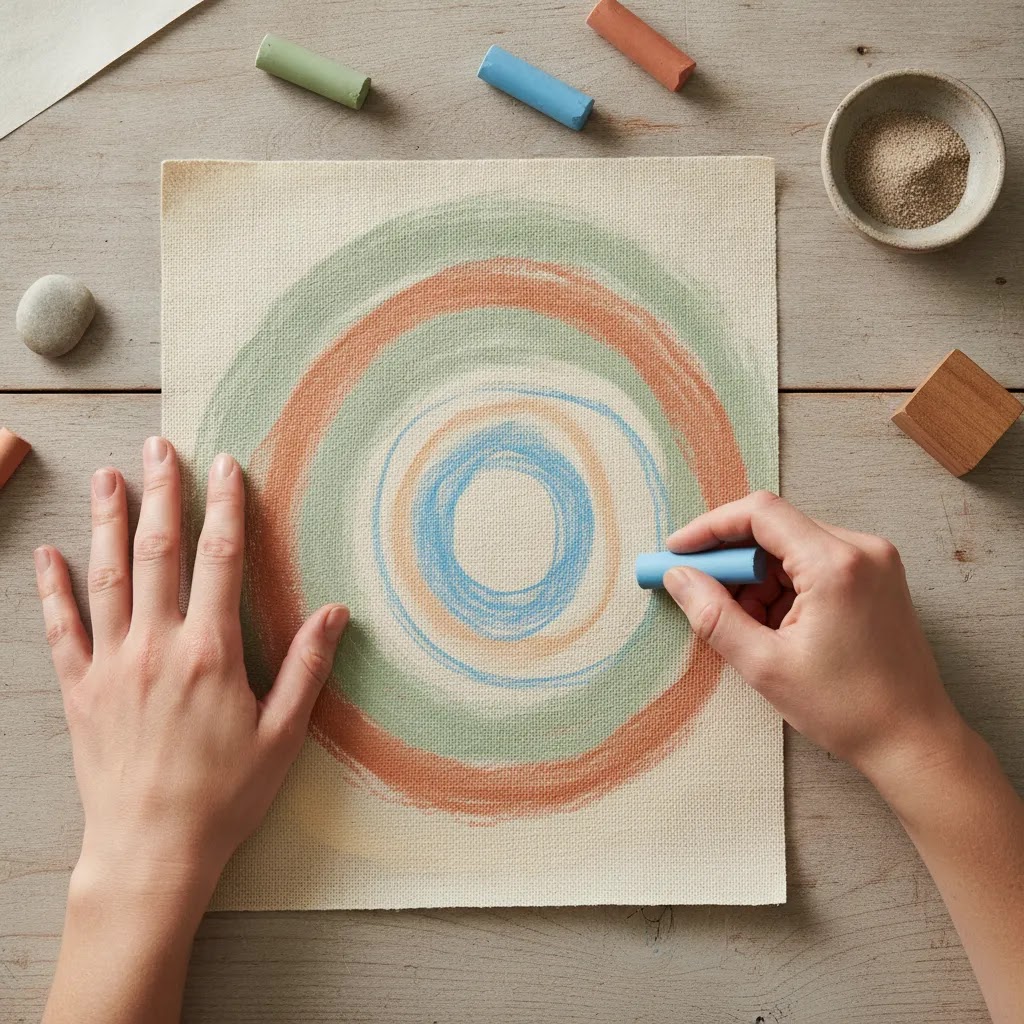
The approach you choose matters, but so does the material in your hand. The same prompt can feel completely different depending on whether you are using a pencil, paint, or clay. Media choice influences control, messiness, sensory intensity, and how fast you get feedback from the page.
If you are trying to regulate, stay within your window of tolerance, or reduce perfectionism, media can either support that goal or quietly work against it.
Pencil and pen for structured art therapy approaches
- What it tends to feel like: precise, controlled, easy to pause, easy to adjust pressure.
- Often supports: borders, containers, mapping, and anything that benefits from clear edges.
- Common matches: #1 Trauma-informed stabilization and #4 CBT- and DBT-informed art therapy, especially when structure feels calming.
Markers and colored pencils for faster art therapy approaches
- What it tends to feel like: faster than pencil, more immediate color payoff, less blended ambiguity.
- Often supports: feeling scales, mood tracking, quick externalization, and play with constraints.
- Common matches: #2 Sensory regulation and rhythmic mark-making, #4 CBT- and DBT-informed art therapy, and #6 Play, experimentation, and mastery-focused work.
Paint and water-based media
- What it tends to feel like: less controllable, more fluid, sometimes soothing, sometimes frustrating.
- Often supports: gradients, emotional atmosphere, letting an image emerge gradually, and practicing “good enough” rather than perfect.
- Common matches: #2 Sensory regulation and rhythmic mark-making (slow washes, repetitive strokes), #5 Narrative and identity-based approaches (tone and mood), and sometimes #3 Symbolic and psychodynamic work when you want the image to surprise you.
Collage for narrative art therapy approaches
- What it tends to feel like: less blank-page pressure, more selection and arrangement, easier to create complexity without drawing skill.
- Often supports: identity themes, values, life chapters, and externalizing a story with some emotional distance.
- Common matches: #5 Narrative and identity-based approaches and #1 Trauma-informed stabilization if drawing feels too exposing.
Clay and tactile materials
- What it tends to feel like: heavy, physical, pressure-based, sometimes deeply regulating, sometimes too intense.
- Often supports: anchoring attention in the hands, building a sense of strength, and working with boundaries in a literal way.
- Common matches: #1 Trauma-informed stabilization (containment through shape), #2 Sensory regulation and rhythmic mark-making (repetitive kneading), and #6 Play, experimentation, and mastery-focused work (experimentation without “drawing right”).
Simple matching guidance for art therapy approaches
- If you want containment and clear edges, try pencil, pen, or colored pencil with a border-based prompt that fits #1.
- If you want downshifting without talking much, try repetitive marks with marker or pencil, or slow paint washes that fit #2.
- If you want meaning but also a bit of distance, try collage or mixed media for #5.
- If you want structure and a take-home tool, try marker or pen for diagrams and coping cards that fit #4.
- If you want permission to experiment, try anything that feels slightly “imperfect by design,” such as non-dominant-hand marker drawings or quick paint studies for #6.
Risk notes worth taking seriously
Some materials can be surprisingly activating. Strong sensory input, fast messy media, or very immersive work may intensify emotion for some people, especially if you already feel close to overwhelm. If you notice your distress rising quickly, it is usually safer to pause, shift to a more containing medium, or return to a stabilization exercise.
If you have a trauma history, dissociation, panic, or feelings that escalate into a sense of being unsafe, deeper work is often better paced with professional support. A qualified provider can help you titrate intensity, build resources first, and close the session carefully rather than leaving you raw at the end. In the United States, you can also review behavioral health guidance from NIMH if you need broader support information.
1. Trauma-informed art therapy approaches for stabilization
This is the strongest starting point when safety and pacing matter more than insight. The focus is not on forcing disclosure. Instead, it helps you feel more contained, more oriented, and less likely to become overwhelmed by what comes up.
Typical techniques include drawing borders, making a “safe container,” creating a resource image, or building a visual sense of distance around a hard feeling. These exercises are often chosen first for trauma-impacted clients, people in acute grief, or anyone who becomes flooded quickly.
Its main benefit is that it respects capacity. You do not have to explain everything. First, you work with shape, edge, color, and space. The limitation is that it may feel slow if you hope for immediate interpretation or dramatic insight. Still, that slower pace is often part of why it helps.
2. Sensory art therapy approaches and rhythmic mark-making
If your mind is spinning but language feels like too much effort, this approach often applies best. It uses repetition, motion, pressure, breath, and visual rhythm to help the body settle enough for clearer thinking later.
You might trace slow lines with the breath, shade from dark to light, repeat circles, or use both hands in alternating motion. The task can look simple, but the simplicity is the point. As a result, it reduces cognitive load while still giving you something active to do.
This approach is especially relevant for stress, bedtime downshifting, agitation, and moments when sitting still with meditation feels impossible. Its drawback is that regulation is not always the same as resolution. You may feel steadier afterward without yet understanding the whole story underneath the feeling.
3. Symbolic art therapy approaches and psychodynamic work
This approach is often best when an emotion keeps returning in images rather than neat explanations. A storm, an empty room, a heavy stone, a cracked bridge. Symbolic work treats those images as meaningful starting points rather than random decoration.
The process may involve drawing a metaphor, revisiting a recurring symbol, or exploring how different parts of an image relate to each other. Rather than asking for a quick answer, it makes room for ambiguity. That can be useful in grief, identity conflict, repeating relationship patterns, or material that feels too layered for direct conversation.
The strength here is depth. Images may hold contradiction better than ordinary speech. However, deeper symbolic work can stir strong feelings. It usually benefits from skilled facilitation and should not be treated like a do-it-yourself decoding game.
4. CBT- and DBT-informed art therapy approaches
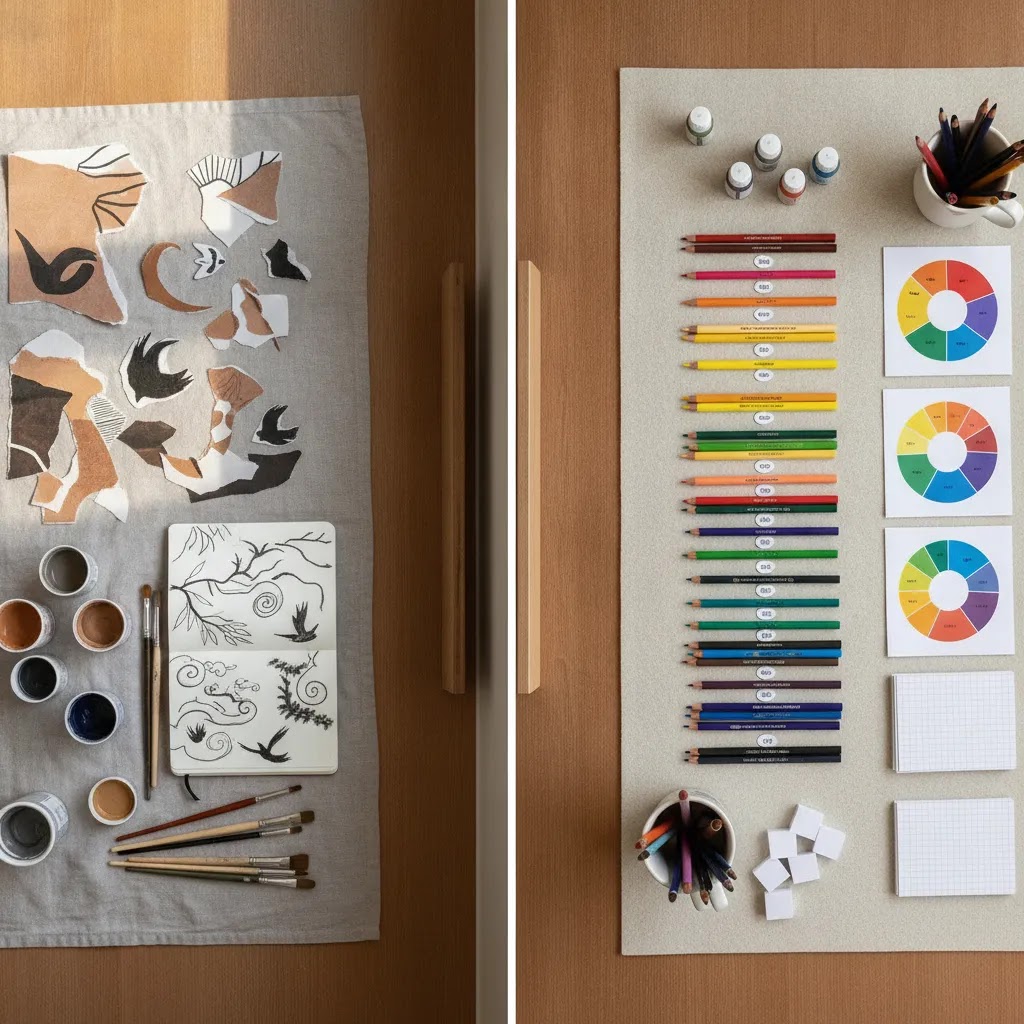
This is one of the clearest approaches for people who want structure without relying only on words. It blends visual expression with coping skills, emotional labeling, distress tolerance, and reflection. If you have ever found text-heavy worksheets tiring, adding image may make the process more accessible.
Examples include drawing a trigger map, creating a visual thought cycle, scaling feelings with color, or building a container image for intense emotion. These methods are often practical, repeatable, and easier to revisit later.
This approach applies best when the goal is skill-building rather than open-ended exploration. It can help with anxiety, rumination, and everyday regulation practice. Its limitation is that some people experience it as too guided, especially if they want more spacious or intuitive image-making. For a broader distinction between modalities, see expressive arts therapy vs art therapy. You can also explore art therapy for anxiety for more focused examples.
5. Narrative art therapy approaches and identity work
This approach fits moments when you are trying to make sense of change. A breakup, a move, becoming a parent, losing a role, finishing school, or realizing an old version of you no longer fits. The aim is not only to express emotion, but to organize experience into a story you can live with.
Common formats include life-path drawings, identity collage, chapter pages, before-and-after images, or future-self pieces. The image becomes a way to see where you have been, what you carry, and what may be emerging next.
Its strength is integration. It can help you notice continuity where life feels fragmented. The caution is timing. If distress is still very raw, a more stabilizing approach may be better first. This style often works best once enough steadiness is already in place.
6. Play-based art therapy approaches for beginners
This is often the best entry point for beginners, perfectionists, and burned-out people who freeze the moment a blank page appears. The goal is to lower pressure, invite movement, and restore a sense that creative action is possible without having to do it “well.”
You might turn a scribble into an image, draw with the non-dominant hand, finish a simple repeating pattern, or work with playful constraints. These tasks may seem modest, but they can help rebuild agency. For many people, finishing something small matters a lot when motivation is low.
The benefit is accessibility. It asks less from you at the start. The drawback is that it may not feel emotionally specific enough for people who want direct processing of grief, trauma, or conflict. Still, getting started is often the hardest part, and this approach meets that barrier honestly.
Practical art therapy approaches by age or context
These are educational examples you can adapt gently. The goal is not to do them “right.” Instead, try to notice what feels supportive, what feels too much, and what helps you come back to yourself. If any prompt increases distress, it is a reasonable choice to stop, shift to something more containing, or seek professional guidance.
Kids
- Safe container drawing (often fits #1): draw a box, jar, or fort with a lid. Ask, “What helps this container feel strong?” Add locks, pillows, or a helper creature. The point is boundaries, not disclosure.
- Breath lines (often fits #2): draw one line on the inhale and one line on the exhale. Make them slow, fast, wiggly, or straight. A few minutes is usually enough.
- Scribble transformation (often fits #6): make a scribble, then turn it into something friendly or funny. Finishing matters more than explaining.
Kids often do better with a time window than an open-ended task. Five to ten minutes can be plenty. If a child starts getting frustrated, it can help to switch to simpler materials and clear steps. If you want more age-based ideas, you can explore art therapy for children.
Teens
- Identity collage (often fits #5): create two areas, “What people see” and “What I actually carry.” Teens can keep it private. The value is in choosing, arranging, and noticing themes.
- Thought spiral map (often fits #4): draw a spiral, put the triggering thought in the center, then add the next thought, body feeling, and action urge as the spiral expands. End with one small coping option on the outside edge.
- Symbol check-in (often fits #3): draw a simple symbol for “today’s mood,” then draw what that symbol needs. Keep it light and avoid forcing interpretation.
Teens often engage more when they can choose the topic, keep their work private, and avoid being pressured to “share the meaning.” Options and consent tend to matter as much as the prompt.
Adults
- Resource image (often fits #1): draw a place, object, or memory cue that signals “I can breathe here.” Add details that support orientation such as textures, colors, and a boundary around the image.
- Two-minute bilateral drawing (often fits #2): alternate hands to make mirrored marks. Keep it repetitive. The goal is rhythm, not aesthetics.
- Chapter page (often fits #5): split the page into “before,” “during,” and “after,” or “old me” and “emerging me.” Use simple shapes if you do not want to draw detailed scenes.
If you are burned out, finishable tasks tend to help more than ambitious ones. A small complete page can be more regulating than a “big project” you never want to return to.
How to choose the right art therapy approaches for your situation
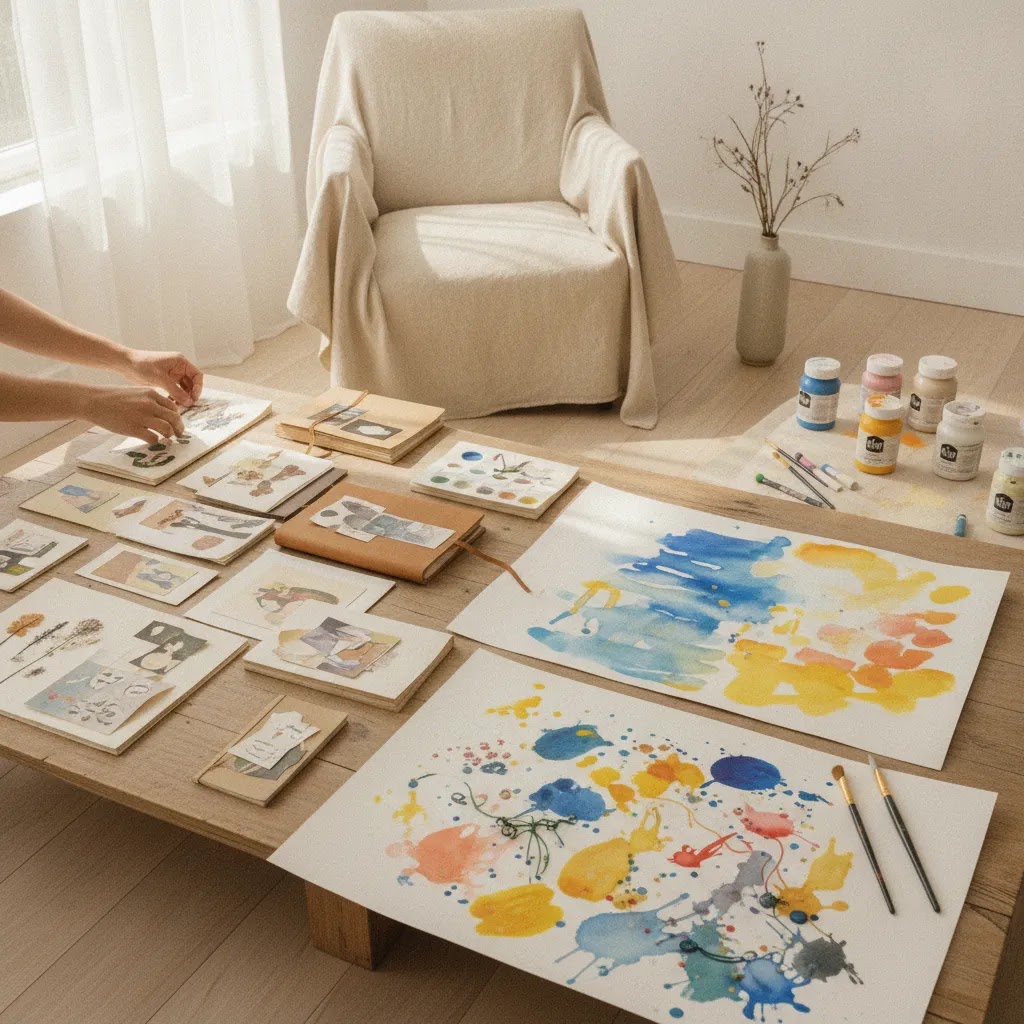
The first question is not “Which approach is most advanced?” It is “What state am I in right now?” If you feel flooded, shaky, numb, or close to tears, a stabilization or sensory approach may fit better than a reflective one. If you already feel calm enough to think, narrative or symbolic work may offer more insight.
The second question is how much language you have available. Some days you can name feelings clearly. Some days you cannot. If words are thin or frustrating, image-first methods often make more sense. That is one reason many people are drawn to art as therapy in everyday life, even outside formal sessions.
The third question is whether your goal is regulation, understanding, or both. Regulation-focused approaches help you return to yourself. Meaning-focused approaches help you interpret what happened. One is not better than the other. They simply answer different needs.
The fourth question is support level. Some approaches are easier to use on your own, especially low-intensity sensory or play-based exercises. Deeper trauma or symbolic work often benefits from a trained professional. If you are exploring options digitally, the Digital Art Therapy & Apps category can help you compare low-pressure formats, while the Art Therapy Fundamentals hub offers broader background. You can also read art therapy fundamentals if you want a wider overview first.
DailyLemons can be one gentle place to start if you want guided, nonverbal exercises that reduce blank-page pressure and do not force interpretation. Its approach is designed around short, therapist-informed drawing sessions that may support emotional regulation and reflection between or outside formal care. It is best viewed as a supportive tool, not a substitute for individualized treatment or crisis support.
Pros and Cons of art therapy approaches
Strengths of art therapy approaches
- Different art therapy approaches serve different emotional states, which gives you more precise choices than a one-size-fits-all idea of “creative healing.”
- Several approaches reduce the pressure to explain yourself in words right away.
- Bottom-up methods may be more reachable during stress, agitation, or shutdown.
- Meaning-focused methods can support identity, grief processing, and personal insight over time.
- Many techniques are adaptable for beginners and do not require art skill.
Considerations with art therapy approaches
- No single approach is best for every person or every moment.
- Deeper symbolic or trauma-related work may bring up strong feelings and could require professional support.
- Some structured methods may feel restrictive to people who prefer free-form creativity.
- Self-guided tools can help, but they do not replace assessment, diagnosis, or emergency care.
Frequently Asked Questions About Art Therapy Approaches
What is meant by art therapy approaches for emotional support?
Art therapy approaches are different ways of using creative process to support emotional expression, regulation, reflection, or meaning-making. These art therapy approaches are not all the same. Some emphasize sensory calming, some focus on symbolism, and others use more structured coping skills. The best fit usually depends on your current state, your goals, and how much support you have available.
Which art therapy approach is best for beginners?
Beginners often do best with play-based or sensory approaches because they reduce pressure and do not require artistic skill. Simple patterns, breath-linked drawing, or scribble transformation can feel more approachable than deep symbolic work. Starting with something low-stakes may help you notice what feels safe and useful before trying more reflective methods.
Are art therapy approaches only for people who are good at art?
No. Art therapy approaches are usually built around process, not performance. The value often comes from externalizing feeling, noticing pattern, and engaging the senses, not from making polished work. In some cases, people with strong art training actually need time to step away from self-critique so they can focus more on inner experience than technique.
How do I know whether I need regulation or insight first?
A practical clue is your level of activation. If your body feels tense, scattered, numb, or overwhelmed, regulation may be the better first step. If you already feel relatively steady and are asking “What does this mean?” insight-focused approaches may fit better. Many people move between both over time rather than choosing only one.
Can I try art therapy approaches without a therapist?
You can try gentle, low-intensity art therapy approaches on your own, especially sensory, play-based, or simple reflective practices. Still, self-guided work has limits. If an exercise brings up intense fear, traumatic memory, or a strong sense of being unsafe, it may be wiser to pause and seek a qualified professional rather than pushing deeper alone.
What are the two main approaches of art therapy?
People usually mean one of two distinctions. One is state-based: bottom-up approaches that focus on regulation and containment versus reflective approaches that focus on meaning and insight. The other is practice-based: art psychotherapy (deeper processing within a professional relationship) versus art as therapy (self-guided creative coping and reflection). Many real-world sessions combine elements of both depending on your needs and support level.
What are the theoretical approaches to art therapy?
Common theoretical orientations include psychodynamic, humanistic or person-centered, cognitive-behavioral (CBT) and skills-based, and developmental or play-based approaches. These orientations describe how a therapist tends to understand change and structure sessions. They often overlap, and many art therapists integrate more than one, especially when they are matching the work to your current capacity and goals.
What is the difference between expressive arts therapy and art therapy?
Art therapy usually centers visual art as the primary mode, while expressive arts therapy may move across several forms such as movement, sound, writing, drama, and image. The overlap can be meaningful, but the training models and session feel may differ. That difference matters if you are choosing a service rather than simply experimenting at home.
What are the 7 different art expressions?
There is no single official list, but people often group “art expressions” into categories such as drawing, painting, collage, sculpture or clay work, printmaking, photography, and digital art. In therapy settings, the best choice is usually the one that matches your state and your sensory tolerance. More controllable media can support containment, while more fluid or tactile media can support release or grounding, depending on how you respond.
What are the 7 types of therapy?
There is no universal set of seven, but common therapy categories you may hear include cognitive-behavioral approaches, psychodynamic approaches, humanistic approaches, family or systems approaches, group therapy, trauma-focused approaches, and creative or expressive therapies such as art therapy. The best fit typically depends on your goals, your preferences, and the level of support you need. If you are unsure, a qualified licensed professional can help you sort options based on your situation and local scope-of-practice rules.
Can these approaches help with anxiety or burnout?
They may help, especially approaches focused on regulation, containment, and low-pressure engagement. Rhythmic mark-making, simple color work, and mastery-focused tasks can be easier to access during stress or depletion than heavy reflection. Results vary by person, though, and persistent distress may need broader support than a creative practice alone can provide.
When should someone seek professional help instead of self-guided art practices?
If distress feels severe, keeps escalating, affects safety, or makes daily functioning hard, self-guided practice may not be enough on its own. Professional support can be especially important when trauma history, intense grief, self-harm concerns, or major life disruption are present. A credentialed provider can help pace the work and respond if difficult material surfaces.
Key Takeaways
- Art therapy approaches differ mainly by what they are trying to do: regulate, contain, express, interpret, or integrate.
- Trauma-informed and sensory approaches usually apply best when your system feels overloaded.
- Symbolic and narrative approaches often fit better once enough steadiness is already present.
- Play- and mastery-focused work can be the most approachable doorway for beginners.
- The right approach may change from day to day, even for the same person.
In brief
If you want the shortest possible summary, start by matching the approach to the moment you are in. Safety and overwhelm point toward stabilization. Restlessness points toward rhythmic regulation. Repeating inner images point toward symbolic work. Skills practice points toward CBT- or DBT-informed methods. Life transitions point toward narrative work. Creative shutdown points toward play and mastery.
| Rank | Approach | Best for | Why it stands out |
|---|---|---|---|
| 1 | Trauma-informed stabilization | Overwhelm and fragile safety | Prioritizes pacing and containment |
| 2 | Sensory regulation and rhythmic mark-making | Stress and racing thoughts | Low verbal demand and easy to start |
| 3 | Symbolic and psychodynamic work | Recurring themes and inner conflict | Offers depth through metaphor |
| 4 | CBT- and DBT-informed art therapy | Skills practice and reflection | Clear structure for everyday use |
| 5 | Narrative and identity-based approaches | Transitions and self-story | Helps organize change into meaning |
| 6 | Play, experimentation, and mastery-focused work | Burnout and perfectionism | Lowers pressure and restores agency |
Conclusion
The most useful question is rarely which art therapy approach sounds most impressive. It is which one meets you with the least friction and the most care right now. A grounding, repetitive exercise may be enough for tonight. Later, a deeper symbolic or identity-based process may fit once more steadiness is there.
If you want a gentle digital starting point, DailyLemons offers guided, art-therapy-informed exercises that can support nonverbal reflection without pressure or over-interpretation. You can explore it at your own pace. If your needs feel bigger than self-guided support, a qualified professional may be the better next step.
This article is for educational purposes only and does not provide medical, psychiatric, or crisis care advice. Art therapy approaches may support emotional well-being, but results vary by person, context, and support level. Self-guided creative practices are not a substitute for licensed care when distress is severe, persistent, or related to safety. If you or someone else may be at risk of harm, contact local emergency services, a crisis resource, or a qualified licensed professional right away. For formal art therapy services, check current credentials, scope of practice, and local regulatory standards. In the United States, professional information may be available through the American Art Therapy Association and applicable state licensing boards.