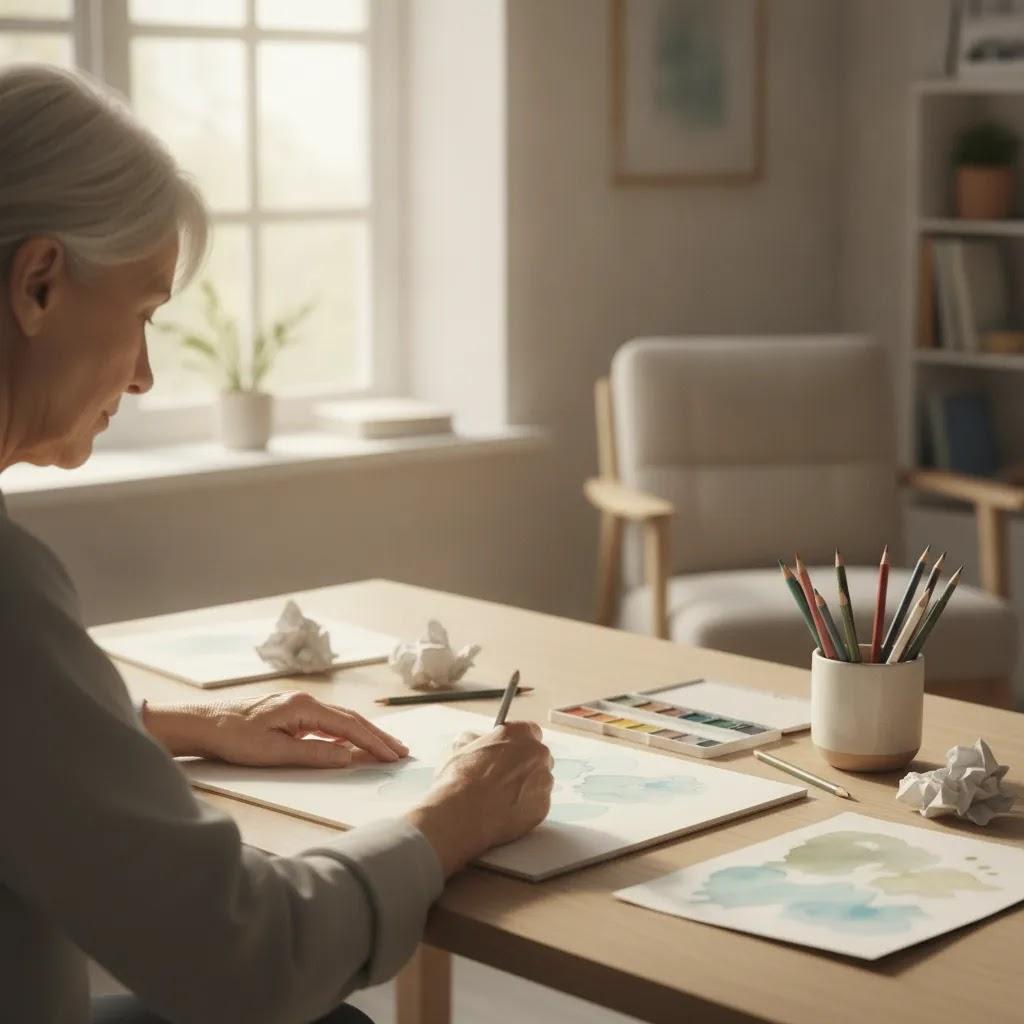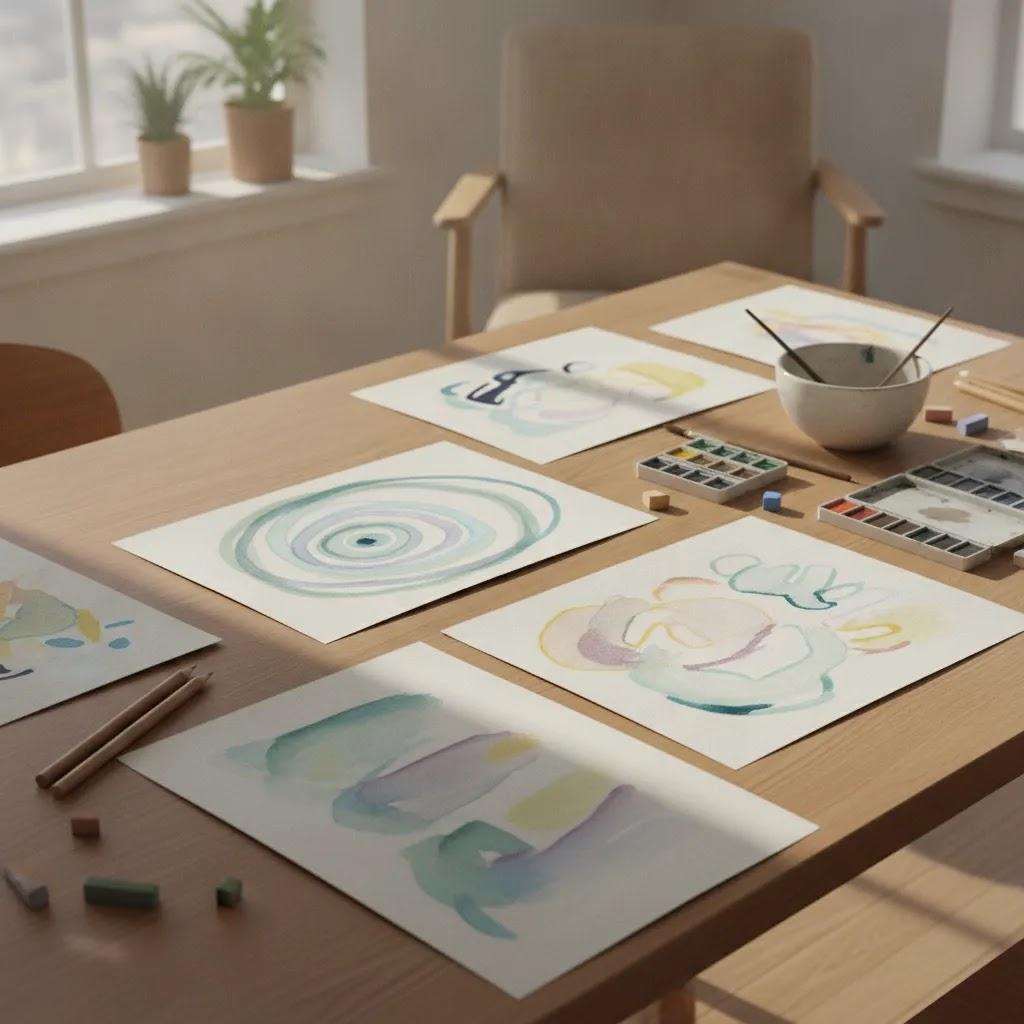
Picture a child sitting quietly with crayons, letting a swirl of color say what words can't quite reach yet, that's often where the real benefit of art therapy shows up. It tends to make big feelings easier to release, brings a softer sense of calm to hard moments, and helps kids (and the grown-ups who love them) understand what's going on beneath the surface. Whether it's a toddler scribbling through a tantrum or a teen sketching through anxiety, gentle creative expression can offer a steady, judgment-free path toward feeling understood.
Why does making simple marks on a page sometimes help people feel more steady, clear, or understood? Part of the answer is that art therapy gives emotion a form outside the body. Instead of asking you to explain everything right away, it can offer another path through color, shape, rhythm, and image.
That makes this topic especially meaningful for people who feel overwhelmed, shut down, or tired of word-heavy coping tools. In this article, you’ll find nine documented art therapy benefits that researchers and clinicians often discuss across children, teens, adults, older adults, and people facing different kinds of distress. If you want broader age-specific context afterward, our look at the benefits of art therapy for adults can help you keep exploring at your own pace.
What the Evidence Is Really Showing
Art therapy is not one single exercise or one fixed protocol. It is a therapeutic use of creative process that can be adapted for many ages, settings, and goals. That matters because “benefits” do not show up in exactly the same way for every person.
When researchers pull together what's known about art therapy, the same themes tend to surface again and again: helping people express what's hard to say out loud, regulate difficult emotions, communicate more openly, reflect on their experiences, and simply stay engaged in their own care. One recent systematic review and meta-analysis looked specifically at active visual art therapy and found encouraging links to health-related outcomes across a wide body of studies, though the authors were careful to flag a real caveat, since the quality, populations, and methods behind that research differ quite a bit from study to study. The honest takeaway isn't that art therapy works the same way for everyone. It's that the evidence looks hopeful across many different groups, particularly for people who find that words alone don't quite capture what they're feeling.
If you want to read official professional context, the American Art Therapy Association explains how the field defines practice and training. In addition, the National Library of Medicine is a useful place to explore published research summaries.
If you are new to the broader field, the Art Therapy Fundamentals category can help you place these benefits in a wider context without turning this page into a general overview.
What Art Therapy Is (and Who an Art Therapist Is)
One reason art therapy benefits can get confusing online is that people use the phrase “art therapy” to describe two different things. Art therapy, in the formal sense, is a professional service delivered within a therapeutic relationship by a trained provider. Therapeutic art (or art-making for mental wellness) is a broader category that can include self-guided drawing, journaling, crafts, and creative prompts that may still feel supportive, but are not the same as therapy.
In sessions with a credentialed art therapist, the focus is typically on process rather than “good art.” The therapist may help you choose materials, guide pacing, notice themes, and support meaning-making in a way that is emotionally safe and appropriate for your situation. They do not typically critique artistic quality. The question is not “Is it pretty?” It is “What did it feel like to make this, and what might it be communicating?”
That is also why “no art skill needed” is not a slogan, it is part of the model. If a person believes they have to perform, they tend to hide, control, or quit. Art therapy is designed to be workable even if your drawings are simple, messy, abstract, or made from shapes you would not show anyone else.
As for who art therapy can be for, the practice is used across the lifespan. You may see it in pediatric settings, schools, teen programs, adult outpatient care, hospitals, rehabilitation, and older adult communities. It is also used with people living with illness, disability, or communication barriers, where image-based expression can add something that conversation alone cannot always provide.
Comparison Snapshot Across Benefits
| Benefit | Most relevant for | How it may help | Common limit |
|---|---|---|---|
| Emotional expression | Children, teens, adults under stress | Offers a nonverbal outlet when talking feels hard | May still need guided reflection to feel useful |
| Stress regulation | People with anxiety, overload, burnout | Uses rhythm, sensory focus, and movement | Not always enough during severe distress |
| Emotion identification | People who feel numb, confused, or mixed up | Makes inner states more visible and nameable | Insight may come slowly |
| Containment | People approaching painful topics | Creates symbolic distance from intense material | Can still feel activating for some people |
| Communication support | Neurodivergent users, children, shut-down teens | Gives another channel beyond direct conversation | Requires a respectful, non-pushy setting |
| Attention and engagement | Older adults, restless learners, low-motivation periods | Structured tasks can hold focus gently | Results depend on fit, pacing, and energy |
| Self-awareness | Adults in transition, grief, identity stress | Supports reflection through image and metaphor | Meaning is not always immediate |
| Social connection | Group participants, isolated populations | Shared making can reduce aloneness | Groups are not comfortable for everyone |
| Agency and mastery | People feeling stuck or helpless | Small completed acts can restore momentum | Progress may be subtle, not dramatic |
1. Emotional Expression May Feel Easier
One of the most documented art therapy benefits is simple but important: it may help people express feelings they cannot yet say clearly. This shows up across ages. A child may draw conflict as separated figures. A grieving adult may use color or broken shapes before they can describe what hurts. A teen may communicate more through image choices than direct answers.
Why this matters is equally simple. Emotional pressure does not disappear just because language is unavailable. Art can offer a safer first step by letting the feeling exist outside the body and outside a forced conversation. For some people, that makes support feel more reachable.
The caveat is that expression alone is not always the same as relief. Sometimes the image needs time, context, or a trusted guide before its value becomes clearer.
2. Stress and Arousal May Soften Through Making
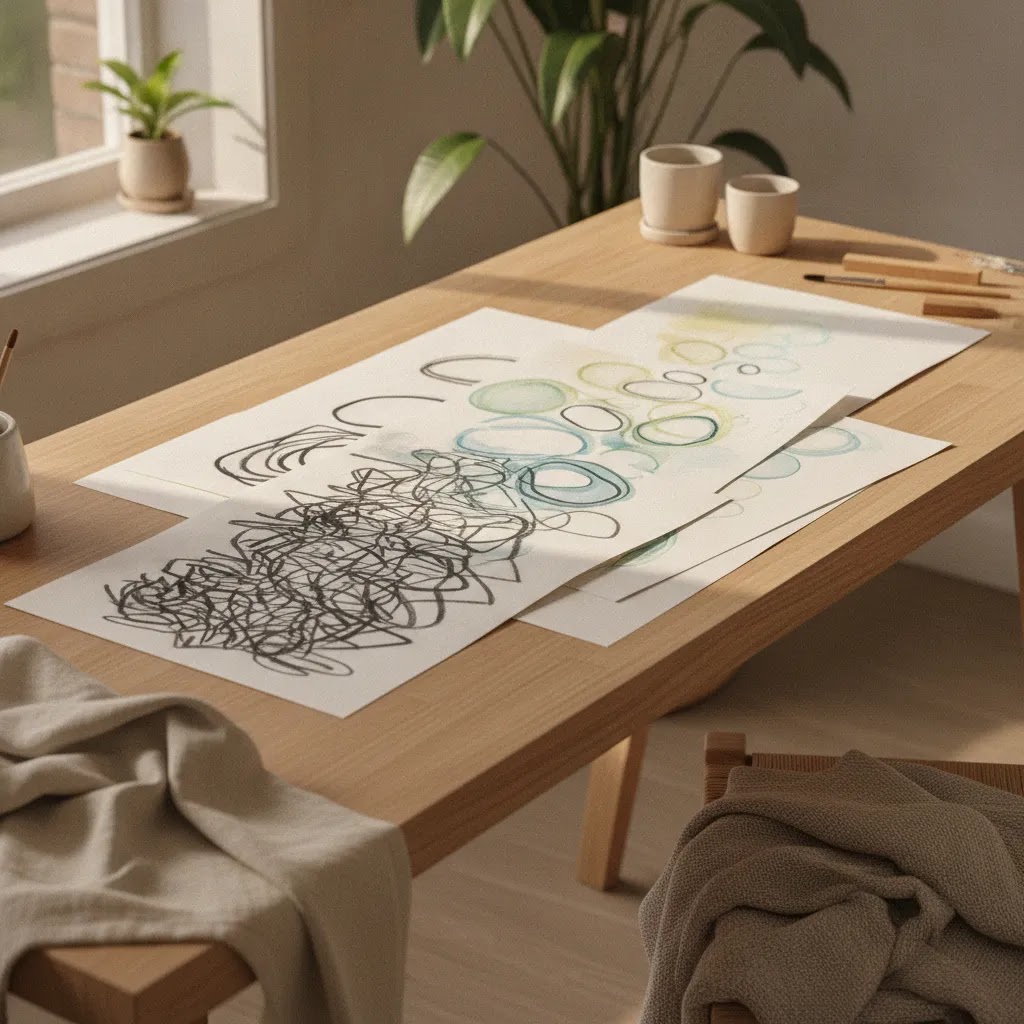
Art therapy may support regulation through sensory focus, repetition, and physical movement. Slow shading, rhythmic lines, shape repetition, and contained mark-making can help attention settle into the present moment. This is one reason visual methods are often discussed alongside anxiety support and body-based calming.
Research and clinical theory suggest that creative process can work through both bottom-up and top-down routes. In plain language, the hands may help before the words do. That can matter when journaling feels too effortful or meditation feels too exposed.
Still, calming is not guaranteed. Some materials, prompts, or themes may stir up more than expected. If strong distress rises or safety feels shaky, more direct human support is the better next step.
3. Feelings May Become Easier to Identify
Many people do not struggle because they feel nothing. They struggle because what they feel is crowded, mixed, or hard to sort. Art therapy may help by turning vague inner states into something more observable. A page can show intensity, emptiness, conflict, pressure, fragmentation, or softness before those ideas are easy to name.
This benefit matters for beginners especially. If you have ever said “I don’t know what I’m feeling,” image-making can offer clues without demanding a perfect answer. Over time, repeated creative check-ins may build emotional granularity, which means noticing the difference between stress, sadness, anger, loneliness, numbness, and overwhelm.
If structured circular forms interest you, our article on mandala art therapy benefits explores one specific way this kind of noticing may happen.
4. Painful Material May Feel More Containable
Another documented benefit is containment. In art therapy, painful material does not always need to be approached head-on in words. A person may use a box, border, storm image, abstract symbol, or divided page to hold difficult feelings at a safer distance. That symbolic distance may make hard experiences feel more manageable to approach.
This can be especially relevant for grief, trauma-related stress, medical hardship, or emotionally loaded transitions. A person may not be ready to recount events directly, but may be able to draw weight, absence, heat, static, or shelter. The image becomes a boundary as well as an expression.
The limit is important here. Art does not automatically make intense material safe. Good pacing, choice, and emotional support still matter, especially for trauma-impacted people.
5. Communication May Improve When Words Feel Limited
Art therapy may support communication for children, teens, neurodivergent people, older adults, and anyone who finds direct verbal processing tiring or inaccessible. Sometimes the artwork becomes a shared reference point. Instead of asking, “Tell me exactly what is wrong,” a helper can ask, “Which part of this image feels most like today?”
That shift can lower pressure. It also respects the fact that people do not always know how to translate body sensations or emotional complexity into neat sentences. For families and caregivers, this may open gentler conversations than repeated verbal prompting.
You can see this more clearly in age-specific contexts in our guide to the benefits of art therapy for children. The main caution is that communication works best when no one is forced to explain or defend what they made.
6. Attention and Engagement May Increase
Structured art tasks may help some people stay engaged when passive coping tools feel slippery. This can matter in older adults, people living with prolonged stress, those with low motivation, or anyone who feels restless with stillness-only practices. The process gives attention something to do.
Clinically, this is useful because engagement is often the doorway to every other benefit. If a person will not or cannot begin a coping practice, its quality matters less than its accessibility. Art therapy may lower that barrier by being active, sensory, and finite.
This does not mean every creative task improves focus. The task has to fit the person. Too much complexity may increase frustration. Too little structure may feel aimless.
7. Self-Awareness and Meaning-Making May Deepen

Once an image exists, people can sometimes notice patterns they miss in ordinary thought. Repeated colors, divided spaces, missing figures, crowded edges, or recurring symbols may invite reflection. Not forced interpretation. Just reflection. Over time, that can support self-awareness and a more coherent sense of what you are carrying.
This is one place where art therapy differs from many casual creative hobbies. The goal is not only to make something pleasing. It is to notice what emerges and what it may be connected to. Some people use this process around identity, life transition, relationships, burnout, or grief.
Curious how this fits alongside other structured methods? Our article on expressive arts therapy vs art therapy walks through the distinction, offering a gentler way to see how visual art practices relate to broader, more multimodal approaches.
8. Social Connection May Grow in Shared Settings
Across populations, shared art-making may reduce isolation. In groups, people can witness one another without needing to disclose everything directly. A page, collage, or shared prompt can create connection with less pressure than eye-to-eye conversation alone. This can be meaningful for older adults, people in care settings, teens, and those living through isolation or recovery periods.
One documented example from supportive materials developed during pandemic-related isolation focused on psychologically supporting senior citizens, hospitalized patients, and people in quarantine through art-based guidance. That kind of use highlights a wider point: creative process may help maintain a sense of human continuity in disconnected times.
Group benefit is real, but not universal. Some people feel safer starting privately before joining others.
9. A Sense of Agency May Return in Small Steps
Distress often shrinks a person’s sense of choice. Art therapy may gently interrupt that by offering manageable decisions: pick a color, make one line, fill one shape, add one boundary, stop when ready. These are small actions, but they can matter. Completing a short creative process may help a person feel less frozen and more able to respond.
This benefit shows up across ages because agency does not only mean major insight. Sometimes it means, “I could begin,” or “I could stay with this feeling for two minutes without disappearing into it.” That may sound modest, but modest gains are often the ones people can repeat.
If you are exploring more support around stress-related regulation, the Anxiety, Stress & Emotional Wellness category is a gentle next place to look.
Pros and Cons
Strengths
- Art therapy may help people express emotion when words feel unavailable.
- Benefits appear across multiple age groups, including children, teens, adults, and older adults.
- It can combine sensory regulation with later reflection, rather than forcing one route only.
- No art skill is required for the process to feel useful.
- It may support communication, engagement, and self-awareness in ways talk-heavy tools do not.
Considerations
- Research quality and methods vary, so benefits should be described carefully rather than as guarantees.
- Not every prompt, material, or setting fits every person.
- Creative work can sometimes bring up more feeling than expected.
- Art therapy may help, but it is not a substitute for crisis care or all forms of professional support.
How to Judge These Benefits in Real Life
If you are reading about art therapy benefits for the first time, the most useful question may not be “Does it work?” in the abstract. A better question is “For whom, in what setting, and for what kind of need?” A calming drawing exercise at home, a school-based group, and formal work with a credentialed art therapist may all look similar from the outside, but they do different jobs.
Start with the goal. Are you hoping for stress relief, easier communication, support with grief, more emotional clarity, or a way to stay connected between therapy sessions? Different goals highlight different benefits.
Then look at fit. Good fit usually matters as much as the method itself. Some people prefer highly structured prompts. Others need more freedom. Some feel safer with pencils and shapes. Others find paint, collage, or clay more expressive.
Context matters too. Gentle app-based or self-guided drawing can be accessible for everyday emotional care. DailyLemons is built around this lower-pressure lane, offering short, guided, nonverbal drawing practices designed to support regulation and reflection without requiring art skill or heavy verbal processing. It may be a helpful starting point for people who want a quiet, bounded practice between harder moments, or alongside broader care.
Finally, keep limits in view. Benefits are often cumulative rather than dramatic. You may notice a little more ease, a little more language, a little more distance from the feeling. If distress is intense, persistent, or linked to safety concerns, human support is the more appropriate priority.
Regulation and Credentialing: How Art Therapy Is Overseen (US, UK, and What to Look For)
If you decide you want formal art therapy, credentials matter. Regulation varies by country, and in some places it can vary by state or province too. That means the phrase “art therapy” can be used loosely in casual settings, even though professional art therapy is a defined role in many systems.
Art therapy credentials in the UK and US
If you're in the UK and come across someone calling themselves an "art therapist" or "art psychotherapist," know that these aren't just job titles, they're legally protected ones. The people who hold them are usually listed with the Health and Care Professions Council (HCPC), which means there's a simple way to check things for yourself: a quick search of the register can tell you whether that person is genuinely entitled to use the title they're offering you.
In the United States, oversight can be more fragmented. Some art therapists are licensed under state mental health licensing categories, which vary by state. Many also carry field-specific credentials. Common credential signals you may see include ATR (Registered Art Therapist) and ATR-BC (Board Certified Art Therapist). If you want a fuller breakdown, our guide to art therapist training paths can help.
How to evaluate art therapy fit
Professional organizations such as the American Art Therapy Association can be a useful starting point for understanding standards and locating information, alongside applicable state licensing boards and regulatory bodies. When you are weighing options, you may also want to ask whether art therapy is worth it for your current needs, budget, and level of support.
If you are choosing between self-guided tools, groups, and 1:1 work, it helps to ask a few concrete questions before you commit time, money, or emotional energy:
- What training do you have specifically in art therapy, and what credential or license do you hold?
- What does a typical session look like, including how much is art-making vs talking?
- How do you handle interpretation: do you ask me what it means, offer your impressions, or both?
- How do you support pacing if intense feelings come up during art-making?
- What are your boundaries around confidentiality, record-keeping, and group privacy (if it is a group)?
- Who is this approach a good fit for, and who might need a different level of care?
For many people, the choice is not either self-guided art or professional therapy forever. It can be “what support matches my current stability and goals?” Self-guided practices can be a gentle on-ramp for daily regulation and reflection. Groups can add structure and connection, but they can also bring social pressure. 1:1 work with a credentialed provider can offer more individualized pacing, containment, and care coordination when needs are complex.
Condition-Specific Examples: Where Art Therapy Is Commonly Used (and What “Benefit” Can Look Like)
Some readers arrive here with a very specific question: not just “What are art therapy benefits?” but “Would this be used for what I am dealing with?” Art therapy is used in a wide range of settings, and the same benefit can look different depending on the person and the condition.
These examples are not promises. They are snapshots of common goals clinicians write about and organizations often describe, with the usual caveat that results vary and more severe conditions typically require coordinated care with qualified professionals.
Older adults, dementia, and Alzheimer’s contexts
In older adult and memory-care settings, art therapy is often used to support engagement and connection. “Benefit” may look like participating for longer than usual, showing a spark of interest, sharing a story prompted by an image, or feeling calmer during the activity. For some people, art can support reminiscence, identity, and continuity, especially when short-term memory is unreliable but sensory and emotional memory still responds to color, music, rhythm, and familiar themes.
In these contexts, the artwork is usually less about insight and more about quality of experience: being met with respect, having a moment of choice, and maintaining human connection. Caregiver involvement and an appropriate environment often matter as much as the activity itself. If you want a closer look, our guide to art therapy benefits for seniors explores this in more detail.
Schizophrenia and psychosis-spectrum care
In some clinical and community programs, art therapy may be used as a supportive channel for expression and routine alongside clinical care. “Benefit” here might mean having a structured way to communicate internal experiences, building a stabilizing weekly rhythm, or reducing the pressure of direct conversation. The artwork can become a bridge, helping a person share what is difficult to explain without having to push for linear storytelling.
This is also an area where qualified oversight matters. If someone is experiencing intense symptoms, art-making may need careful pacing and clinical coordination to keep the work grounding rather than disorganizing or overwhelming.
CPTSD and trauma-related distress
For complex trauma histories, the potential benefits often center on containment, pacing, and nervous-system stabilization. Sometimes image-making can help a person externalize a feeling, build a boundary around it, or practice “touching in” without being flooded. A contained prompt, such as drawing a safe border, mapping parts of the body that feel tense, or using abstract color fields, can be more tolerable than recounting details.
There is a real caution here too. Art-making can be activating, especially if the prompt is unstructured or directly trauma-themed. If images bring up intrusive memories, dissociation, or a sense of losing control, it is usually a sign to slow down and seek qualified trauma-informed support. In higher-risk situations, professional care is not just helpful, it is the safer container.
Frequently Asked Questions
Is art therapy only helpful for people who are “good at art”?
Not at all. If there's one thing that comes up again and again in art-therapy-informed work, it's that talent has nothing to do with it. What actually matters is the act of expressing something, tuning into your senses, finding meaning in symbols, and taking a moment to reflect. Ironically, people who've never picked up a paintbrush before sometimes ease into this more easily than trained artists, simply because there's no pressure to make something look good or "impressive.
What is the biggest documented benefit of art therapy?
There is not one single benefit that outranks all others in every study or population. Emotional expression and regulation are among the most commonly described. Still, the “biggest” benefit depends on the person. For one person it may be calming. For another, it may be communication, self-understanding, or simply being able to begin a supportive practice at all.
Does art therapy help with anxiety?
It may help some people with anxiety by giving the body and attention something structured to do. Repetitive mark-making, visual containment, and sensory focus can feel more reachable than purely verbal reflection. That said, anxiety varies a lot. Severe panic, trauma-related distress, or safety concerns may require more direct support from a qualified professional.
Can children and teens benefit from art therapy too?
Yes, many children and teens may benefit because art offers communication without demanding advanced emotional language. It can help with expression, engagement, and relational safety. The form should match age, developmental level, and support needs. Young people should never be pushed to explain artwork in ways that feel exposing or shaming.
How quickly do art therapy benefits show up?
Some people notice a shift in tension or focus during a single session. Others notice benefits more slowly through repetition. Small changes often matter most at first, such as feeling more grounded, less stuck, or a little clearer about what is going on inside. Longer-term meaning-making and pattern awareness may take more time.
Is self-guided art the same as art therapy?
Not exactly. Self-guided art activities can still be supportive, especially for grounding, reflection, and daily emotional care. Formal art therapy is delivered within a therapeutic relationship by a trained professional. There is overlap, but they are not identical. The right option depends on your needs, current stability, and how much guidance you want.
Can art therapy ever feel unhelpful?
Yes. Some people feel self-conscious, frustrated, overstimulated, or emotionally activated by certain materials or prompts. Others simply connect better with different approaches. A method does not have to work for everyone to be valuable. If something feels too intense, too vague, or too pressuring, that feedback matters and should shape the next step.
What kinds of issues are art therapy benefits most often linked to?
They are often discussed in relation to stress, anxiety, grief, depression, trauma-related distress, illness, isolation, identity challenges, and communication barriers. The exact benefit depends on the setting and the person. Art therapy may support coping and reflection, but it should not be framed as a guaranteed answer for every emotional difficulty.
Does art help with Alzheimer’s?
It may help some people, especially in supportive settings where the goal is engagement, connection, and quality of experience rather than “fixing” memory. In dementia and Alzheimer’s contexts, benefit can look like increased participation, calmer mood during the activity, moments of reminiscence prompted by images, or easier connection with caregivers. The best fit often depends on the person’s current abilities, the environment, and whether the activity is paced gently.
What is art therapy for schizophrenia?
In some programs, art therapy is used as a supportive approach alongside clinical care to help with expression, communication, and structured engagement. Benefit may look like having a safer channel to share internal experiences, building routine through regular sessions, or reducing the pressure of direct verbal processing. If symptoms are intense or changing, it is usually best for art therapy to be coordinated within a qualified care team.
Is art therapy actually effective?
The most careful answer is that the research base is encouraging, but mixed. Reviews and meta-analyses often find positive associations across a range of outcomes, while also pointing out that studies vary in quality, population, and method. Art therapy may be effective for some people and goals, especially where nonverbal expression and supportive reflection are a good fit. It is not a guaranteed answer, and the setting and provider qualifications can change what the experience actually delivers.
Is art therapy good for CPTSD?
It may be helpful for some people with complex trauma histories, especially when the work emphasizes pacing, containment, and stabilization. Art can support externalizing feelings and building boundaries around painful material. It can also be activating, particularly with unstructured prompts or trauma-focused themes. If you notice flooding, dissociation, or a sense of losing control, it is a sign to slow down and seek trauma-informed support from a qualified professional.
Key Takeaways
- Documented art therapy benefits most often involve expression, regulation, communication, reflection, engagement, connection, and agency.
- These benefits appear across ages and conditions, but not in identical ways for every group.
- Art therapy may be especially helpful when words feel unavailable or too demanding.
- Research is encouraging, though still varied in quality and method.
- The best reading of the evidence is careful and human: helpful for many, not magic for everyone.
Brief Recap
| No. | Benefit | Why it matters | Best fit |
|---|---|---|---|
| 1 | Emotional expression | Helps feelings take shape without forcing words | All ages |
| 2 | Stress regulation | Supports calming through movement and sensory focus | Anxiety, overload |
| 3 | Emotion identification | Makes mixed feelings easier to notice | Beginners, alexithymia traits |
| 4 | Containment | Creates safer distance from painful material | Grief, heavy stress |
| 5 | Communication | Offers another path when talking is hard | Children, teens, neurodivergent users |
| 6 | Engagement | Can hold attention more actively than passive tools | Low motivation, older adults |
| 7 | Self-awareness | Invites pattern noticing and meaning-making | Life transition, burnout |
| 8 | Social connection | Shared making may reduce isolation | Groups, care settings |
| 9 | Agency | Restores small experiences of choice and completion | Feeling stuck or helpless |
Conclusion
Art therapy benefits are easiest to understand when you stop asking whether the method is universally powerful and start asking what kind of support it offers that other tools sometimes miss. Its distinctive strength is not perfection, speed, or certainty. It is the chance to work through image, movement, and symbol when language feels thin or too far away. Across ages and conditions, that can mean more expression, more steadiness, more connection, or simply one small opening where there was none before. If you want to keep exploring gently, DailyLemons offers art-therapy-informed practices designed for short, approachable emotional check-ins, and you can also browse related topics in our broader art therapy resources whenever it feels useful.
Please know that what you're reading here is meant to inform and gently support you, not to stand in for medical, psychiatric, or crisis care. Everyone's experience with art therapy is different, shaped by individual circumstances, environment, and the kind of support that's available. DailyLemons was created as a companion for wellness, drawing on art-therapy-informed ideas, but it's not a substitute for working with a licensed clinician or a trained art therapist. If what you're feeling ever becomes overwhelming, doesn't ease with time, or touches on your safety, please reach out to a qualified professional, local emergency services, or a trusted crisis line without delay. For those in the United States, helpful guidance and referrals may also be found through resources like the American Art Therapy Association, as well as relevant state or local licensing bodies.