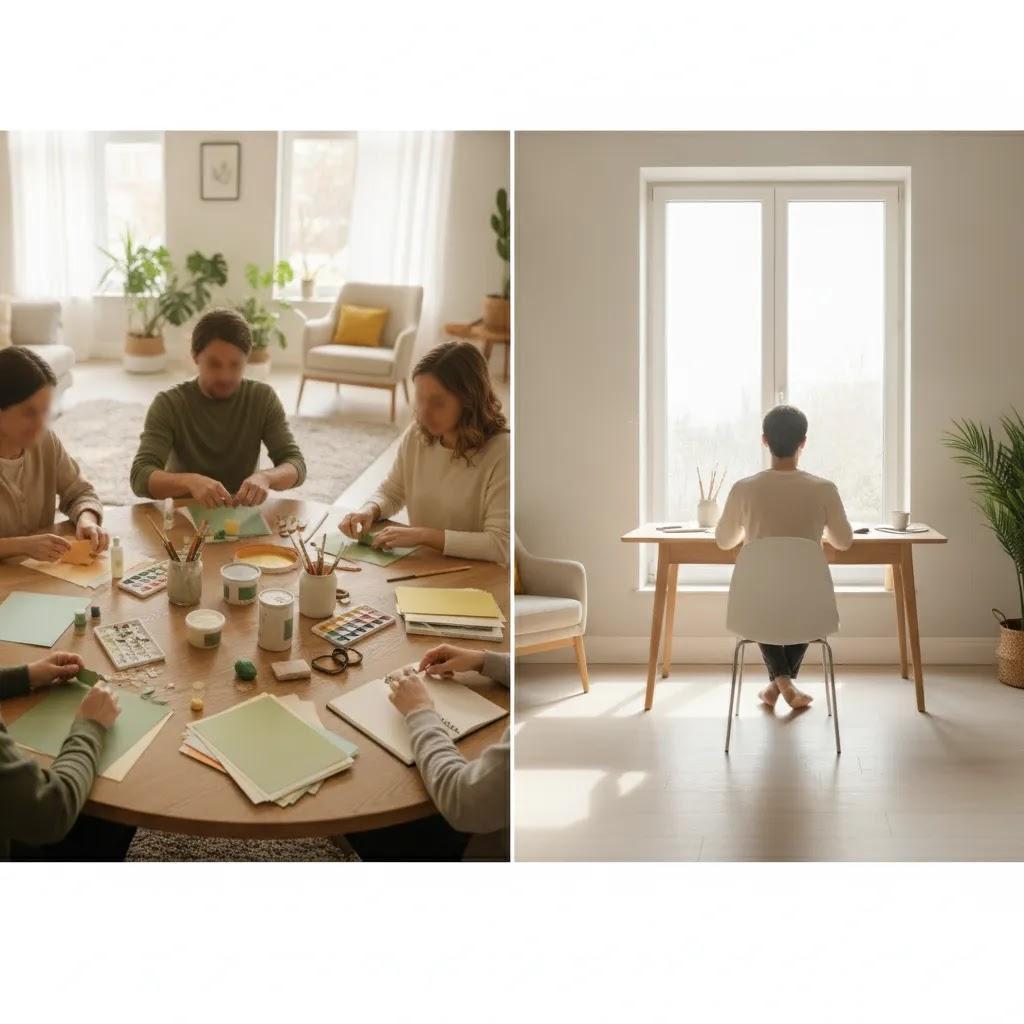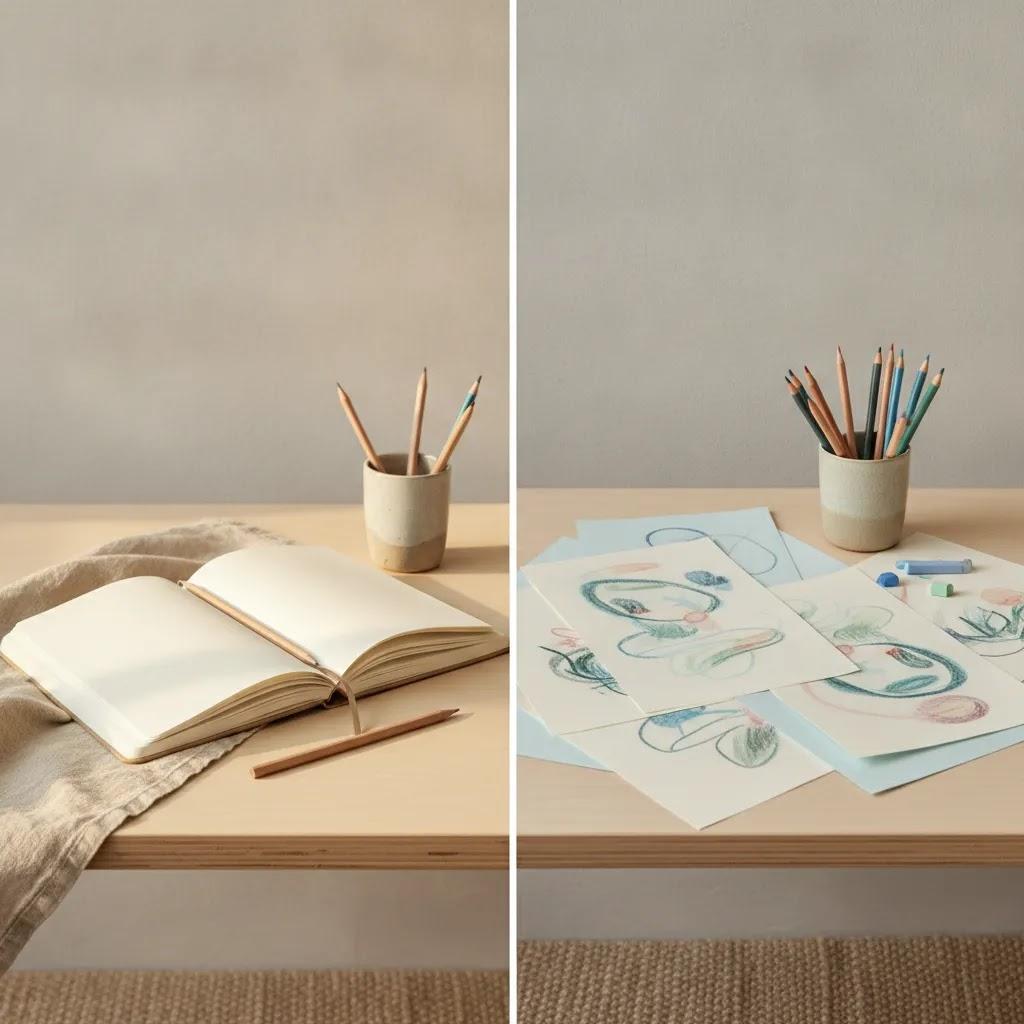
Not quite the same path, but they can lead to the same place. Counselling tends to lean on dialogue, while art therapy invites feelings out through color, shape, and creation when speaking feels out of reach. Some find comfort in one, some lean on both together. What matters most is choosing whichever feels gentler and more within reach for you today.
If you know you need support but feel unsure what kind, this comparison can help without adding pressure. One path leans more on image, materials, and creative process. The other usually leans more on spoken reflection, conversation, and verbal meaning-making.
That difference matters when words feel available one day and far away the next. If you are still getting oriented, it may help to start with a broader look at Art Therapy Fundamentals before comparing methods more closely. In this guide, you will see how art therapy and counselling differ in scope, method, and likely outcomes, so you can choose a path that feels more usable for the season you are in.
Art therapy vs counselling: quick verdict
Choose art therapy if talking feels hard, your stress shows up strongly in the body, or you process best through images, color, movement, and guided creative structure. Choose counselling if you want a mostly conversation-based space to sort thoughts, relationships, decisions, or recurring emotional patterns through dialogue.
Art therapy vs counselling comparison table
| Criteria | Art Therapy | Counselling |
|---|---|---|
| Price | Varies by provider and region | Varies by provider and region |
| Target user | People who benefit from nonverbal, sensory, and image-based expression | People who want verbal reflection and structured conversation |
| Key strength | Creates a usable path when feelings are difficult to explain in words | Offers direct verbal exploration of thoughts, relationships, and decisions |
| Key weakness | May feel unfamiliar or awkward if you dislike art materials or open-ended creativity | May feel inaccessible in moments when language, concentration, or emotional naming are hard |
| Best for | Emotional expression, regulation, symbolism, embodied processing | Talking through problems, gaining clarity, communication, perspective-taking |
| Worst for | Someone wanting only direct conversation with no creative process | Someone who shuts down, dissociates, or feels flooded when asked to explain feelings verbally |
Art therapy vs counselling: two valid paths

Art therapy and counselling often share a broad goal: helping you understand, hold, and move through difficult inner experience with support. The split is not about which one is “more serious.” Instead, it is about how each approach opens the door.
In counselling, the main channel is usually conversation. You speak, the counselor responds, and together you notice themes, beliefs, conflicts, habits, and possible next steps. In art therapy, the artwork becomes part of the conversation. Making marks, choosing colors, shaping space, or creating symbols can externalize what feels tangled inside.
That difference in method changes the scope too. A trained art therapist may work with verbal reflection, but the creative process is central rather than decorative. If you want a wider picture of modalities, our guide to art therapy approaches can help place this comparison in context.
Art therapy vs counselling: scope of support
Art therapy often works especially well where expression, regulation, and symbolic meaning matter at the same time. It can turn an internal state into something visible enough to observe. A storm, a closed room, a split page, a heavy color field, or a jagged line may say something before a full sentence can.
Counselling usually centers more directly on spoken experience. As a result, it can be especially useful for sorting relationships, decision-making, recurring thought patterns, conflict, self-understanding, and practical coping plans. If your main need is “I need to talk this through with someone who can help me organize it,” counselling may feel like the cleaner fit.
Neither scope is narrow. Both can support stress, grief, anxiety, burnout, heartbreak, identity questions, and life transitions. The real distinction is the entry route. Art therapy begins more comfortably for some people through making. Counselling begins more comfortably for others through talking.
Art therapy vs counselling credentials and regulation
The method is only part of the decision. Titles, qualifications, and legal scope of practice may vary a lot by country, state, or region. In some places, “art therapist” is a protected title tied to specific graduate training, supervised practice, registration, or board recognition. In others, the language may be used more loosely, which makes verification especially important.
The same is true for counselling. A general counselor, licensed counselor, psychotherapist, and art therapist may not have the same training background, regulatory status, or permitted scope, even if their websites sound similar. If formal care is what you are seeking, it helps to confirm whether the provider is registered, licensed, accredited, or otherwise recognized by the appropriate local body rather than relying on the title alone.
Before you book, ask practical questions. What training do you have in this modality? Is art-making central to the sessions or only occasional? What kinds of concerns do you usually work with?
Also ask who they support. Do they work with adults, teens, children, or families? How do they handle sessions if someone becomes overwhelmed, dissociative, or unable to speak much? Those questions may tell you more than a label does. They also help you judge whether the provider’s pace, structure, and experience match what you actually need.
For location-specific standards, you can also check the American Art Therapy Association and the American Counseling Association.
How art therapy vs counselling feels in practice

Art therapy is usually more experiential. You may be invited to notice your body, choose a color, draw a boundary, create a metaphor, or respond to a prompt through image rather than explanation first. That can lower pressure for people who freeze when asked “how are you feeling?” It can also help when attention, language, or emotional naming are limited in the moment.
Counselling tends to be more linear and discussion-led. You describe what happened, what you noticed, what you felt, and what might need to change. For many people, that directness is comforting. It can feel grounding to be heard in plain language and to build understanding through conversation.
Some approaches overlap. A counselor may use visual tools occasionally, and art therapy may include plenty of talking. Still, the primary mode matters. If you are comparing this with expressive art therapy, the common thread is still that creativity is used intentionally, not just as a relaxing add-on.
Art therapy vs counselling: what sessions may look like
A lot of hesitation comes from not being able to picture the room. In art therapy, a session may begin with a brief check-in, followed by a prompt, material choice, or simple creative task. You might work with pencils, paint, collage, clay, or another medium, depending on the setting and the therapist’s training.
Some sessions are structured, such as drawing a safe place, mapping stress in the body, or creating an image of a current conflict. Others are more open. In those sessions, the therapist helps you notice what you are drawn toward and what emerges as you make.
After or during the art-making, there is often reflection. The therapist may ask what you notice in the image, what parts stand out, what feels surprising, or whether the artwork connects to something in your life. The goal is not to judge whether the art is good. Artistic skill is not the point.
The image becomes part of the process. It gives feeling, pattern, memory, or tension a more visible form, so you can observe it more safely and discuss it at a manageable pace.
A counselling session usually begins with spoken check-in and stays more conversation-centered throughout. You may describe what happened during the week, what feels most urgent, what patterns keep repeating, or what you are trying to understand. The counselor may ask questions, reflect themes back to you, help organize events, and explore emotions, beliefs, and choices through dialogue.
There may be exercises, but the main material is still your spoken experience. If you are choosing based on comfort, the clearest question is often this: do you feel more able to access yourself by making first or by talking first?
Art therapy vs counselling outcomes and evidence
Art therapy may be especially helpful for emotional expression, containment, sensory grounding, and the move from felt experience into meaning. Research summaries on active visual art therapy suggest beneficial associations with health-related outcomes, while also showing that study quality and methods vary. That means the evidence is promising, but careful reading still matters.
Counselling may be especially helpful for cognitive clarity, communication, problem-solving, relationship insight, and verbal processing over time. If the difficulty is less “I cannot reach the feeling” and more “I keep circling the same issue and need perspective,” counselling may have an advantage.
In practical terms, art therapy may help you slow a spiraling state enough to observe it. Counselling may help you understand what that spiral means, how it repeats, and what choices are available next. Many people benefit from both, either at different times or together.
If you want to go deeper into the evidence, you can read Is Art Therapy Effective? Clinical Study Results Reviewed or browse Top Art Therapy Research: 8 Published Findings Worth Reading.
Art therapy vs counselling: who may prefer each

Art therapy may fit you better if you often say things like: “I do not know how to explain it,” “writing makes me shut down,” or “I feel it in my chest before I can name it.” It can also suit neurodivergent users, teens, and anyone who prefers structure without heavy verbal demand. For example, some readers exploring attention and regulation may also find how art therapy helps with ADHD focus and regulation useful.
Counselling may fit you better if speaking helps you think, you want direct feedback through dialogue, or your main goals involve communication, self-understanding, boundaries, and practical life decisions. It can also feel more familiar if you are already comfortable with reflective conversation.
If you are choosing by location as well as modality, local service options can shape the decision. Readers looking for regional context may find our overview of art therapy singapore useful.
Art therapy vs counselling head-to-head
1. Art therapy vs counselling when words feel blocked
Art therapy: Stronger starting point. It gives you something to do with your hands and attention before asking for a polished explanation.
Counselling: Weaker starting point in this specific scenario. It may still help, but conversation can feel demanding when you are flooded, numb, or unsure what you feel.
Winner on this dimension: Art therapy.
2. Art therapy vs counselling for direct verbal insight
Art therapy: Can absolutely lead to insight, but often through metaphor, symbol, and reflection after making.
Counselling: Stronger if you want to talk through ideas, relationships, and decisions in a straightforward way.
Winner on this dimension: Counselling.
3. Art therapy vs counselling for body-based overload
Art therapy: Often better positioned because mark-making, rhythm, color, and sensory focus can help shift state before analysis begins.
Counselling: Helpful once some steadiness is present, but not always the easiest entry point if your body is already highly activated.
Winner on this dimension: Art therapy.
4. Art therapy vs counselling for relationship issues
Art therapy: Useful, especially if conflict is hard to articulate and visual mapping helps. Still, the path may be less direct.
Counselling: Usually stronger for discussing patterns, conversations, boundaries, and behavior in explicit terms.
Winner on this dimension: Counselling.
5. Art therapy vs counselling for beginners
Art therapy: Can feel deeply relieving or slightly intimidating, depending on whether creativity feels inviting or exposing.
Counselling: Often more familiar culturally because “talking to someone” is easier to picture than using art in a therapeutic setting.
Winner on this dimension: Counselling, by a small margin.
6. Art therapy vs counselling for emotional access
Art therapy: Strong advantage where symbolism, ambiguity, and layered feeling states are present. It can hold mixed feelings without forcing a neat sentence too early.
Counselling: Strong once you can name and sequence what you are experiencing, but it may ask for clarity sooner.
Winner on this dimension: Art therapy.
Art therapy vs counselling pros and cons
Strengths
- Art therapy may reduce pressure if you struggle to describe feelings verbally.
- Counselling may offer clearer direct dialogue for relationships, choices, and recurring thought loops.
- Art therapy can combine sensory grounding with emotional reflection in one process.
- Counselling can feel more familiar and easier to explain to family, schools, or employers.
- Both approaches may support stress, grief, burnout, anxiety, and life transitions when the provider is a good fit.
Considerations
- Art therapy may feel uncomfortable if creative work triggers self-criticism or feels too unfamiliar at first.
- Counselling may be hard to use in moments when your nervous system is overloaded and words disappear.
- Provider quality, training, and relational fit matter as much as modality for many people.
- Neither approach guarantees a specific outcome, and progress may depend on consistency, goals, and complexity of need.
Art therapy vs counselling: limits to keep in mind

Art therapy is not automatically gentler just because it uses materials. For some people, making something visible can feel exposing very quickly. Others may find the process frustrating if they want direct answers, dislike mess or sensory input, or feel irritated by symbolism and open-ended prompts.
If you are highly self-critical about creativity, the art-making itself may become a barrier before it becomes useful. A skilled therapist can help with that. Still, it is a real disadvantage for some people.
Counselling has its own limits. If you struggle to identify feelings, go blank under questions, dissociate, or feel flooded when explaining yourself, a conversation-heavy format may feel too abstract or demanding. Some people leave talk-based sessions understanding themselves intellectually but still feeling disconnected from the emotional or bodily part of the experience.
That does not mean counselling is weak. It means the route may not match the bottleneck.
Either approach may also be a poor fit if the relationship feels off, the pace feels wrong, or expectations are mismatched. A provider may be well qualified and still not feel usable for you. If you are living with complex trauma, intense emotional swings, or concerns that carry safety risk, the provider’s specific training and local licensure matter even more, and formal clinical support may be more appropriate than a general wellness-style offering.
Ultimately, the tradeoff is simple. The best method on paper can still underperform if you do not feel safe enough, understood enough, or able to engage with the process.
A gentle digital option to explore
Sometimes what helps most isn't another meditation app or blank journal page, it's a gentler way in. That's where Daily Lemons comes in, offering therapist-designed exercises rooted in art-therapy principles, built around guided drawing, quiet reflection, and simple visual prompts. There's no expectation of artistic skill here. The point is simply to give your inner world a little more room to be seen and understood. On days when sitting still to meditate or write feels like too much, this kind of gentle, visual approach might meet you exactly where you are.
Daily Lemons can sit alongside broader reading in Anxiety, Stress & Emotional Wellness and the educational resources in Art Therapy Fundamentals. If you are comparing options and want something that feels gentle, private, and creative, you might explore our comparison tool or check a detailed review when you feel ready.
How to choose art therapy vs counselling without overthinking it
A useful way to choose is to start with the bottleneck, not the label. Ask yourself: what usually gets in the way when I try to process what I feel?
If your bottleneck is language
If you know something is there but cannot find words for it, art therapy may be the better first move. Image, shape, and color can give form to experience before full verbal clarity arrives.
If your bottleneck is confusion
If you can talk but keep getting lost in your own story, counselling may be more useful. The spoken format can help sort events, beliefs, reactions, and choices in a clearer sequence.
If your bottleneck is overwhelm in the body
If your stress shows up as tightness, panic, numbness, agitation, or shutdown, art therapy may offer a more reachable entry point. The act of making can sometimes help settle attention enough for reflection to follow.
If your bottleneck is a specific relational issue
If the core issue is a breakup, family conflict, communication problem, or decision you need to think through out loud, counselling may be the more direct route.
If you are still unsure
You do not always need a permanent answer. Sometimes the wisest choice is simply the method you are most likely to actually use. If one path feels a little more reachable, that is meaningful information. Starting somewhere gentle is often better than waiting for perfect certainty.
Frequently Asked Questions
Is art therapy better than counselling?
Not universally. Art therapy may be better if you process through images, sensation, and creative structure, especially when words feel blocked. Counselling may be better if talking helps you organize thoughts, relationships, and decisions. The better choice is usually the one that matches how you access emotion most naturally.
What is the main difference between art therapy and counselling?
The main difference is the primary method. Art therapy uses creative process and visual expression as a central part of the work. Counselling usually relies more on spoken dialogue. Both may include reflection, insight, and emotional support, but they open that process through different channels.
What is the difference between art therapy and counseling?
The difference is mostly in how the work is done. Art therapy uses image-making, materials, and creative process as a core part of emotional exploration, while counseling usually centers on spoken conversation. Both may support stress, grief, anxiety, and life transitions, but one begins more through making and the other begins more through talking.
Can art therapy and counselling be used together?
Yes, often very well. Some people use art therapy to access and regulate feeling states, then use counselling to talk through meaning, relationships, or next steps. Others switch depending on the season they are in. The approaches are not opposites. They can be complementary.
Is art therapy only for people who are good at art?
No, and that worry can quietly hold people back before they even begin. What actually helps has little to do with technique, it's the act of putting something outside yourself, giving feelings a shape, and then sitting with what emerges. Many people who've never considered themselves "artistic" find a strange comfort here, a kind of relief in discovering there's nothing to prove and nothing that needs to look a certain way.
Does counselling work better for anxiety?
It depends on how anxiety shows up. If anxiety is mostly thought-based and you want to examine patterns, triggers, and coping choices through discussion, counselling may help. If anxiety becomes highly physical or hard to verbalize, art therapy may offer a more usable first step into regulation and awareness.
How do I know if I need an art therapist rather than a counselor?
Look at what helps you access yourself. If conversation opens things up, counselling may fit. If talking makes you freeze, overexplain, or disconnect, an art therapist may be a better match. You can also ask providers how they work and whether their method suits your goals and comfort level.
Is there research behind art therapy?
Yes, though it should be read with care. Research syntheses suggest art therapy may support health-related outcomes across varied groups and goals, while also showing differences in study design and quality. That supports cautious optimism rather than sweeping claims. It is best viewed as evidence-informed, not magic.
Which is easier for beginners?
Counselling is often easier to picture because it is culturally familiar. Art therapy may feel less familiar at first, but for the right person it can quickly feel easier because it lowers the demand to explain everything in words. Beginner fit depends less on complexity and more on comfort with the method.
Is therapy better than counselling?
Not necessarily. “Therapy” is a broad umbrella term that may include counseling, art therapy, psychotherapy, and other approaches. A better question is which modality, provider, and pace match your needs. The most effective support for one person may feel inaccessible or unhelpful to another.
Is art therapy good for CPTSD?
Sometimes the hardest part of healing is finding words for what happened, and that's where art therapy can offer another way in, giving space for expression, pacing, and steadying yourself without relying only on language. That said, working through trauma can stir up intense feelings, which is why the skill and training of the person guiding you matters so much. If complex PTSD is something you're navigating, it's worth asking directly about their experience with trauma-specific work, how they handle crisis moments, and whether they're properly licensed or registered in your area before you begin.
Is art therapy good for BPD?
Art therapy may support emotional expression and reflection for some people living with intense emotional instability or relationship difficulty, but it is not a universal answer and should not be treated as one. In higher-risk situations, structured care from a properly qualified clinician may be more appropriate, whether or not art is included. The safest next step is to verify the provider’s qualifications and ask how they work with strong emotional swings, safety concerns, and pacing.
Art therapy vs counselling recap
If you want the shortest version, start here: art therapy tends to win on access when feelings are pre-verbal, body-heavy, or difficult to explain. Counselling tends to win on direct spoken clarity for relationships, decisions, and thought patterns.
This guide compares 2 main approaches, includes 5 images, and ends with 12 common questions. Those details do not decide the better fit for you, but they can make the choice easier to picture.
| Rank | Approach | Best for | Price |
|---|---|---|---|
| 1 | Art Therapy | Blocked words, emotional expression, sensory grounding, symbolic work | Varies |
| 2 | Counselling | Talk-based clarity, relationships, decisions, recurring thought patterns | Varies |
Key Takeaways
- Art therapy and counselling can both help, but they work through different main channels.
- Art therapy may suit people who struggle to name feelings or feel overloaded by verbal tools.
- Counselling may suit people who want direct spoken reflection and practical conversational clarity.
- The best choice often depends on your bottleneck: blocked words, body overwhelm, confusion, or relationship issues.
- Many people benefit from using both approaches at different times or in combination.
Bottom line
The top verdict stays the same. Pick art therapy if your inner life arrives first as sensation, image, tension, or something hard to say. Pick counselling if speaking helps you think and you want a more direct conversational route through what is happening.
Neither option is “better” in the abstract. The better one is the one you can enter honestly. If you are curious about a softer starting point, Daily Lemons can help you explore creative emotional processing in a gentle, structured way before or alongside deeper support. You do not need to force the perfect choice right away. You may only need the next workable one.
Please know that what you're reading here is meant to inform and support, not to replace professional guidance, it isn't medical, psychiatric, legal, or crisis advice. Because titles, training, and rules for art therapists and counselors differ depending on where you live, it's worth taking a moment to check credentials and local standards before starting any formal treatment. And if things ever feel too heavy, if safety feels uncertain, or you're worried about harm, please reach out right away to emergency services, a crisis line, or a licensed professional near you. When we mention research or outcomes, we're speaking in general terms, every person's experience is different, and studies can't promise the same result for you.