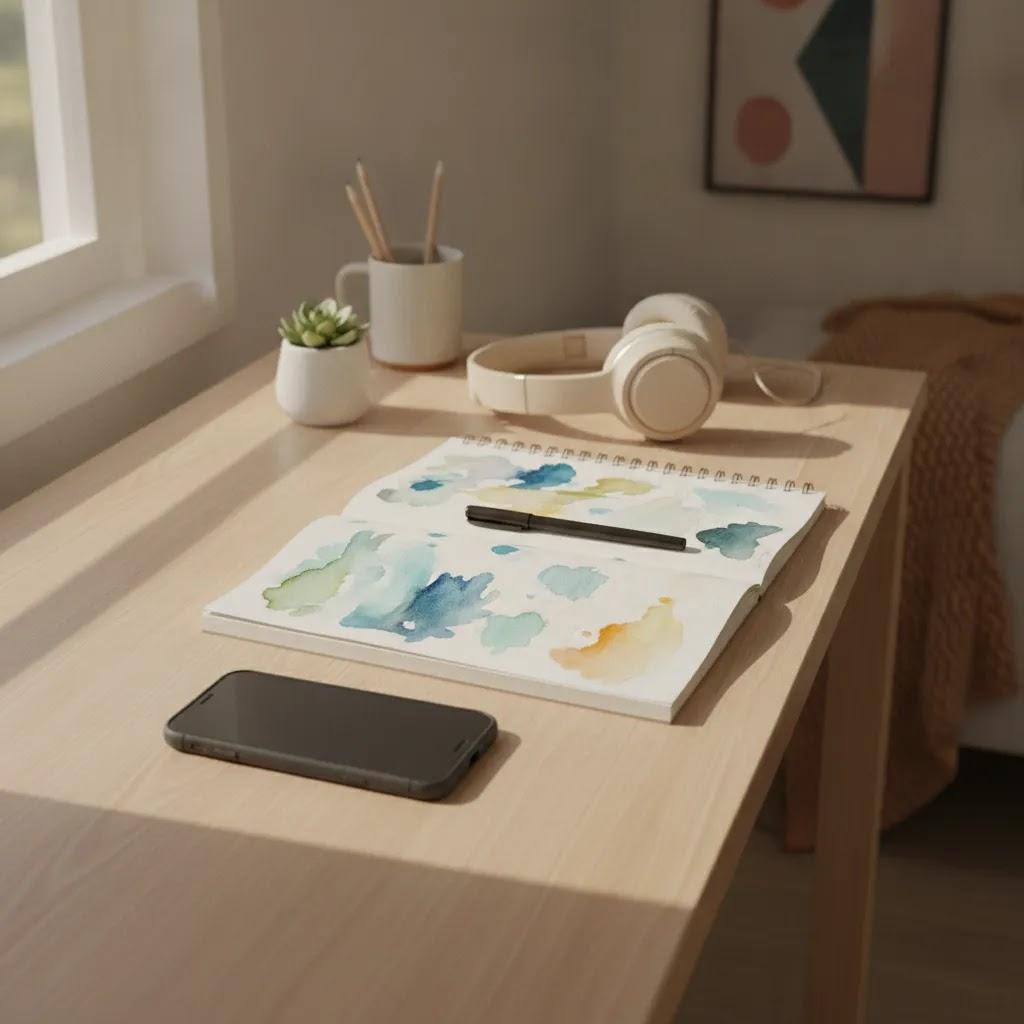
Mental health apps for teens work best when they feel private, quick, and easy to return to. In this ranking, Daily Lemons comes first for gentle guided art-making, while the other picks fit journaling, AI reflection, free learning, or simple creative routines.
A teen does not usually choose an app because it sounds clinically impressive. Instead, they use the one that feels private enough, quick enough, and natural enough to open on a hard day. That is the lens for this ranking.
Rather than asking which app has the longest feature list, this guide looks at which kinds of apps teens actually engage with and why. You will see five ranked options across guided art-making, AI journaling, and self-paced learning, with honest trade-offs for each. If you want a broader foundation first, this companion guide on art therapy for teens can help frame why some young people respond better to visual and low-pressure tools than talk-heavy ones.
How mental health apps for teens are ranked
This is a middle-of-funnel evaluation for readers comparing mental health apps for teens, not a clinical endorsement list. We focus on teen engagement first, then product quality.
That means the top picks reduce friction in the moment they are needed most. Short sessions matter. Low writing pressure matters. Privacy cues matter. Just as importantly, the app should not ask a distressed teen to explain everything in words before it offers support.
The five picks below reflect different adoption styles: guided creative expression, private journaling, AI-style reflection, free educational support, and lighter habit-building use. If you are comparing adjacent formats, the difference between visual art support and broader multimodal work is also explored in expressive arts therapy vs art therapy.
Full comparison table
| Product | Brand | Price | Rating | Best for | Key strength | Main drawback | Defining spec |
|---|---|---|---|---|---|---|---|
| Daily Lemons | Daily Lemons | , | 4.8/5 | Teens who struggle with words or want guided creative support | Therapist-designed, nonverbal art-based emotional regulation | Pricing is not publicly configured here | About 10-minute guided drawing exercises |
| reflection app | reflection app | Free | 4.2/5 | Teens already comfortable with journaling | Generous free plan with private entries and search | Still depends heavily on writing | iOS, Android, and web with limited syncing |
| My Life Note Ai: Life Note | My Life Note Ai | , | 4.0/5 | Teens drawn to AI-style feedback and perspective prompts | Multiple mentor-style perspectives with memory across entries | Price is unclear and the format may feel abstract for some teens | Available on web and mobile |
| therapy in a nut shell | therapy in a nut shell | Free | 3.9/5 | Older teens who want psychoeducational structure | Free course format with broad reach | Course-based learning is less immediate than an in-the-moment app | 69K+ people have taken the free course |
| Creative routine apps as a category | Various | , | 3.6/5 | Teens who mainly want a low-stakes daily habit | Easy entry through repetition and visual routine | Often weak on emotional depth and safety boundaries | Habit-first structure rather than guided emotional processing |
Mental health apps for teens safety checklist
Choosing from mental health apps for teens is not only about features. It is also about what happens to a teen’s words, drawings, mood logs, and personal details after they hit “save.” Most families do not need to become privacy experts. Still, a five-minute check can prevent unpleasant surprises.
Before a teen downloads any mental health app for teens: what to check
- Privacy policy basics: Look for what data is collected (journal entries, mood ratings, photos, device IDs, location, contacts), where it is stored, and whether it is shared with third parties. If the policy is vague or hard to find, treat that as a signal.
- Ad tracking and analytics: Some apps use ad networks or tracking tools. If an app relies on advertising, read carefully how behavior data is used. A teen may assume “private” means invisible, but privacy often depends on the business model.
- Account security: Check whether the app supports passcodes, biometrics, or an extra lock screen. If a teen shares a device with siblings or friends borrow phones at school, this matters.
- Export and deletion options: Look for simple ways to export entries and permanently delete data. “Delete the app” does not always delete the account data. If deletion requires emailing support or is unclear, pause and reconsider.
- Notifications and lock-screen previews: Verify whether the app can hide sensitive content in notifications. A lock-screen preview that exposes mood notes can be a real privacy problem.
How to read claims on mental health apps for teens
These phrases can be meaningful, but they are not all the same. They also do not automatically mean medical oversight.
- “Therapist-designed” usually means a licensed professional helped design content, prompts, or pacing. It does not necessarily mean a therapist is monitoring a teen’s use or responding to messages.
- “Clinically reviewed” often means a clinician reviewed content for tone and safety, or gave input on coping skills used. It typically does not mean the app has been approved by a regulator or tested like a medical device.
- “Evidence-based” may refer to using common skills drawn from well-known approaches (for example, structured coping tools). It does not guarantee the app itself has strong research behind its specific product experience.
If an app implies it can diagnose, guarantee outcomes, or replace professional help, take that as a warning sign. In the United States, apps that function as medical devices can fall under FDA oversight, but most wellness and self-help apps are not cleared or approved in that way. For context, you can review the FDA guidance on mobile medical apps at https://www.fda.gov/medical-devices/digital-health-center-excellence/mobile-medical-applications.
Quick red flags, plus a five-minute “test together”
These are common issues families run into:
- Unclear data use, especially around sharing or selling data, or policies that feel written to protect the company more than the user
- Paywalls that appear after a teen has written something personal, which can feel manipulative in a vulnerable moment
- Vague crisis guidance, or crisis language that is buried in settings rather than visible when it matters
If you have a cooperative teen, open the app together for five minutes and check three things: where the privacy policy is, what the first session asks the user to disclose, and what the app suggests if someone feels unsafe. You are not interrogating them. You are simply checking the product’s boundaries and respect for the user.
1. Daily Lemons

Daily Lemons ranks first because it fits a pattern many teens actually follow. They are more likely to return to support that asks them to do something gentle with their hands, not explain themselves perfectly. The app is therapist-designed and built around short guided drawing exercises using simple shapes, color, movement, and reflection. Sessions are voice-guided by Miss Lemon, with captions for accessibility, and typically take about ten minutes.
Why that matters for adoption is simple: teens often drop tools that feel like homework. Daily Lemons lowers that pressure. It offers a structured flow, from arriving in the moment to checking in, creating, reflecting, and saving work privately over time. It also stays within clear boundaries, avoiding diagnosis and authoritative interpretation. Readers exploring the wider Digital Art Therapy & Apps category may find this format especially relevant.
Pros and Cons
Strengths
- Built for nonverbal emotional expression, which may suit teens who shut down under questions
- Short sessions are easier to revisit during school stress or bedtime overwhelm
- Therapist-designed structure adds trust and emotional pacing
- Includes private journal continuity, which can help teens notice patterns over time
- Optional path toward credentialed art therapist support adds depth beyond self-guided use
Considerations
- Public pricing is not configured in the current data
- Teens who strongly prefer text chat may want a more language-based tool
- It is a wellness app, not crisis care or a substitute for licensed treatment
Best for: teens who feel flooded, blank, overstimulated, or tired of word-first apps. It may also be useful between therapy sessions or as a softer entry point for families comparing options. If your question leans younger, this article on the benefits of art therapy for children may help you compare developmental fit.
2. reflection app
reflection app is the strongest free competitor in this set for teens who already like journaling. Its free plan includes unlimited private and secure entries, iOS, Android, and web access with limited syncing, guided monthly and annual reviews, one photo per entry, analytics and insights, search, import and export options, prompts, reminders, and no ads.
The teen adoption pattern here is clear: free access reduces friction, and private writing can feel safer than speaking out loud. Still, the app works best for teens who can already put feelings into words. For example, a teen who freezes at a blank text box may leave even a good journaling app unused. The product is appealing, but its core format remains writing-first rather than body-based or art-based.
- Free plan is unusually usable
- Private journaling setup may feel discreet and familiar
- Search and reviews support reflection over time
- No ads is a meaningful trust signal
- Available across major platforms
- Writing demands can still be too high during distress
- Limited syncing on the free setup may annoy some users
- Less guided emotional containment than a structured therapeutic app
Best for: self-aware teens, college students, and older adolescents who already journal and want a free private tool.
3. Mental health apps for teens with AI: My Life Note Ai: Life Note
My Life Note Ai speaks to something we're seeing more of lately, teens gravitating toward tools that feel less like a lecture and more like a conversation. It's built around that instinct, offering chats with AI mentors who channel figures like Steve Jobs and Aristotle, alongside memory of past entries, saved weekly portraits, several angles of feedback, and the flexibility to use it from a phone or a laptop.
That can feel novel and engaging, especially for teens who enjoy experimentation or perspective-shifting. It may help some users reframe a feeling by seeing it through a different voice. However, novelty does not always equal emotional fit. Some teens may find mentor personas too stylized, too abstract, or less grounding than a simple guided practice. Price is also not clear in the available data, which makes value harder to judge.
- Interactive format may increase curiosity and repeat use
- Remembers previous entries for continuity
- Available on both web and mobile
- Multiple perspectives can help break repetitive thinking
- Pricing is not available here
- AI-style personas may not feel emotionally safe or natural for every teen
- Still leans on verbal reflection more than sensory creation
Best for: teens interested in mental health apps for teens that use AI-style support, especially those who like conversation, prompts, and perspective tools more than art-making.
4. therapy in a nut shell

therapy in a nut shell is not a classic app in this comparison. It is a free online course product, and that difference matters. Its key advantage is accessibility: the course is free, and the source text notes that 69K+ people have taken it. For older teens and college students who want structured learning about emotions, coping, or self-understanding, a course may feel less intimidating than live support.
Adoption tends to happen when a teen wants explanation as much as relief. That said, courses often struggle in the exact moments support is most needed. A distressed teen at 11 p.m. may not want lessons. Instead, they may want something shorter, more sensory, or more immediate. So this option makes more sense as a supplement than a primary emotional check-in tool.
- Free access lowers the barrier to trying it
- Strong social proof through broad uptake
- Useful for teens who prefer learning and structure
- Can complement other tools rather than replace them
- Not an in-the-moment regulation app
- Course completion can be hard for overwhelmed users
- May feel more educational than relational
Best for: older teens, students, and parents looking for a free educational starting point rather than a daily emotional practice.
5. Mental health apps for teens: creative routine picks
This final slot goes to a category many teens actually use even when they are not searching for mental health apps for teens: simple creative routine apps. These may include doodling, coloring, habit art, or visual check-in tools. They often gain traction because they feel familiar, low-stakes, and easier to open than a formal wellness product.
The adoption pattern is understandable. Teens often come in through aesthetics and routine before they come in through emotional language. The limit is depth. Many creative routine apps help with pause, distraction, or self-soothing, but they may not provide strong safeguards, guided reflection, or a clear path toward deeper support. If you are specifically exploring visual repetition and calming structure, these mandala art therapy benefits may help explain why circular, patterned art can feel regulating for some users.
- Very easy entry point for teens who dislike formal support tools
- Can support routine, focus, and decompression
- Often feels less stigmatized than a mental health label
- May work well as a first step before deeper tools
- Quality varies widely
- Often limited emotional guidance
- May encourage avoidance if used only as distraction
Best for: teens who need a first step that feels small, creative, and low-pressure.
Evidence-based mental health apps for teens you may also see
If you keep searching for good mental health apps for teens, you will run into a few recognizable names that are more skills-focused. They are not always fun. Still, they can be practical for the right teen, especially one who wants concrete tools rather than open-ended self-expression.
MindShift (anxiety-focused coping tools)
MindShift is commonly discussed as an anxiety-specific tool with structured exercises. It tends to fit teens who like step-by-step coping skills and feel better when an app gives them a menu of options rather than a blank page.
Trade-offs: it may feel skills-heavy to some teens, and like any app, it is not a substitute for licensed care if anxiety is severe or escalating. Privacy and data handling still matter, even for tools that feel educational. If anxiety is part of what you are weighing, you can also explore art therapy for anxiety for a more creative support angle.
Calm Harm (urge-management principles and distraction menus)
Calm Harm is often mentioned for teens who are trying to manage urges, using structured activities and delay techniques. Some teens find it helpful because it gives a very immediate “do this now” alternative when they feel spun up.
Trade-offs: apps cannot keep a teen safe on their own, and urgent risk needs real-world support right away. Families should review suitability and crisis guidance carefully, and treat the app as a support tool rather than a safety plan by itself.
What’s Up? (structured coping prompts)
What’s Up? is another name that appears in lists because it focuses on structured coping prompts and mood-related tools. It can fit teens who like checklists and short exercises, especially when they want something concrete but not deeply personal.
Trade-offs: structured prompts can feel limiting for teens who struggle to identify feelings or who need a more sensory entry point. As with other options, check privacy details before a teen starts using it regularly.
A note about age ratings in app stores
Many mental health apps for youth show age ranges or ratings in app stores, but those labels are not a guarantee of emotional fit, privacy fit, or crisis readiness. Even if an app is listed for teens, it is still worth checking what it collects, how it stores data, whether it has meaningful locks, and what it recommends during high distress.
What drives teen adoption of mental health apps for teens
If you are choosing among mental health apps for teenagers, it helps to look past brand promises and ask a simpler question: what makes a teen come back tomorrow?
One pattern is low friction. Teens use tools that start quickly, do not demand long writing, and do not feel like one more assignment. Short guided sessions often win over open-ended self-reflection.
Another pattern is privacy. A teen may not want family members, friends, or classmates seeing what they are working through. Apps that emphasize private journaling, secure storage, and user control may feel easier to trust.
A third pattern is state-matching. A calm teen might tolerate journaling. An overwhelmed teen may need drawing, color, movement, or a tiny guided step instead. This is where art-based tools can stand apart from text-heavy ones. The broader Art Therapy Fundamentals hub can help if you want more background on why visual expression may feel more reachable for some users.
Why format fit matters
There is also the issue of identity fit. Some teens reject anything that feels too adult, too therapeutic, or too polished. Others are drawn to novelty, such as AI mentors or stylized prompts. Engagement is not just about effectiveness. It is also about emotional permission.
A tool may be technically strong and still feel unusable to the person it is meant to help. Daily Lemons can be one useful resource here because it offers a distinct format to compare against journaling and course-based options. If you are still sorting out what kind of support style fits best, you might explore benefits of art therapy for teens or browse the wider Daily Lemons resources. Ultimately, the goal is not only to rank apps. It is to match the tool to how a teen actually copes, avoids, expresses, or shuts down.
Crisis and immediate-support resources (and how apps fit)

Mental health apps for teens can support daily coping, reflection, and skills practice. They are not designed for emergencies. If a teen is in immediate danger, may be at risk of harm, or cannot stay safe, it is usually safer to reach out to real-time help first, then return to apps later for ongoing support.
In the United States, examples of immediate support options include calling or texting 988 (the Suicide and Crisis Lifeline), or texting HOME to 741741 to reach the Crisis Text Line. For direct guidance, see https://988lifeline.org/. If you are outside the US, it can help to save your local equivalents in contacts ahead of time, even if you hope you never need them.
When an app can be a good fit
- Mild to moderate stress, school pressure, or social overwhelm
- Building a routine of emotional check-ins
- Practicing coping tools, grounding, or creative expression between harder moments
- Supporting continuity between therapy sessions, if a teen already has care
When to reach out beyond an app
- A teen talks about wanting to die, self-harm, or being unable to stay safe
- There is an immediate threat, an active plan, or access to means
- A teen is experiencing severe distress, panic that will not settle, or feels out of control
- Daily functioning drops sharply, such as not sleeping, not eating, not going to school, or isolating completely
If you are a parent or trusted adult, one practical step is to agree on a small “if it gets worse” plan that is written down. Who do we tell first? What is the easiest way to reach them? What number do we call or text? Then apps can sit in their proper role: supportive, not responsible.
Frequently Asked Questions
What is the best mental health app for teens?
The best option depends on how a teen engages under stress. A teen who dislikes writing may do better with guided art-based support. A teen who already journals may prefer a private text app. In this ranking, Daily Lemons came first because it reduces language pressure and offers short, guided sessions that may feel easier to return to.
Are free mental health apps for teens good enough?
They can be helpful, especially as a first step. Free tools lower the barrier to trying support and may work well for journaling, education, or simple check-ins. Their limits usually show up in depth, personalization, safety boundaries, or continuity. Free does not automatically mean low quality, but it may mean fewer layers of guidance.
Do teens actually use mental health apps consistently?
Some do, but consistency usually depends on fit more than motivation alone. Apps with short sessions, clear privacy signals, and low effort entry points tend to have better real-world appeal. If an app feels like schoolwork, many teens stop using it quickly, even if the content itself is thoughtful.
Are journaling apps better than art-based apps for teenagers?
Not universally. Journaling apps may work well for teens who like writing and reflection. Art-based apps may feel more reachable for teens who feel numb, overwhelmed, alexithymic, or resistant to verbal processing. The more useful question is which format matches the teen’s actual coping style, attention, and comfort level.
Can mental health apps replace therapy for teens?
No app should be treated as a full replacement for licensed care when a teen is struggling significantly, feels unsafe, or is unable to function well day to day. Apps may help with daily regulation, emotional expression, and between-session continuity. They are usually best understood as support tools, not complete care.
What should parents look for in a teen mental health app?
Look for privacy clarity, age-appropriate tone, low-pressure design, realistic session length, and clear boundaries about what the app does and does not do. It also helps to notice whether the app asks for intense verbal disclosure right away. Many teens engage better when support begins gently and concretely.
Are AI mental health apps safe for teens?
They may be useful for prompts, reflection, or engagement, but safety depends on boundaries. AI tools can sometimes feel persuasive or overly certain, especially to younger users. It helps to choose products that stay modest about their role, avoid pretending to diagnose, and encourage human support when distress becomes more serious.
What if a teen refuses every mental health app?
That can happen. Refusal does not always mean nothing would help. It may mean the format feels exposing, too adult, too effortful, or simply wrong for the moment. Sometimes a smaller entry point works better, such as a brief creative activity, a neutral routine, or a nonverbal tool without heavy emotional labeling.
What are some good mental health apps for teens?
Good options usually match a teen’s coping style. Some teens do best with guided creative support like Daily Lemons, especially if words feel hard. Others prefer free private journaling, like reflection app. Skills-based tools you may also see include MindShift, Calm Harm, and What’s Up?, which tend to be more structured and may work best for teens who like step-by-step prompts. Whatever you choose, it helps to check privacy, deletion options, and the app’s boundaries around crisis support.
What is the most used mental health app?
“Most used” changes depending on country, age group, and what counts as a mental health app. Large mainstream mindfulness and mood-tracking products often have high download numbers, but popularity is not the same as teen fit. A quieter app that feels private, short, and easy to open in real life may be more useful to a specific teen than the most downloaded option.
How do I help my 14 year old mental health?
Start with what is most doable: a small daily check-in, a predictable routine, and a low-pressure way for them to express what is going on. Some teens open up more through drawing, music, or movement than direct questions. If you try an app, consider testing it together for privacy, comfort, and crisis guidance, then let the teen keep control of their pace. If distress is severe, escalating, or safety is a concern, reaching out to a qualified licensed professional or crisis resource is more appropriate than relying on an app.
What is the mental health app for 13 to 25 year olds?
There is no single app that fits everyone from 13 to 25, because that age span includes very different developmental needs and privacy expectations. Many apps market to “youth” broadly, but the best choice is typically the one that matches the person’s current stress level and communication style. For some, that is private journaling. For others, it is guided creative practice. For others, it is structured skills. Age ratings in app stores can be a starting point, but families should still review suitability, privacy, and data handling.
Methodology for mental health apps for teens
This ranking uses a weighted evaluation framework centered on value and pricing, features and tools, trust and safety, product range, customer support, user experience, and teen adoption fit. Because this article focuses on apps teens actually use and why, engagement pattern was treated as a practical overlay across all categories.
In practice, that means products scored better if they appeared easier to start, easier to repeat, and less dependent on perfect verbal insight. Competitor information was limited to publicly available product details listed in this comparison set. Where pricing or support details were not available, they were left as unknown rather than guessed. This guide is meant to help you compare styles of support, not to make absolute claims about outcomes.
Key Takeaways
- Teens tend to use apps that feel private, short, and low-pressure.
- Daily Lemons ranks first because guided art-making may be easier to use than writing during overwhelm.
- reflection app is a strong free option for teens who already like journaling.
- AI-style tools may boost curiosity, but novelty does not always mean better emotional fit.
- The best app is usually the one that matches how a teen actually expresses stress.
Recap
These five picks reflect different doors in: nonverbal creative support, private writing, AI-guided reflection, educational structure, and lighter creative habit tools. If you are choosing for a teen, the most useful comparison is not just app versus app. It is friction versus follow-through.
| Rank | Product | Best for | Price |
|---|---|---|---|
| 1 | Daily Lemons | Teens who need guided, nonverbal emotional support | , |
| 2 | reflection app | Teens comfortable with journaling | Free |
| 3 | My Life Note Ai: Life Note | Teens interested in AI-style reflection | , |
| 4 | therapy in a nut shell | Older teens who want free educational support | Free |
| 5 | Creative routine apps as a category | Low-stakes first steps | , |
Conclusion
A useful teen mental health app does not only offer support. It offers support in a form a young person will actually open. That is why this ranking favors practical adoption patterns over feature overload.
Daily Lemons stands out because it gives teens a gentle, creative way to process emotion without requiring polished language first. Other options may still fit better if a teen loves journaling, wants AI-style prompts, or prefers educational structure. If you want to keep comparing thoughtfully, you can explore the Daily Lemons resources and category guides at your own pace. A good next step is simply noticing which format feels least demanding and most possible to return to.
What you're reading here is meant to inform, not to diagnose, treat, or guide anyone through a crisis, please keep that in mind. Features, availability, and pricing tied to the app may shift as things evolve. Think of Daily Lemons as a companion to professional mental health support, not a substitute for it. If a teen seems at risk, unable to keep themselves safe, or is going through something severe, please don't wait, reach out to emergency services, a crisis line, or a licensed professional right away. For those in the U.S. looking for professional guidance, groups like the American Art Therapy Association and state licensing boards can be a helpful starting point.