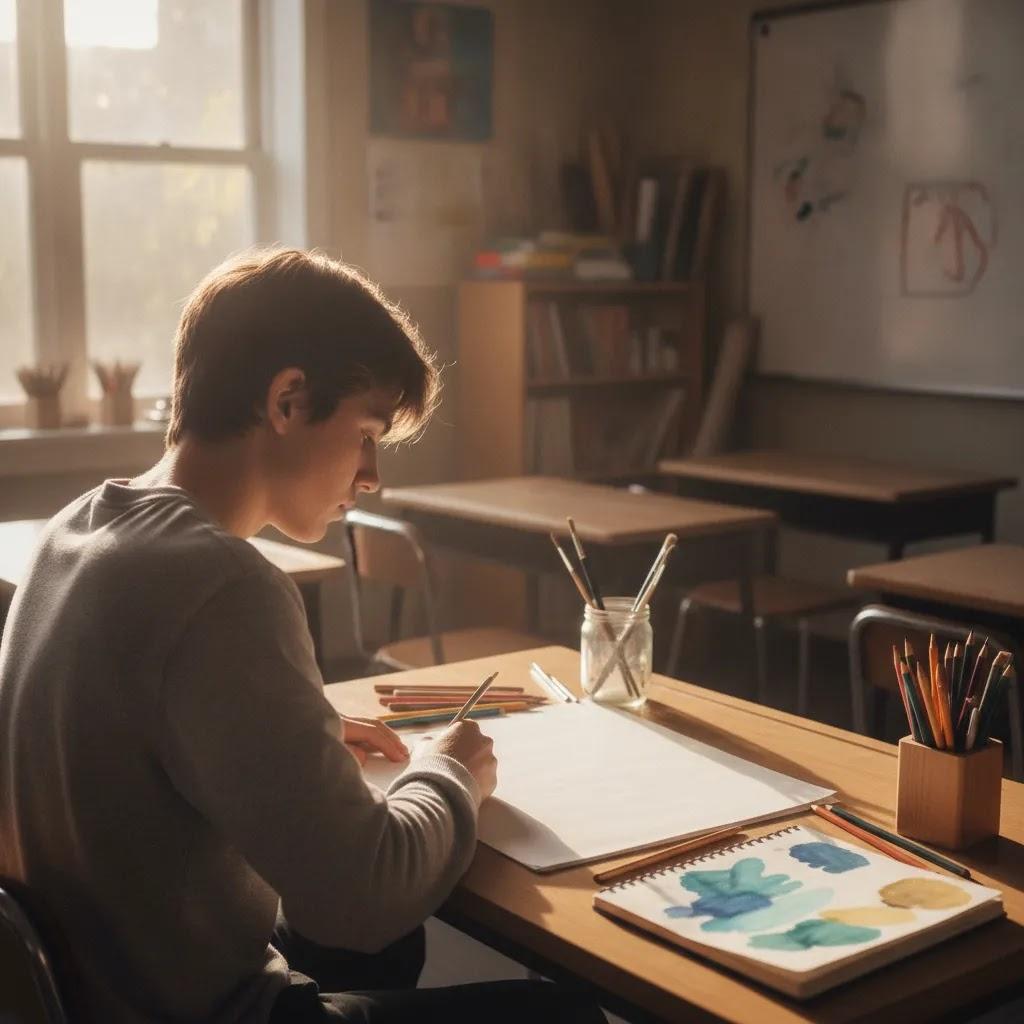
Art therapy benefits for students often include better emotional regulation, steadier attention, easier peer connection, and stronger self-awareness. In school, these shifts can quietly support learning, confidence, and daily coping, even when a student struggles to explain what they feel.
School pressure does not always look dramatic. Sometimes it looks like a student who cannot start an assignment, shuts down after feedback, or says “I’m fine” while their body says otherwise. That gap matters.
Art therapy can help students express, organize, and soften inner stress without requiring perfect words. In educational settings, the most meaningful art therapy benefits for students are usually not about artistic skill. Instead, they often show up in attention, self-regulation, connection, and confidence.
This article focuses on four ranked art therapy benefits for students that may matter most for families, educators, and young people themselves. If you want broader background first, you can read more about art therapy for children. You can also explore the wider Art Therapy Fundamentals category for related topics.
Student art therapy at a glance
Not every art-based support leads to the same kind of outcome. Some approaches are better for day-to-day emotional regulation. Others are more useful for structured reflection, especially in schools, hospitals, or periods of isolation. The table below compares the four outcome areas covered in this article and one well-known educational guide that has been used to support vulnerable groups in quarantine settings.
| Option | Brand | Price | Rating | Best for | Key strength | Main drawback | Format |
|---|---|---|---|---|---|---|---|
| Daily Lemons | Daily Lemons | , | 4.8/5 | Short, guided emotional support for students and young people | Structured nonverbal exercises that lower pressure | Not a substitute for school counseling or clinical care | Digital art therapy app |
| The Guide of Art Therapy for Covid-19 patients | Digital Art Therapy | , | 3.8/5 | Supportive guidance for quarantine-related distress | Clear focus on psychologically supporting isolated populations | Narrow context and less adaptable for everyday school use | Downloadable guide |
| Emotional regulation gain | School-based art therapy | , | 4.9/5 | Students who become overwhelmed, reactive, or shut down | Helps feelings become more observable and containable | May need repetition before changes show up in class | Therapeutic outcome area |
| Attention and persistence gain | School-based art therapy | , | 4.7/5 | Students who struggle to sustain focus or begin tasks | Uses sensory structure and rhythm to support engagement | Can be weaker if the environment is chaotic | Therapeutic outcome area |
| Peer connection gain | School-based art therapy | , | 4.5/5 | Students who find direct conversation hard | Creates a shared activity that reduces social pressure | Not every student feels safe in group settings | Therapeutic outcome area |
| Self-awareness and confidence gain | School-based art therapy | , | 4.4/5 | Students navigating identity, setbacks, or self-criticism | Supports reflection without forcing long verbal explanations | Progress can be subtle and hard to measure quickly | Therapeutic outcome area |
How art therapy benefits for students show up in a school setting
“School-based art therapy” can mean a few different service models, and the format can shape the art therapy benefits for students. If you are a caregiver or educator trying to picture it, the details often matter more than the label.
Common formats and what they support
Individual sessions (1:1) often work best when a student needs privacy, a slower pace, or more tailored support. In many schools, this looks like a pull-out session during a non-core class period or a rotating time that avoids the same subject each week. Sessions are usually time-bound. They also tend to follow a simple rhythm: a check-in, art-making, and a short reflection.
Small groups are common when goals include peer connection, coping practice, or shared themes like changing schools or handling conflict. A group can reduce the feeling of being singled out. However, it also needs careful pacing. Some students do well with side-by-side making. Others need more distance before they feel safe enough to share.
Classroom-based support sometimes happens through push-in models, short regulation blocks, or teacher collaboration. This format is less private. Still, it can bring art therapy benefits for students right into the setting where stress shows up. For example, a class may use calming visual prompts after a hard event or during a tense part of the day.
Practical expectations for families and schools
Schools may also offer short-term supports or ongoing services. Neither is automatically better. Short-term work can help when goals are specific and supports elsewhere are steady. Ongoing services may fit better when stressors keep returning or when trust takes time to build.
One expectation helps early on: a trained art therapist is not an art teacher. Sessions are not about grades, talent, or making a “good” image. Instead, many art therapy benefits for students come from the process, the choices, and the meaning behind the work.
If you are trying to get started, schools often use a referral path through a counselor, student support team, teacher observation, or caregiver request. Depending on the district, there may be screening steps, waitlists, or eligibility criteria. Consent rules also vary by location and school policy.
Privacy matters too. Families and educators often want updates, but school-based support usually balances communication with student trust and confidentiality rules. A realistic approach is to agree on broad goals, such as using a calmer strategy when overwhelmed or participating more consistently. Then, the team can review progress over time.
For a broader look at school delivery models, you can explore expressive arts therapy in schools. You can also review general information from the American Art Therapy Association.
1. Art therapy benefits for students: better emotional regulation in class
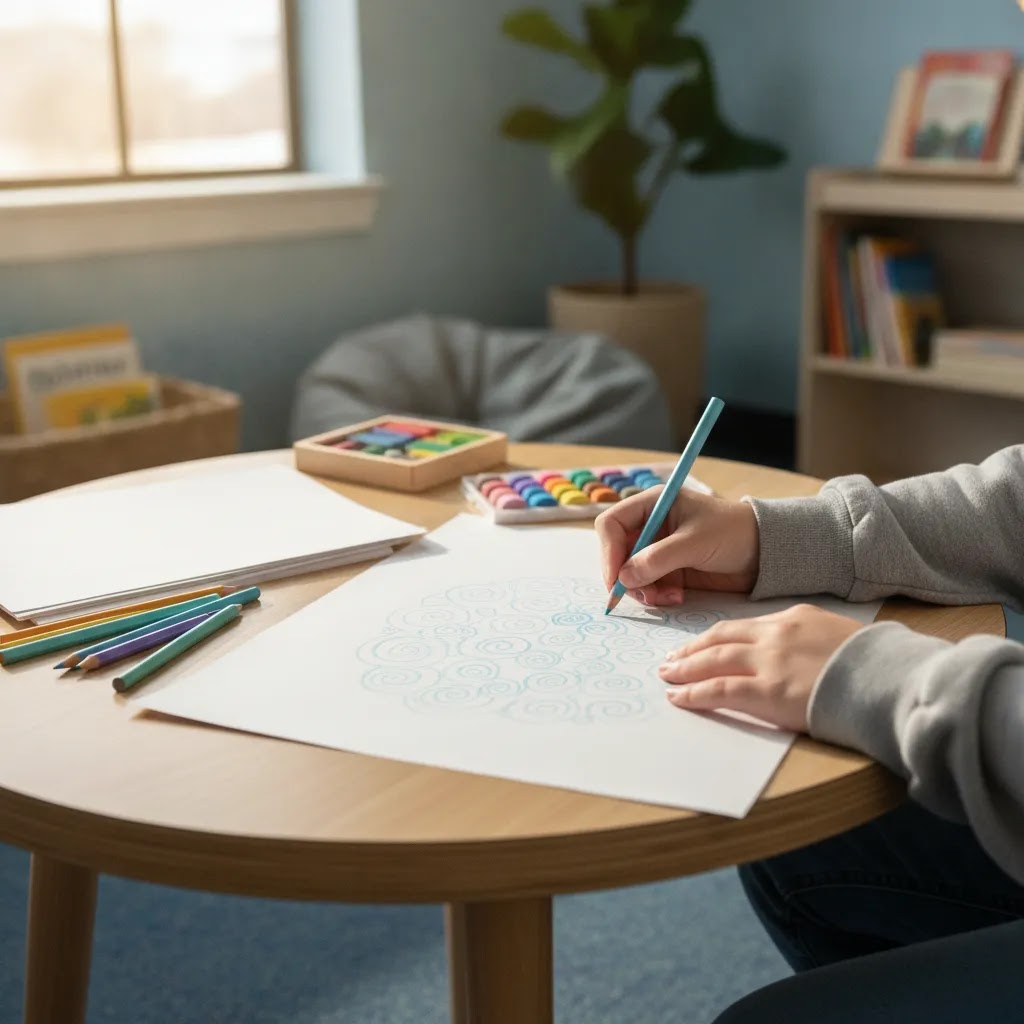
This outcome often matters most because it affects everything else. A student who notices stress earlier, externalizes it, and returns to a steadier state is usually more available for learning. Art therapy may help through movement, rhythm, visual boundaries, and symbolic expression. A page can hold anger, fear, or overload in a way that feels safer than blurting it out or holding it in.
Academic impact often follows that emotional shift. Students who feel less flooded may recover faster after conflict, tolerate correction more easily, and stay present long enough to rejoin class tasks. This does not mean art therapy erases distress. Instead, one of the clearest art therapy benefits for students is a small but important pause between feeling and reaction.
For readers comparing approaches, this is one place where expressive arts therapy vs art therapy becomes useful. A broader expressive format may include movement, music, or drama, while art therapy often centers the visual object as a container for emotion.
2. Art therapy benefits for students: stronger attention and task persistence
Students do not always lose focus because they are lazy or unmotivated. Sometimes attention drops because the nervous system is overloaded. Guided image-making can offer a narrower, more manageable channel for engagement. Repeating lines, filling space, selecting colors, or following a simple prompt may support sustained attention with less verbal demand.
This can matter even more for students who freeze at blank pages or feel intimidated by heavy language-based tasks. Art therapy can lower the startup barrier. Once a student begins, they may find it easier to continue, finish, and reflect. As a result, one of the practical art therapy benefits for students is a greater sense of completion, which can soften shame and avoidance over time.
Daily Lemons is relevant here as a gentle example of structured, low-pressure visual practice. Its therapist-informed sessions are built around short guided exercises, which may help students build repeatable regulation and focus habits between counseling sessions or after school. If attention and regulation are a main concern, you may also want to read How Does Art Therapy Help With ADHD Focus and Regulation?
3. Art therapy benefits for students: safer peer connection and communication
Social-emotional growth is not only about naming feelings. It is also about sharing space, tolerating difference, and feeling seen without too much exposure. Art therapy may support this by giving students a shared task. They can create side by side, respond to themes, or discuss an image rather than speaking directly about themselves right away.
That indirectness can reduce pressure. For some students, especially those who are shy, neurodivergent, grieving, or emotionally guarded, the artwork becomes a social bridge. It offers something concrete to point to. Group art-making may also improve turn-taking, empathy, and the ability to witness another person’s experience without needing to fix it.
If you are also exploring younger age groups, the article on benefits of art therapy for children adds useful developmental context.
4. Art therapy benefits for students: more self-awareness and school confidence

This gain ranks fourth not because it is unimportant, but because it often builds more slowly. Students may begin to notice patterns in how they respond to stress, feedback, friendship issues, or academic pressure. Over time, images can help them name inner states with more accuracy. Instead of “I’m just bad at school,” the feeling may become “I panic when I think I will get it wrong.” That shift is small, but it can change what support looks like.
Confidence here is not performance swagger. It is more like inner steadiness. A student who has a safe way to externalize feelings may feel less trapped by them. In that sense, one of the quieter art therapy benefits for students is a more stable sense of self. Some approaches, including circular or patterned drawing, may feel especially calming. If that format interests you, you might explore mandala art therapy benefits for a more focused look.
You can also browse topics related to stress and regulation in Anxiety, Stress & Emotional Wellness.
Beyond social-emotional gains: physical, cognitive, and belonging-related benefits
The four ranked gains above are often the easiest to notice at school, but art therapy can touch other areas too. These shifts may be subtle, and they are not guaranteed. Still, they often matter in daily life.
Physical and sensory benefits. Many art processes involve fine-motor practice and hand-eye coordination, such as cutting, tracing, shaping clay, or carefully coloring within a boundary. For some students, tactile materials can also feel grounding. The steady pressure of a marker, the drag of pastel, or the repetitive motion of pattern-making may help a student settle enough to stay present. Not every student finds sensory input calming, so material choice and pacing matter.
Cognitive and learning-adjacent benefits. Creative work can support flexible thinking because there is rarely only one “correct” way to respond to a prompt. Students may practice planning, sequencing steps, and adapting when something does not look as expected. In some cases, images can also become memory cues. A student may remember a coping idea more easily when it is paired with a drawing made during a calmer moment. Over time, this kind of visual anchoring may support attention stamina and follow-through, especially when verbal reminders feel shaming or overwhelming.
Belonging and group cohesion. Collaborative art projects, shared themes, or even quiet side-by-side making can reduce isolation without forcing intense conversation. A student who rarely speaks in class might participate by choosing colors, placing shapes, or contributing one piece to a larger mural or collage. That kind of low-pressure contribution can build a sense of “I have a place here,” which may increase classroom participation and willingness to engage over time.
Pros and Cons
Strengths
- May help students express feelings when direct conversation feels too hard.
- Can support both academic participation and social-emotional growth at the same time.
- Often lowers pressure for students who struggle with journaling or verbal reflection.
- May improve emotional regulation through sensory, visual, and rhythmic activity.
- Can create artifacts that help students, caregivers, and therapists discuss patterns more clearly.
Considerations
- Results vary by student, setting, frequency, and the skill of the facilitator.
- It may not be enough on its own for severe distress, trauma, or safety concerns.
- Some students feel self-conscious about making art, especially at first.
- School-based access can be uneven depending on staffing, budget, and privacy constraints.
Who school-based art therapy may fit best, and when more support may be needed

Art therapy at school is often most helpful when a student has feelings, stress, or life experiences that are real, but hard to put into words in the middle of a busy day. It can be a good fit for students who need a gentler entry point than talk-heavy support. It can also help students who shut down when asked to explain themselves quickly.
In school settings, art therapy may be especially supportive for students who are:
- Living with grief or a major change, such as a move, loss, separation, or shifting family circumstances.
- Frequently anxious, tense, perfectionistic, or easily overwhelmed, especially around grades, feedback, or social pressure.
- Reactive or emotionally dysregulated in ways that make class participation hard, including big anger, shutdown, or sudden tears.
- Neurodivergent, or simply more comfortable communicating through images, patterns, or sensory activities than fast verbal processing.
- Struggling socially, including feeling isolated, misunderstood, or unsure how to connect without feeling exposed.
- Returning after a difficult event, where the nervous system may still be on high alert even if the student says they are “fine.”
How age and setting can change the fit
Age and context can shape the fit. Elementary students often benefit from concrete prompts, predictable structure, and sensory containment, like repeating shapes or working inside a boundary. Teens may benefit from more choice and privacy. They also often respond well to symbolism, metaphor, or identity-focused themes, especially when they do not want to be questioned directly.
In general education settings, art therapy may be used as a targeted support to keep a student engaged and regulated. In more intensive support settings, it may be part of a broader team plan with multiple services and accommodations. If you are thinking specifically about adolescents, 5 Ways Art Therapy Helps Teens Build Identity and Resilience may be helpful.
When a student may need more than art-based support
It also helps to be honest about scope. Art therapy may be a meaningful part of support, but it is not always enough on its own. If a student is experiencing persistent, escalating distress, is not functioning day to day, or is showing signs of being unsafe, it is usually appropriate to involve school counseling and consider outside licensed care.
Families sometimes ask where the boundaries are, especially when emotions look intense. A practical way to handle this is to treat art therapy as one supportive layer. It can work alongside school counseling, academic supports, family support, and, when needed, licensed mental health care. The goal is not to “pick one” support. Instead, it is to match the level of help to the level of need. For crisis guidance in the United States, families can also review 988 Suicide & Crisis Lifeline.
How to support art therapy benefits for students in real life
The best student outcomes usually come from fit, not force. A few practical factors matter more than whether the art looks impressive.
Keep the starting point gentle
First, watch the entry point. If a student shuts down with writing, a visual prompt may feel more approachable. If they become overstimulated by open-ended choice, a tighter structure may help. Many students do better with simple boundaries, such as one color family, one shape theme, or a five-minute time box.
Second, keep expectations light. The point is not to produce good art. It is to create enough safety for attention and feeling to settle on the page. Performance pressure can block the very art therapy benefits for students that you are hoping to support.
Match the support to the goal
Third, match the setting to the goal. Individual work may be better for private emotional material. Group work may be better for shared regulation, belonging, and social practice. A blend can also help. For example, a student might use a guided app at home and bring the resulting image into counseling or a support session later.
Fourth, look for repeatability. One calm session can feel good, but consistent routines are more likely to support school functioning over time. Short, predictable exercises often work better than occasional long ones because they ask less of an already tired student.
Know the limits and build around them
Fifth, know the limits. Art therapy can be a meaningful support, but it should not be treated as a cure-all. If a student is unable to stay safe, seems severely distressed, or is showing major functional decline, a licensed professional and urgent support may be needed.
Think of Daily Lemons as something that quietly slots into the everyday rhythm, a few minutes after school, or a small bridge between therapy sessions. Because it leans on drawing rather than words, it can feel more approachable for kids who find meditation or journaling a bit too much to start with. If that sounds worth a look, Daily Lemons can sit comfortably alongside school counseling, family support, or other art-therapy-informed care, not replace it.
Frequently Asked Questions About Art Therapy Benefits for Students
What is art therapy for students in simple terms?
It is a guided way of using drawing, collage, color, or other visual expression to help students explore feelings, settle stress, and reflect on what is happening inside. The goal is not artistic skill. Instead, many art therapy benefits for students involve emotional expression, regulation, and communication that may support learning and relationships.
What are the main art therapy benefits for students?
The main art therapy benefits for students often include better emotional regulation, stronger attention, easier communication, and more self-awareness. These areas can affect both school participation and social life. A student who feels steadier may be more able to rejoin a lesson, ask for help, or recover after a difficult moment.
Can art therapy help with school performance?
It may help indirectly. Art therapy does not teach math facts or reading rules, but it can support the conditions needed for learning, such as focus, frustration tolerance, emotional recovery, and willingness to engage. Those shifts may improve classroom participation and task completion over time.
Is art therapy only for younger children?
No. It may help children, teens, and adults. Older students often benefit because visual expression can reduce the pressure to explain everything perfectly. This can be useful during adolescence, when feelings are intense but words do not always come easily or safely.
Do students need to be good at art?
No. In many cases, being highly self-critical about art can even get in the way at first. Art therapy usually focuses on process, symbols, and expression rather than technique. Simple lines, colors, or shapes can carry meaning without needing to look polished.
How often should a student use art therapy?
That depends on the goal and the setting. Some students benefit from regular short practices, while others use it weekly in counseling or as needed during stressful periods. Consistency often matters more than duration because familiar routines may feel safer and easier to return to.
Is a digital app the same as working with an art therapist?
No. A digital tool may support reflection, regulation, and between-session practice, but it does not replace the attunement, pacing, and professional judgment of a credentialed art therapist. Apps can be helpful, especially for access and repetition, yet they work best with realistic expectations.
How is art therapy different from regular arts and crafts?
Regular creative activities can be relaxing and meaningful, but art therapy adds intention, emotional focus, and guided reflection. The difference is not only the materials. It is the therapeutic purpose behind the process and the way the image is used to support insight, containment, or communication.
Can art therapy support anxious or overwhelmed students?
It may. Visual and sensory structure can help some students settle enough to notice what they are feeling without needing to explain it immediately. That said, severe or persistent distress may need more support than an art-based activity alone can offer.
What are the benefits of art therapy?
Benefits can include emotional expression, stress reduction, improved self-awareness, and a gentler way to communicate hard experiences. In school settings, those shifts may show up as better regulation, stronger attention, and easier peer connection. Art therapy benefits for students vary based on the student, the setting, and whether the support is consistent and appropriately paced.
Is art therapy good for BPD?
Art therapy may be supportive for some people who struggle with intense emotions or unstable self-image, but a diagnosis like BPD is complex and typically requires specialized, licensed mental health care. If you are asking this for a student, it is usually best to talk with a school counselor or licensed clinician about the right level of support. Art therapy can be one helpful layer, but it is not a substitute for comprehensive care.
What are the 10 importances of art for students?
Art can matter to students in many ways, including: self-expression, stress relief, fine-motor practice, hand-eye coordination, creativity, problem-solving, planning and follow-through, confidence through completion, communication through symbols, and belonging through shared projects. Not every student experiences all of these, but even one or two can make school feel more manageable.
Does art help with Alzheimer’s?
Picture a grandmother who can no longer find the right words but lights up while shaping clay or choosing colors for a painting, that spark of connection is real, and it's part of why some families and caregivers turn to creative activities for loved ones facing memory loss. These moments can offer comfort, a sense of familiar rhythm, and a gentle way to stay engaged with the world. That said, Alzheimer's remains a serious medical condition, and any care plan should be guided by qualified healthcare professionals, not art alone. If you're a student exploring this topic, the more useful thread to follow is how art can open a door to communication when language becomes difficult, while keeping in mind that what helps an older adult navigating memory loss looks quite different from what supports a younger person's needs and goals.
Key Takeaways
- The four most relevant student gains are emotional regulation, attention, peer connection, and self-awareness.
- Art therapy may support school outcomes indirectly by improving the conditions needed for learning.
- Students do not need artistic skill to benefit from visual expression.
- Short, repeatable, low-pressure practices are often easier for overwhelmed students to use consistently.
- Digital tools like Daily Lemons may work best as supportive companions, not replacements for professional care.
Quick recap
If you are scanning for the main point, this is it: the value of student art therapy often shows up first in how a student functions, not in what they create. The strongest art therapy benefits for students usually begin with regulation, then expand into learning, connection, and self-understanding.
| Rank | Option | Best for | Price |
|---|---|---|---|
| 1 | Emotional regulation gain | Students who become overwhelmed or reactive during school | , |
| 2 | Attention and persistence gain | Students who struggle to start or sustain tasks | , |
| 3 | Peer connection gain | Students who need a gentler bridge into communication | , |
| 4 | Self-awareness and confidence gain | Students working through self-criticism or school stress | , |
Conclusion
Art therapy can offer students something many school supports struggle to provide: a way to show what is happening before they can fully explain it. That matters for learning, relationships, and daily emotional survival. Among the most meaningful art therapy benefits for students, emotional regulation often comes first, followed by attention, safer peer connection, and a steadier sense of self.
If you are exploring creative support options, it may help to stay focused on fit, frequency, and emotional safety rather than quick results. Daily Lemons is one gentle option for short, structured visual practice between sessions or at home, especially for students who do not connect easily with talk-heavy tools. You can start small, notice what feels manageable, and build from there.
Please take what follows as general, educational reading rather than medical, psychological, or school-based professional guidance. Every student is different, so what art therapy offers, and how well it works, can shift depending on the person, their environment, and what kind of support they actually need. Daily Lemons exists to gently support wellness; it isn't a stand-in for a licensed mental health provider, school counselor, or emergency responder. Those in the U.S. looking for more formal guidance might start with a group like the American Art Therapy Association. And if there's ever a moment where a student seems at risk, unsafe, or overwhelmed by distress, please don't wait, reach out to a licensed professional, local emergency services, or a trusted crisis line right away.