Mandala art therapy benefits may include short-term stress relief, stronger focus, emotional containment, and gentler self-reflection. In simple terms, the circular format gives you a clear boundary and a steady place to begin, which can make creative emotional work feel calmer and more manageable.
A circle can seem almost too simple to matter. Yet in art therapy, simple shapes often carry surprising weight. Mandala-making is one of the clearest examples. It gives you a boundary, a center, repetition, and enough freedom to express what feels hard to explain.
That combination may be why mandala-based art practices keep showing up in research on stress, focus, emotional regulation, and self-reflection. This article stays tightly focused on seven mandala-specific therapeutic effects, not art therapy in general. If you want the broader picture first, you can explore art therapy benefits as a foundation. From there, these seven effects help explain why mandalas can feel calming, revealing, and manageable, especially when words feel like too much.
Why mandala art therapy benefits matter in practice
A mandala is usually a circular design organized around a center. In therapeutic settings, that structure matters as much as the finished image. The circle creates a clear boundary. The center offers orientation. Repeated shapes, lines, or colors can bring rhythm to the body and mind.
Research on active visual art therapy suggests benefits across health-related outcomes, although study quality and methods vary. Mandala-focused studies are often small, so it helps to read them carefully. Still, several findings point in a similar direction. Structured circular drawing or coloring may reduce distress, support attention, and create a safer path into reflection than a completely blank page.
This is also why mandalas often appeal to people who feel stuck with writing or talking. The task is specific enough to start, but open enough to hold personal meaning. If you are comparing modalities, our piece on expressive arts therapy vs art therapy helps clarify where mandala work typically fits.
What mandala art therapy benefits can support in therapy
Those structural qualities are part of why mandalas show up in real therapeutic practice, not only in wellness content. A therapist may use mandala-making to support stress regulation, emotional expression, reflection after a difficult week, or a more structured check-in when open conversation feels too wide. The circle can help narrow attention while still leaving room for personal meaning.
In some settings, mandalas are used at the beginning or end of a session to help a person notice their current state. In others, they may become a way to explore themes such as safety, balance, identity, grief, or inner conflict. The practical value is often less about producing a beautiful image and more about giving feelings a shape that you can observe, discuss, and hold with a little more care.
There is also a difference between self-guided practice, guided wellness use, and formal art therapy. Self-guided mandala work might look like drawing or coloring at home for focus or calm. A guided wellness class may offer prompts, timing, or group reflection. Formal art therapy adds something different: art-making plus therapeutic reflection with a qualified professional trained to respond when difficult material surfaces.
That distinction matters because mandalas are one tool, not a universal fit. Some people find them centering. Others feel restless, constrained, or unexpectedly activated by the process. During severe distress, trauma-related overwhelm, or ongoing emotional patterns that feel hard to carry alone, a mandala may be supportive but may not be enough on its own.
Mandala art therapy benefits research snapshot
| Therapeutic effect | Why mandalas may help | What research tends to observe | Common caveat |
|---|---|---|---|
| Stress relief | Repetition, symmetry, and visual rhythm can settle attention | Short-term reduction in tension or anxious arousal in some participants | Often measured immediately after the activity, not long term |
| Emotional containment | The circular border creates a visual holding space | People may feel less overwhelmed while expressing difficult material | Containment is not the same as deep processing by itself |
| Attention support | A center and repeated pattern give the mind one place to return to | Improved focus and reduced mental scattering for some users | May not feel regulating for everyone |
| Externalization | Abstract emotion can be turned into shape, color, and space | Greater emotional clarity or distance from a feeling | Insight can be subtle rather than dramatic |
| Lower entry pressure | The format reduces blank-page anxiety | Beginners may start more easily than with open-ended art tasks | Some still feel self-conscious about drawing |
| Symbolic reflection | The circular form invites themes of balance, protection, and identity | Richer personal associations and metaphors | Symbols should not be over-interpreted from the outside |
| Agency and completion | A bounded shape makes the task finishable | Small increase in mastery, control, or follow-through | Benefit may be modest during severe distress |
1. Mandala art therapy benefits may include stress relief
One well-known benefit of mandala art therapy is simple stress relief. Circular repetition gives your hands something steady to do. Filling space, tracing patterns, and returning to the center may create a calming rhythm that feels more reachable than sitting still with your thoughts.
Research on structured coloring and mandala-making often finds short-term reductions in anxiety or tension, especially when compared with unstructured free drawing. The likely reason is not magic in the shape itself. Instead, it is the combination of repetition, visual order, and sensory focus. Your attention has somewhere to rest.
This effect can be especially helpful if ordinary relaxation tools feel too abstract. Instead of trying to “calm down,” you keep drawing the next line, petal, or ring. As a result, that small physical sequence may help your body settle enough to think more clearly afterward.
2. Mandala art therapy benefits may support emotional containment
Difficult feelings can seem scattered, shapeless, or too large. A mandala offers a container. The circular edge creates a boundary that may make expression feel safer and more manageable. In art therapy, containment matters because it can help you approach emotion without feeling swallowed by it.
Instead of putting distress everywhere on the page, you place it inside a defined space. That may sound small, but it changes the task. The page no longer feels endless. A feeling can be held, observed, and limited visually. For some people, this lowers the fear of “opening too much.”
This is one reason mandala work may be used gently with people who feel emotionally flooded. It does not guarantee comfort, and it is not the right fit for every situation. Still, the circular boundary often provides enough structure to make expression feel tolerable.
3. Mandala art therapy benefits may improve focus

Mandalas can function like a visual anchor. The center gives you a point of return. Repeated forms reduce the number of decisions you need to make. That matters if your mind is racing, tired, or fragmented.
Some studies and clinical observations suggest that focused drawing tasks may help improve concentration in the moment. Mandala-making suits this well because it balances predictability with choice. You can repeat a pattern, then shift color, spacing, or pressure without losing the thread.
For people who struggle with blank-page overwhelm, this can feel easier than open-ended art. The activity gently narrows attention. You are not trying to solve everything. You are following one shape into the next. That kind of guided focus may also help explain why similar structured approaches can support both adults and younger users. If attention is the main concern, you may also want to read how art therapy helps with ADHD focus and regulation.
4. Mandala art therapy benefits may make feelings easier to externalize
Externalization means placing an inner experience outside yourself so it becomes easier to observe. This is one of the clearest mechanisms behind art therapy. With mandalas, the process often feels especially accessible because you can translate emotion into color, density, symmetry, emptiness, or pressure without needing a perfect explanation.
You might notice that anger becomes sharp red spikes near the edge, or that exhaustion turns into pale empty space in the center. The image does not diagnose anything. It simply gives form to what was previously vague. Once a feeling has form, it may become easier to name, tolerate, or discuss.
That is part of what makes mandalas useful for people who say, “I know something feels off, but I can’t explain it.” In practice, the page begins the explanation for you, gently and indirectly.
5. Mandala art therapy benefits may lower pressure for beginners
A blank sheet can feel exposing. A mandala gives you a starting boundary, which often lowers the pressure to invent something impressive. You do not need advanced drawing skills. You only need a shape, a few marks, and permission to repeat.
This matters more than it may seem. Performance anxiety can block emotional exploration very quickly. People who think they are “bad at art” often do better with structured visual prompts because the task feels clear and finite. The goal shifts from making something beautiful to noticing what happens while you create.
That beginner-friendly quality may be one reason mandalas are frequently used in low-pressure therapeutic or wellness settings. They offer enough order to begin, while still leaving room for mood, symbolism, and choice. If you want a wider look at how this principle shows up across adulthood, see our guide to the benefits of art therapy for adults.
6. Mandala art therapy benefits may deepen self-reflection
The circle has deep symbolic associations across many cultures, often linked with wholeness, cycles, protection, or balance. In therapy, those meanings should never be forced onto you. Still, the form itself often invites reflection. People naturally begin asking: what is at the center, what stays at the edge, what feels missing, and what repeats?
This makes mandalas useful for quiet self-inquiry. A design can reveal contrasts between control and chaos, openness and defense, fullness and emptiness. Sometimes the insight is immediate. Sometimes it appears later, when you look back and notice a pattern across several drawings.
The key is that meaning stays with the maker. A therapist or guide may ask curious questions, but the image is not a codebook to be solved from the outside.
7. Mandala art therapy benefits may support agency and completion
Many emotional struggles come with a felt loss of control. Mandalas can offer a modest but meaningful counterexperience. The page has edges. The task can be finished. You make choices about pattern, color, pace, and stopping point.
That sense of bounded completion may support self-trust, especially on days when larger tasks feel impossible. Finishing even a small circular drawing can create a quiet feeling of “I started something and stayed with it.” In therapeutic terms, that can strengthen mastery and agency.
This does not mean a mandala will create a major shift every time. Some sessions may feel neutral. Some may feel frustrating. Even so, the finishable nature of the form is one reason it remains a practical therapeutic tool, especially for short, structured practice.
Pros and cons of mandala art therapy benefits
Strengths of mandala art therapy benefits
- Mandalas offer clear structure, which may reduce overwhelm and make starting easier.
- The circular boundary can support emotional containment during difficult moments.
- Repetition and symmetry may help regulate attention and lower short-term stress.
- They work well for people who struggle with verbal processing or blank-page pressure.
- Mandalas can create a bridge between body-based calming and later reflection.
- The activity is accessible to beginners and does not require art training.
Considerations to keep in mind
- Research on mandala-specific outcomes is promising but still limited in size and consistency.
- Not everyone finds circular repetition calming. Some people may feel bored, constrained, or irritated by it.
- A relaxing coloring session is not automatically the same as formal therapy with a qualified professional.
- Meaning should not be over-interpreted from colors or shapes alone.
What formal support adds beyond mandala art therapy benefits at home
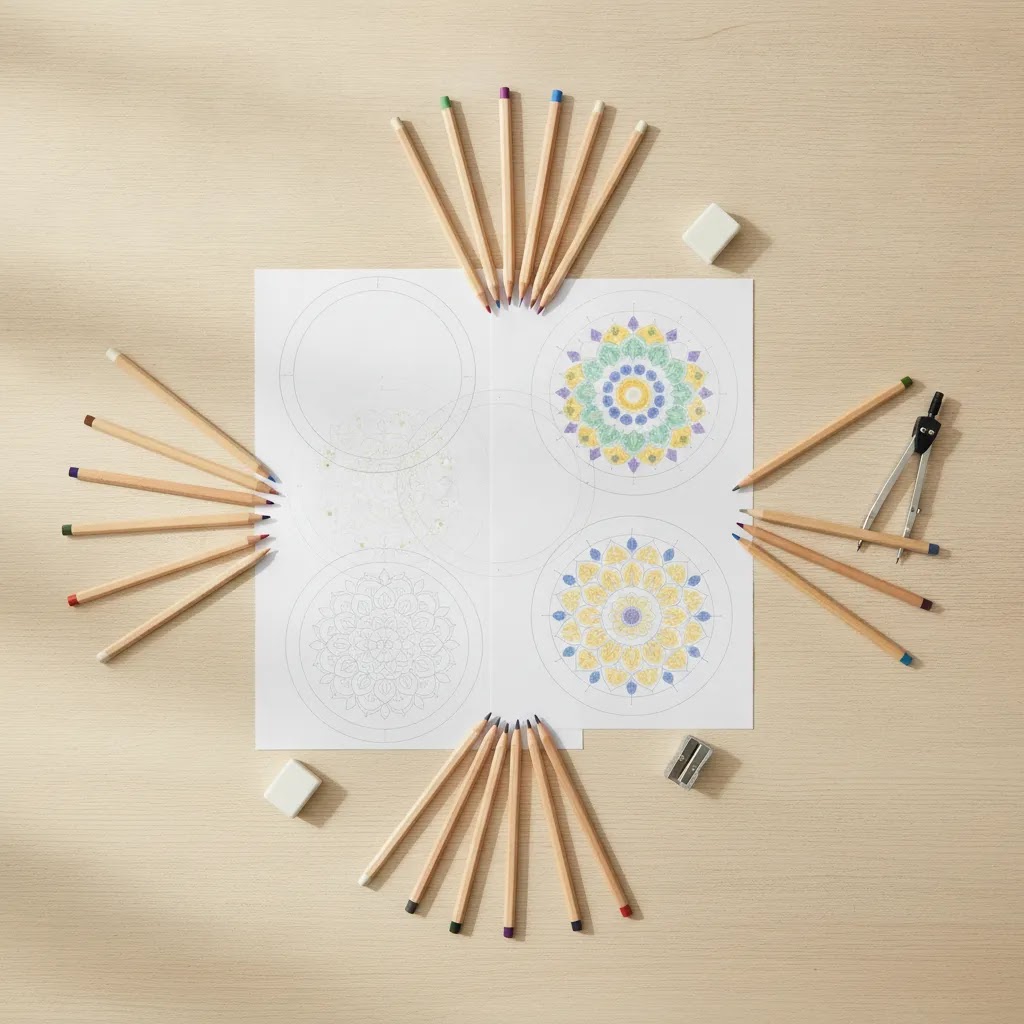
That difference between a calming activity and formal support is worth making more concrete. In a formal art therapy session, a trained professional may invite you to make art, notice your process, and reflect together on what came up. A mandala could be one option among many. Sessions may include prompts, quiet creating time, discussion, and attention to how the experience felt in your body, emotions, or relationships.
This is different from coloring alone because the professional relationship can help hold material that feels complex, persistent, or difficult to sort through by yourself. No artistic skill is required. In fact, people often begin art therapy because words feel insufficient or because they do not see themselves as artists. The point is not technical quality. The point is whether the process helps you express and understand something that felt hard to reach.
Should you decide to pursue formal support, it's worth pausing to look into how art therapy is actually overseen in your part of the world. Titles and requirements aren't universal, what qualifies someone in one place may look completely different somewhere else. Readers in the United States, for instance, might look for ties to the Art Therapy Credentials Board or the American Art Therapy Association, though state-level licensing or registration can add another layer to check. Elsewhere, oversight might come from entirely different associations, boards, or registries. Rather than assuming a title carries the same weight everywhere, take a moment to confirm current credentials and local expectations before you begin.
That extra care may matter most if emotions feel ongoing, layered, or hard to hold alone. A self-guided mandala can still be meaningful, but professional support may offer more containment, context, and responsiveness when the work touches grief, trauma, or persistent distress.
How to use mandala art therapy benefits thoughtfully
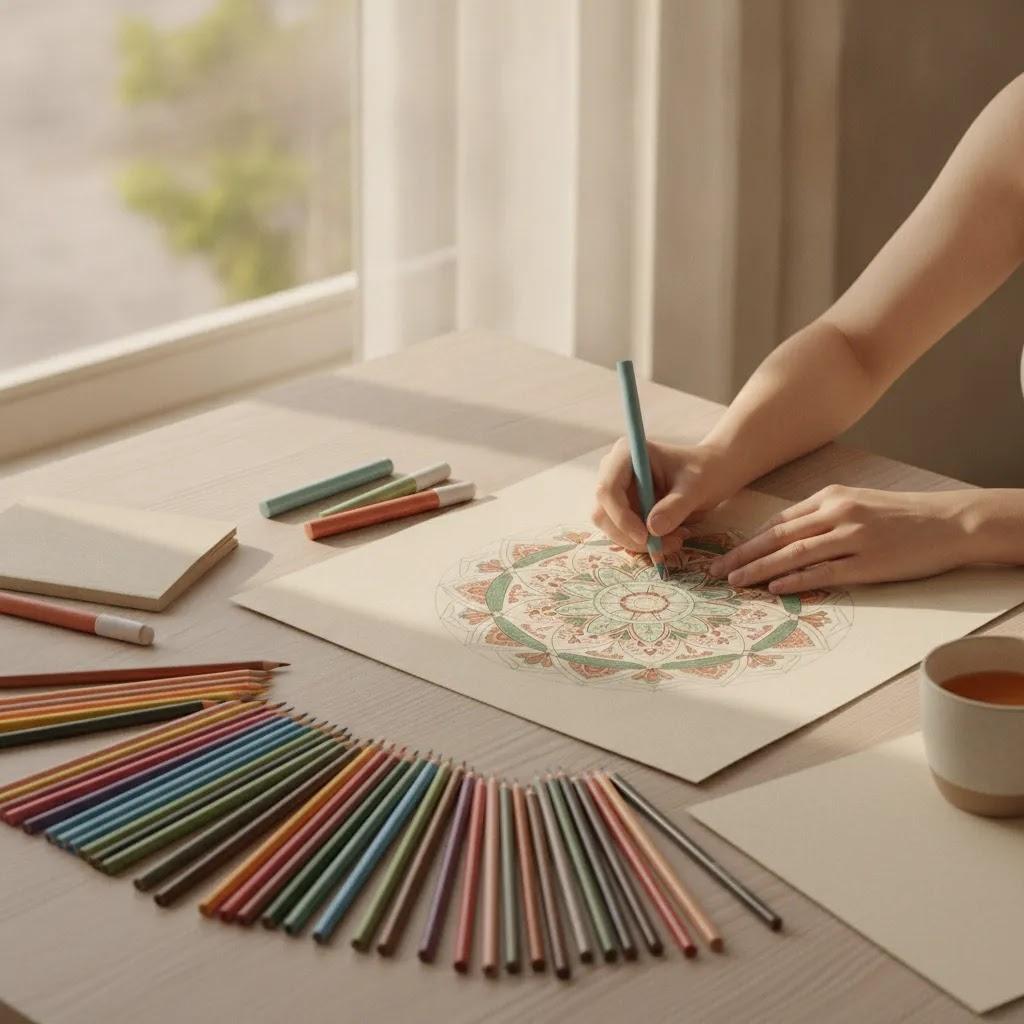
If you want to try this practice, start small. Draw a circle, place a dot or shape in the center, and build outward with repeating lines, colors, or patterns. A short session often works better than forcing depth. Ten minutes is enough for many people.
It may help to choose one gentle intention before you begin. You might ask: what feels loud right now? What needs more space? What would steadiness look like on this page? Then notice your pace, pressure, and color choices without judging them too hard.
Afterward, pause before interpreting. You do not need to decode the whole drawing. A few simple questions are enough: what stands out, where does the image feel heavy or open, and what shifted while making it? If you are interested in broader creative approaches, the category Art Therapy Fundamentals offers more context. You can also explore our practical guide to stress management techniques for related support.
If the process brings up intense memories, panic, or a strong sense of being overwhelmed, it may be better to stop and seek support from a qualified professional. Mandala work can be supportive, but it is not a replacement for individualized care when distress is severe or safety is a concern.
A simple mandala art therapy benefits exercise for beginners
If you want a more concrete place to start, try a short four-step version. First, draw one circle that feels comfortably sized on the page. Second, place a small mark, dot, or shape in the center. Third, build outward using one or two repeating forms such as petals, lines, arcs, or small triangles. Fourth, choose only two or three colors so the process stays simple enough to follow.
You do not need to fill every space. Some people prefer a sparse image, while others keep adding rings until the circle feels complete. Let the pacing be part of the information. Fast marks, tight spacing, heavy pressure, large gaps, or a very protected center may all tell you something about your state in that moment, even if the meaning is not obvious right away.
Once you stop, take a minute to look rather than analyze. You might ask: what drew me toward these colors, does the center feel open or guarded, where is the image crowded or spacious, and how do I feel when I look at the outer edge? These questions are meant to support reflection, not force a hidden message.
If the exercise starts to feel activating, confusing, or overwhelming, it is okay to pause before finishing. Set the page aside, ground yourself in the room around you, and return only if it feels manageable. A shorter or simpler version may be the better fit on some days.
Frequently Asked Questions
Is mandala art therapy the same as coloring a mandala book?
Not always. Coloring a mandala can be soothing and may support focus or stress relief. Mandala art therapy is broader and more intentional. It may involve creating your own mandala, noticing emotional themes, and reflecting on the process. In formal therapy, that reflection happens within a supportive relationship rather than as a stand-alone activity.
What is mandala art therapy in simple terms?
It is the use of circular image-making to support emotional expression, calming, and reflection. The circle gives you a center and a boundary, which can make the art process feel safer and easier to begin. The goal is not artistic skill. The goal is to notice what the process helps you feel, express, or understand.
Are mandala art therapy benefits backed by strong research?
There is meaningful research support, but it is not all equally strong. Some studies suggest mandala-making or structured coloring may reduce short-term anxiety and improve focus. Larger reviews of active visual art therapy also support benefit across outcomes. Still, methods vary, so it is wiser to say mandalas may help rather than promise a specific result. If you want a deeper evidence roundup, see published art therapy findings worth reading.
Who may benefit most from mandala-based art practices?
People who feel overwhelmed by talking, journaling, or open-ended art often respond well to mandalas. The structure can be especially helpful for beginners, visually oriented people, and those who want a brief, contained practice. Some people in grief, stress, burnout, or emotional overload may also find the format gentler than a blank page.
Can children use mandalas too?
Yes, many children can engage well with simple circular art activities, especially when the task is age-appropriate and low pressure. The benefits may look different than they do for adults. Children may show more through play, color, and pacing than through verbal reflection. You can read more about the benefits of art therapy for children for a broader picture.
Do I need to be good at drawing for mandala art therapy to help?
No. In fact, strong art expectations can sometimes get in the way. Mandala work often helps because it reduces the pressure to perform. Repeated lines, simple shapes, and color choices are enough. What matters more is whether the process helps you slow down, externalize a feeling, or notice something about your inner state.
How long should a mandala session be?
Many people do well with 10 to 20 minutes. A short session may feel more approachable and emotionally contained. You do not need to finish a highly detailed design for the practice to matter. If you feel settled and want to continue, you can. If you start feeling activated or exhausted, it is okay to pause.
How is this different from other expressive approaches?
Mandalas are one structured visual method within the wider family of creative emotional support tools. Other approaches may involve movement, music, writing, collage, or drama. The difference is the specific circular format and the way it combines repetition, boundary, and symbolism. If you want a fuller distinction, see expressive arts therapy vs art therapy.
What are mandalas used for in therapy?
They may be used for stress regulation, emotional expression, structured reflection, and session check-ins. A therapist might invite mandala-making when someone needs more containment than a blank page provides or when feelings are easier to express visually than verbally. The image can then become a starting point for reflection rather than an end in itself.
What is the healing power of mandalas?
Their value usually comes from structure rather than mystique. A center, an edge, and repeating forms may help settle attention, reduce blank-page pressure, and make emotions feel more observable. For some people, that combination supports calm, clarity, or self-reflection. For others, the effect may be modest or neutral, which is why mandalas are best understood as a supportive practice rather than a guaranteed result.
What is the psychology behind mandalas?
Psychologically, mandalas may work through boundary, repetition, symbolism, and focused attention. The circular format gives the mind a contained space to organize experience. Repeated shapes can steady attention, and the center-to-edge structure often invites reflection on what feels protected, crowded, distant, or central. Personal meaning still matters more than any fixed interpretation.
Is it good to keep mandala art at home?
It can be, if the image feels supportive or meaningful to you. Some people like keeping mandalas as visual reminders of a calmer state, a personal insight, or a completed effort. Others prefer to store them away or discard them, especially if the artwork holds difficult material. There is no single right choice. The better question is whether having the image nearby feels grounding, neutral, or uncomfortable.
Key Takeaways
- Mandalas may help through structure, repetition, boundary, and visual focus.
- The most supported benefits are short-term stress relief, containment, attention support, and easier emotional externalization.
- They are often beginner-friendly because they reduce blank-page pressure.
- Meaning in a mandala should stay with the person who made it, not be imposed from the outside.
- Mandala practice can be supportive, but it is not a substitute for professional care during severe distress or safety concerns.
Quick recap of mandala art therapy benefits
| No. | Benefit | Why it matters | Main caution |
|---|---|---|---|
| 1 | Stress relief | May calm the nervous system through rhythm and repetition | Often short-term |
| 2 | Emotional containment | Helps difficult feelings feel more bounded | Not full processing by itself |
| 3 | Attention support | Gives the mind a visual anchor | Not soothing for everyone |
| 4 | Externalization | Makes inner experience easier to observe | Insight may be subtle |
| 5 | Lower pressure | Helps beginners start without a blank page | Self-criticism can still show up |
| 6 | Symbolic reflection | Encourages personal meaning-making | Avoid over-interpretation |
| 7 | Agency and completion | Creates a small finishable act of choice | Effects may be modest on very hard days |
Conclusion
Mandalas are not just pretty circles. In therapeutic use, their value comes from what the form quietly offers: a center, a boundary, repetition, and room for meaning. Research does not suggest that mandalas solve everything. It does suggest they may help with several real, measurable experiences, especially stress, focus, containment, and emotional expression.
If you are curious, you might begin with one simple circle and see what your hands notice before your mind explains it. For more context around related methods and age-specific use, you can also explore our guides on art therapy benefits and the broader Art Therapy Fundamentals library.
This article is for educational purposes only and does not provide medical or mental health advice. Research on mandala-based art practices is still developing, and individual responses may vary. Creative wellness tools may support reflection and emotional regulation, but they do not replace individualized care from a qualified licensed professional. If distress is severe, persistent, related to trauma, or connected to safety concerns, contact a licensed clinician, local emergency services, or an appropriate crisis resource right away. For formal art therapy, review current credentials and applicable local regulatory standards before beginning.